

Last Updated: October 24, 2026
Quick Summary
No, most classic car insurance policies do not cover track days, and standard personal auto policies typically exclude track use too. Track day insurance is a separate policy that covers physical damage during eligible events like driver education days, but it does not cover racing or timed competition.
- Track day coverage typically excludes wheel-to-wheel racing, timed competition, time trials, time attack and autocross events.
- HPDE insurance covers high-performance driver education events where drivers learn car control under instruction, not compete for lap time.
- Track miles count against classic car insurance mileage limits, though policy exclusions are the bigger obstacle to coverage.
- A classic policy’s agreed value usually does not carry over to track coverage, which has its own limit, deductible and valuation method.
- Before driving on track, know the event policy’s physical damage limit, deductible and listed agreed value, or you self-insure the difference.
Table of Contents
- Why Your Classic Car Policy Probably Stops at the Track Gate
- What Track Day Insurance Covers, and What It Leaves Out
- HPDE Insurance for Classic Cars: How Driver Education Events Differ
- Classic Car Insurance Mileage Limits and How They Interact With Track Use
- Questions to Ask About Track Day Coverage Before You Sign
- Claims, Agreed Value, and Repair After an On-Track Incident
- Get a Classic Car Quote That Matches How You Actually Drive
- Frequently Asked Questions
Why Your Classic Car Policy Probably Stops at the Track Gate
The short answer: no, most classic car insurance policies do not cover track days. That is a hard truth many collectors learn the hard way.
A standard personal auto policy typically excludes track use, and that includes high-performance driver education events, according to Marshall & Sterling’s coverage guidance. To see how classic car insurance compares to standard auto insurance, review the coverage differences before assuming your collector policy follows the car to the track.
Here is what most guides get wrong. They treat “classic car insurance” and “track day insurance” as the same product. They are not.
Below, we break down exactly where your coverage ends and what to do about it.
What Track Day Insurance Covers, and What It Leaves Out
Track day insurance is a separate policy built for on-track driving. It covers physical damage to your vehicle during an eligible event, like a driver education day at a race track. It does not cover racing or timed competition.
Covered Damage and Physical Damage Protection
Most track day policies focus on physical damage to your car. That means damage from a spin, a slide, or contact with a barrier. Some policies also cover damage in the paddock area.
This is different from a standard policy. A personal auto policy usually stops coverage the moment you enter a race track. For a deeper look at how damage protection works, see our guide to comprehensive vs collision coverage.
Exclusions for Racing, Timed Competition, and Wheel-to-Wheel Events
Here is where people get burned. Track day coverage is not race coverage. The following are typically excluded:
- Wheel-to-wheel racing
- Timed competition and time trials
- Time attack and autocross events
- Any event where the goal is speed, not skill
Watch out: booking a “track day” that is actually a timed event can void your coverage entirely. Read the event rules before you pay.
HPDE Insurance for Classic Cars: How Driver Education Events Differ
HPDE insurance is coverage for high-performance driver education events, where drivers learn car control under instruction, not compete for a lap time.
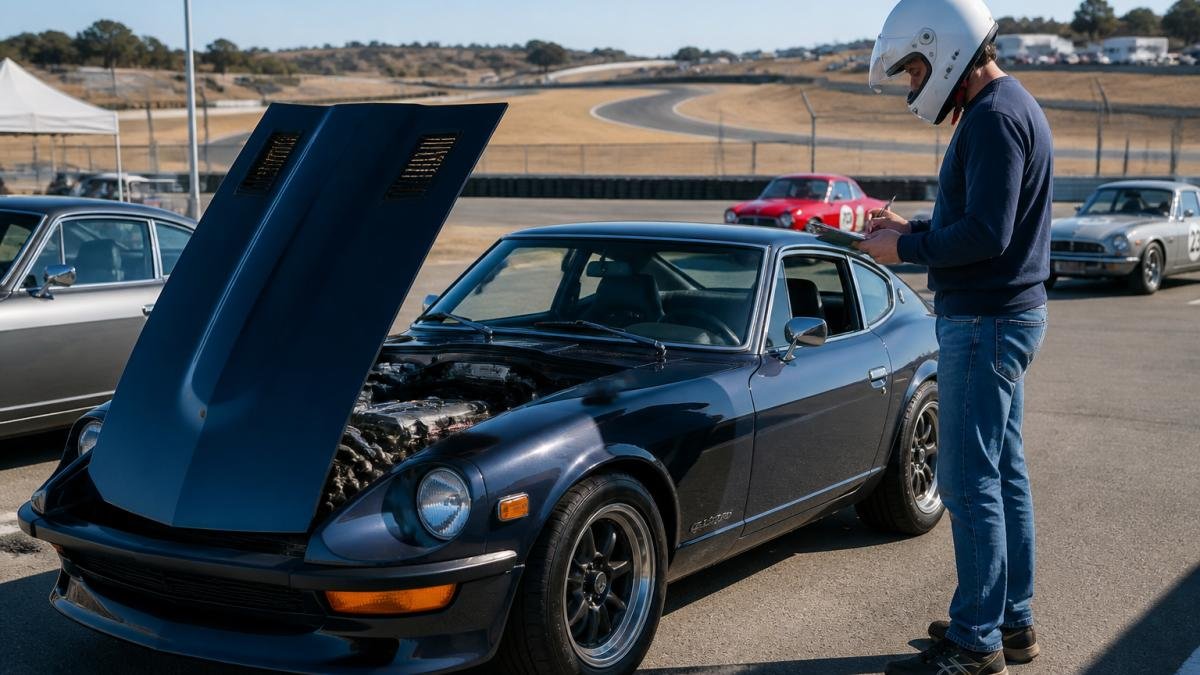
A few providers, including Hagerty’s track day program, describe separate HPDE coverage for eligible events. The key word is eligible. Not every event qualifies, and not every car qualifies.
How to classify your event before you buy coverage
Use the format, not the marketing name, to sort your event into one of these buckets:
| Event format | What it looks like | Usually covered by an HPDE/track policy? |
|---|---|---|
| Instructional HPDE | Run groups by experience level, an in-car or classroom instructor, passing by point-by, no transponder and no published results | Yes, if the event and vehicle are eligible |
| Open lapping / test day | No instruction requirement, no timing, drivers self-selected by experience | Sometimes, depends on the policy’s event definition |
| Autocross | Cone course in a parking lot or paddock, one car at a time, times posted | Often excluded, check the policy terms |
| Time trial / time attack | Transponder or timing equipment, results ranked by lap time | Typically excluded as timed competition |
| Wheel-to-wheel racing | Multiple cars racing for position, sanctioned or unsanctioned | Excluded, separate race coverage needed |
Two details trip people up. First, an event can be instructional in the morning and timed in the afternoon; if any session is timed or ranked, treat the whole day as competition unless the insurer confirms otherwise in writing. Second, “passing by point-by” and “no timing” are the features insurers tend to look for in an eligible HPDE, a lapping day with open passing and no instructor can fall outside the definition even though nobody is racing.
What to confirm with the organizer and the insurer
- Ask the organizer for the event’s written rules and run-group structure, and whether any session uses timing equipment or publishes results.
- Ask the insurer whether that specific organizer and venue are on the eligible list, and get the answer in writing.
- Confirm the coverage dates include the full event, including any pre-event tech inspection or parade laps.
- Ask whether your classic car meets the policy’s vehicle eligibility rules, some programs set age, value, safety-equipment, or driver-experience requirements.
Booking a “track day” that is actually a timed event can void your coverage entirely. Read the event rules before you pay, and do not rely on the event’s name.
So if you are coming from a casual HPDE background, expect to verify event eligibility before every single day, and expect the answer to depend on the format, not the label.
Classic Car Insurance Mileage Limits and How They Interact With Track Use
Classic car insurance mileage limits cap how many miles you can drive per year. Track driving adds miles, and those miles count against your limit.
Usually, no. Mileage limits are one reason. Policy exclusions are the bigger one. A collector policy is built for limited, pleasure use, not track abuse.
For practical guidance on agreed value policies and mileage caps, read our tips for insuring a classic car.
Questions to Ask About Track Day Coverage Before You Sign
Before you buy any track day policy, ask these questions. The answers decide whether you are actually protected.
- Does this policy cover my specific event type?
- Is my classic car eligible under the policy?
- What is the physical damage limit and deductible?
- Are paddock and off-track incidents covered?
- Is racing or timed competition excluded?
- How is my car’s value set after a claim?
Get every answer in writing. A verbal “you’re covered” means nothing at claim time.
Claims, Agreed Value, and Repair After an On-Track Incident
Agreed value is the amount you and the insurer set as your car’s worth before a loss. After an on-track incident, that number drives your payout. It also shapes how repairs get handled, and it is the single most misunderstood part of track coverage for classic-car owners.
A common mistake is assuming your classic policy’s agreed value carries over to track coverage. It usually doesn’t.
How a separate event policy interacts with your classic-car policy
This is the question most guides skip. If your classic car is insured on a collector policy and you buy a separate track-day or HPDE policy for an event, the two policies generally do not stack into one big pot of money. Instead, each policy responds under its own terms:
- The classic-car policy typically excludes track use, so it may contribute nothing to an on-track loss even though the car is insured.
- The event policy responds up to its own physical damage limit, subject to its own deductible.
- If the event policy is written on an agreed-value basis, the payout is tied to the value stated on that policy, not the value on your collector policy.
- If the event policy is written on an actual cash value basis, the payout can be far below what you think the car is worth.
Before the event, call both insurers and ask each one, in writing: does my policy respond to this loss, and in what order? Confirm whether either policy has an “other insurance” clause that changes how the two interact. Do not assume the collector carrier will pick up a gap the event policy leaves.
What to collect after an on-track incident
Documentation decides how smoothly a claim moves. Collect and keep:
- Photos of the damage from multiple angles, plus photos of the whole car before the event.
- The event registration, rules packet, and run-group confirmation showing the format.
- The organizer’s incident report and any steward or safety notes.
- Names and contact information for witnesses, instructors, and track staff.
- Your policy declarations page showing the limit, deductible, and valuation basis.
- Repair estimates from a shop experienced with your make and model.
File promptly, most policies set a notice deadline, and keep copies of everything you send.
Know three numbers before you drive onto the track: the event policy’s physical damage limit, its deductible, and the agreed value it lists for your car. If any of those three is lower than what a repair would cost, you are self-insuring the difference.
Repair costs on a high-value vehicle can climb fast, so know your limit before you drive. If your car is damaged on track, document everything, file promptly, and confirm with both insurers which policy is responding.
Get a Classic Car Quote That Matches How You Actually Drive
The real challenge is matching coverage to your actual driving. Street use, weekend shows, and the occasional HPDE day each need different protection. Guessing leaves gaps.
At United Family Insurance, we compare the market for you. Our agents help Las Vegas drivers sort out classic car coverage, track day questions, and everything in between.
Ready to protect your collector car the right way? Compare affordable options with our guide on finding affordable classic car insurance, or check whether specialized coverage is worth it for your muscle car.
Frequently Asked Questions
Does a standard classic car policy cover damage during an HPDE event?
Usually not. Personal auto policies and most classic car policies exclude track driving, including high-performance driver education events. Hagerty and RLI both describe separate HPDE or track-day coverage for eligible events, which means you buy a distinct policy for the day rather than relying on your collector car coverage. Before any event, read your policy’s exclusion section and confirm in writing whether HPDE is listed. Coverage depends on the specific policy and the event’s eligibility rules, so a verbal yes from an agent is not enough.
Can I buy separate track day insurance for my classic car?
Yes. Dedicated track day insurance exists for eligible events and is sold as a standalone policy, separate from your classic car coverage. It typically covers physical damage to your vehicle during the event, subject to coverage limits and a deductible. Some policies also extend limited coverage to the paddock and off-track areas of the venue. Confirm the event is on the insurer’s eligible list, that your vehicle qualifies, and whether agreed value or actual cash value applies to a total loss.
How many miles can I drive with classic car insurance?
Mileage limits vary by carrier and policy, and many collector policies cap annual mileage somewhere between a few thousand and roughly 7,500 miles per year. Some policies are unlimited but require the car to be used for hobby purposes only, not daily driving. Track miles usually are not counted toward the limit, but the drive to and from the track may be. Ask your agent how mileage is tracked, whether you self-report it, and what happens if you exceed the cap mid-term.
Does track day insurance cover damage to other cars or track property?
Most track day policies focus on physical damage to your own vehicle and do not provide liability coverage for other drivers’ cars or track property. That gap matters because a spin into a barrier or contact with another participant can create costs your policy will not pay. Ask specifically whether the policy includes any third-party liability, and check whether the event organizer requires participants to carry their own liability coverage or sign a waiver. If liability is excluded, decide before the event whether that risk is acceptable.
Your classic car deserves coverage that keeps up with it, on the street and at the gate. Get started with United Family Insurance and find a policy built around your car, your events, and your budget.
