
Table of Contents
- Comprehensive vs Collision Coverage: A Side-by-Side Comparison
- What Collision Coverage Covers (And What It Doesn’t)
- What Comprehensive Coverage Covers: Theft, Hail, and More
- Is Collision Insurance Mandatory in Nevada?
- How to Choose the Right Auto Insurance Deductible
- When to Drop Full Coverage on a Car
- Pros and Cons of Collision vs Comprehensive Coverage
- Conclusion
- Frequently Asked Questions
Last Updated: September 23, 2026
Comprehensive vs Collision Coverage: A Side-by-Side Comparison
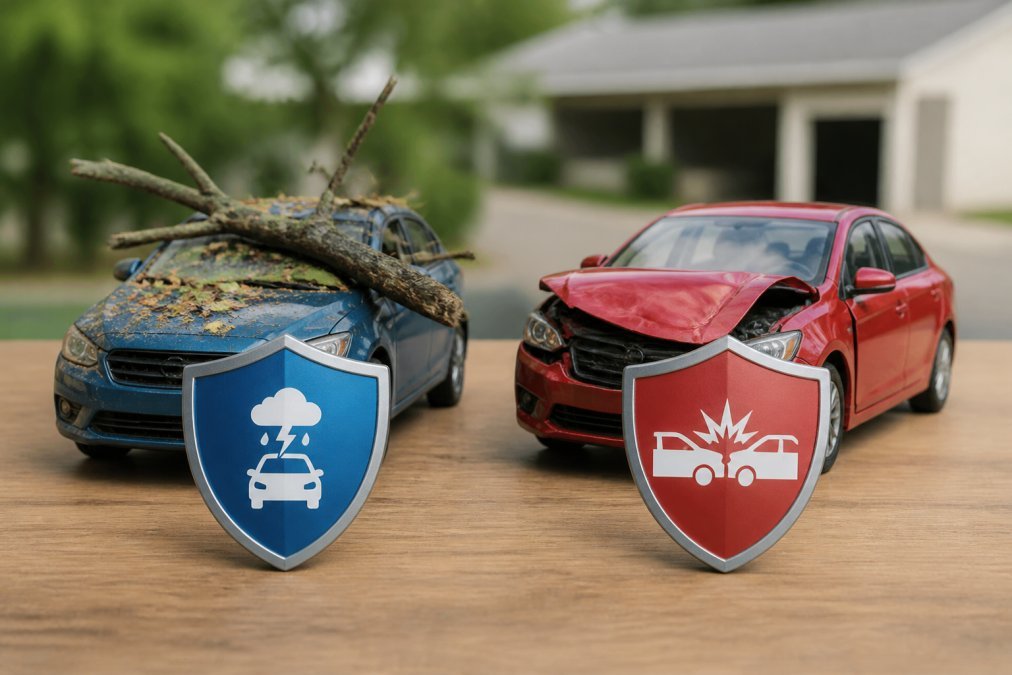
Understanding the difference between comprehensive and collision coverage is the single most useful step a Las Vegas driver can take when reviewing an auto insurance policy. Collision coverage pays to repair or replace your vehicle after you hit another car or an object. Comprehensive coverage pays for damage from almost everything else: theft, hail, fire, flooding, or a deer on the road.
This guide from United Family Insurance breaks down both coverages, explains what Nevada actually requires, and gives you a practical framework for deciding which ones your vehicle needs in 2026.
The short version: collision is for crashes you cause; comprehensive is for everything the road throws at you. Most lenders require both on a financed vehicle. Neither is legally mandatory in Nevada, which surprises many drivers.

| Feature | Collision Coverage | Comprehensive Coverage |
|---|---|---|
| What it pays for | Hitting another car or object | Theft, hail, fire, flood, vandalism |
| Typical trigger | At-fault accident | Non-collision incidents |
| Required by Nevada law | No | No |
| Required by lenders | Usually, on financed cars | Usually, on financed cars |
| Deductible | Set by you | Often separate, set by you |
| Best for | Newer or financed vehicles | Any car worth repairing |
What Collision Coverage Covers (And What It Doesn’t)
Collision coverage pays to repair or replace your car after it collides with another vehicle or an object such as a guardrail, mailbox, or utility pole. It applies regardless of who was at fault, though your insurer may pursue the other driver later. A hit-and-run that dents your parked car also falls here if the damage came from an impact.
What it does not cover matters just as much. Collision won’t pay for theft, hail, flooding, fire, or a cracked windshield from road debris. Those belong to comprehensive. It also won’t cover the other driver’s vehicle or injuries; that’s liability insurance, which Nevada does require.
A common mistake is assuming “full coverage” is a legal term. It isn’t. It’s shorthand lenders and agents use for a policy carrying both collision and comprehensive alongside liability.
What Comprehensive Coverage Covers: Theft, Hail, and More
Comprehensive coverage is the catch-all that handles vehicle damage from non-collision incidents. It pays for theft, vandalism, fire damage, glass breakage, falling objects, animal impact, and weather-related damage like the flash flooding that occasionally sweeps through the valley. If a monsoon storm drops hail on your hood or a coyote dents your bumper, this is the coverage that responds.
Nevada’s desert climate creates a specific risk most national guides ignore: intense sun and heat degrade rubber, plastic, and paint faster than in cooler states, and wind-driven sand can pit your windshield. Comprehensive is what covers that glass breakage, so don’t drop it just because snow and ice aren’t a local concern.
Is Collision Insurance Mandatory in Nevada?
Collision insurance is not mandatory in Nevada. The state requires liability insurance only: minimum bodily injury and property damage limits that pay for harm you cause to others. Collision and comprehensive are optional coverages you choose to add.
Nevada Division of Insurance guide to auto coverage requirements
How to Choose the Right Auto Insurance Deductible
Choosing the right auto insurance deductible comes down to one trade-off: a higher deductible lowers your premium, but it raises what you pay out of pocket when you file a claim. A deductible is the amount you cover before insurance kicks in. If you set a $1,000 deductible and the repair costs $3,000, you pay $1,000 and your insurer pays the rest.
| Coverage | Typical deductible range | Who sets it |
|---|---|---|
| Collision | $250 – $1,500 | You, at purchase |
| Comprehensive | $0 – $1,000 (often lower than collision) | You, at purchase |
| Liability | No deductible | N/A, pays third parties |
Set your deductibles with these questions in mind:
- How much could you comfortably pay tomorrow if your car were damaged?
- Do you have separate deductibles for collision and comprehensive? Many policies do.
- Would a lower deductible strain your budget less than a surprise repair bill?
- Have you compared the premium savings against the added risk?
- Does your policy include a separate glass deductible, or is glass covered under comprehensive?
The most expensive mistake is setting a deductible so high you can’t actually pay it. If a $2,000 deductible exceeds your emergency fund, a single at-fault accident could leave your car sitting unrepaired because you can’t cover your share.
Nevada drivers should ask one extra question before signing: does the policy waive the deductible when the other driver is identified and at fault? Some carriers offer this as an endorsement, and it changes the math on how high you can comfortably set your collision deductible.
When to Drop Full Coverage on a Car
The 10% rule of thumb. If your combined annual collision + comprehensive premium exceeds roughly 10% of your car’s ACV, the coverage is usually a poor financial bet. At that ratio, you’re paying a meaningful share of the car’s value every year to protect a payout that would be capped at that same ACV, minus your deductible.
Run it with real numbers:
| Car’s ACV | Combined annual premium | Premium as % of ACV | Verdict |
|---|---|---|---|
| $25,000 | $600 | 2.4% | Keep both |
| $12,000 | $700 | 5.8% | Keep both |
| $6,000 | $650 | 10.8% | Consider dropping |
| $3,500 | $600 | 17.1% | Usually drop |
Consider dropping collision and comprehensive when:
- Your car’s market value is low enough that a payout wouldn’t replace it meaningfully
- Your combined premiums for both coverages cost a large share of that value each year
- You have savings to cover repairs or replacement yourself
- You’ve paid off the loan and no lender requires the coverage
Nevada-specific overlay: even when the math says drop, two local risks argue for keeping comprehensive. First, desert heat and wind-driven sand cause glass and paint damage that can total an older car’s value in a single event. Second, animal strikes, including wild horses and burros in the outer Las Vegas valley and rural Clark County, are covered under comprehensive, not collision, and they’re more common here than in most states. If your commute regularly takes you near open desert, weigh that against the 10% rule before you cancel.
Consumer Financial Protection Bureau guide to auto loan requirements
Pros and Cons of Collision vs Comprehensive Coverage
Each coverage solves a different problem, and each has real drawbacks. Here’s an honest look.
Collision coverage pros:
- Protects your car after an at-fault accident
- Applies even in a hit-and-run involving your parked vehicle
- Required by most lenders on financed cars
Collision coverage cons:
- Doesn’t cover theft, weather, or vandalism
- Adds meaningfully to your premium
- You still pay a deductible before it pays out
Comprehensive coverage pros:
- Covers theft, vandalism, fire, hail, and falling objects
- Handles glass breakage, a frequent desert issue
- Often cheaper than collision for the same vehicle
Comprehensive coverage cons:
- Doesn’t cover crash damage
- Separate deductible can surprise policyholders
- Still optional, so it’s easy to overlook
Conclusion
Sorting out collision versus comprehensive coverage shouldn’t require a law degree, and it shouldn’t mean calling five carriers yourself. United Family Insurance compares the market on your behalf, so our agents can match you with the right coverage at a lower price, with potential savings. We handle auto, home, and commercial policies in one place, offer expert advice from licensed agents, and provide a user-friendly platform for filing claims when you need it.
Frequently Asked Questions
Is it better to have a $500 deductible or a $1000 deductible?
The better deductible depends on your emergency savings and risk tolerance. A $500 deductible means you pay less out of pocket after a claim, but your premium will be higher. A $1000 deductible lowers your monthly premium, but you need to have that amount available if you file a claim. If you can comfortably cover $1000, the lower premium often saves money over time. If not, stick with $500 to avoid financial strain after an accident.
Is collision insurance mandatory in Nevada?
No, Nevada law does not require collision coverage. Nevada mandates liability insurance only, which pays for damage you cause to others. However, if you finance or lease a vehicle, your lender will almost certainly require collision and comprehensive coverage until the loan is paid off. Many drivers in Las Vegas choose collision coverage anyway to protect their vehicle from repair costs after an at-fault accident.
Does hitting a tree count as a collision or comprehensive claim?
Hitting a tree is typically a collision claim if you were driving and lost control. Collision coverage pays for damage when your car hits another object, including a tree, guardrail, or fence. Comprehensive coverage applies if a tree limb falls on your parked car or a tree falls during a storm without you driving into it. The distinction matters because your deductible and premium impact may differ between the two.
When should I drop full coverage on an older car?
Consider dropping full coverage when your annual premium for collision and comprehensive approaches or exceeds your car’s actual cash value minus your deductible. For example, if your car is worth $3,000 and you have a $1,000 deductible, your maximum payout is $2,000. If you pay $1,500 per year for full coverage, you may be better off saving that money for a replacement vehicle. Review this calculation yearly as your car depreciates.
Are comprehensive and collision insurance required by Nevada law?
Nevada law does not require comprehensive or collision coverage. The state mandates liability insurance with minimum limits of $25,000 per person and $50,000 per accident for bodily injury, plus $20,000 for property damage. However, lenders and lessors require comprehensive and collision coverage on financed or leased vehicles. If you own your car outright, these coverages are optional but can still be valuable for protecting your investment.