
Table of Contents
- Why Classic Car Insurance Is Different From Standard Auto Coverage
- Agreed Value vs. Stated Value: What Every Classic Car Owner Must Know
- Classic Car Insurance Requirements You Need to Meet
- Understanding Classic Car Insurance Mileage Limits
- Coverage Types Every Classic Car Policyholder Should Consider
- Tips for Insuring a Classic Car Under Restoration or With Modifications
- Top Tips for Insuring a Classic Car and Getting the Best Premium
- Conclusion
Last Updated: June 4, 2026
Getting the tips for insuring a classic car right from the start can mean the difference between a payout that covers your investment and a settlement that leaves you thousands short. Standard auto policies treat depreciation as a feature, not a bug. For a 1969 Camaro or a pre-war roadster, that approach is financially devastating. Classic car insurance is a fundamentally different product with different underwriting logic, different valuation methods, and different eligibility rules. Understanding those differences before you shop is the single most valuable thing you can do.
Why Classic Car Insurance Is Different From Standard Auto Coverage
Standard auto insurance assumes your vehicle loses value over time. Classic car insurance assumes the opposite. A well-maintained collector vehicle appreciates, and the policy structure reflects that reality.
Classic car insurance is designed for vehicles that hold or increase in value due to historical interest, limited production, or collector demand. Specialized carriers underwrite these vehicles differently because the risk profile is genuinely distinct: lower annual mileage, controlled storage, and owners who treat the vehicle as an asset rather than a daily driver.
According to the Hagerty Vehicle Rating system and collector car market data, the collector car market has shown consistent long-term appreciation across multiple vehicle categories, which is exactly why standard auto carriers are poorly equipped to handle these risks.
What Qualifies as a Classic, Antique, or Collector Vehicle?
A vehicle generally qualifies when it is at least 25-30 years old, maintained in original or restored condition, and used primarily for exhibitions, club activities, or occasional pleasure driving rather than daily commuting.
Specific categories include:
- Antique vehicles: Typically 25+ years old, often pre-1975
- Classic cars: Usually 20-45 years old, with recognized historical or collector value
- Vintage automobiles: Pre-war era vehicles, generally pre-1945
- Muscle cars and special interest vehicles: Post-war performance cars with limited production or cultural significance
- Custom builds: Vehicles substantially modified from their original production configuration
How Specialized Carriers Underwrite Collector Vehicles
Specialized carriers examine originality, restoration quality, documented provenance, storage conditions, driving record, club membership, and whether the vehicle is garaged. The process typically requires a formal appraisal, photographs, and confirmation of storage arrangements. This thoroughness creates an agreed baseline for valuation that protects you at total loss.
Agreed Value vs. Stated Value: What Every Classic Car Owner Must Know
The most important financial decision in classic car insurance is choosing between agreed value and stated value coverage. Getting this wrong is the single most common and most expensive mistake collectors make.
Agreed value means the carrier and policyholder agree on the vehicle’s worth at policy inception. At total loss, the carrier pays that full amount with no depreciation applied. Stated value is different: you declare a value, but the carrier retains the right to pay the lesser of the stated value or actual cash value at the time of loss.
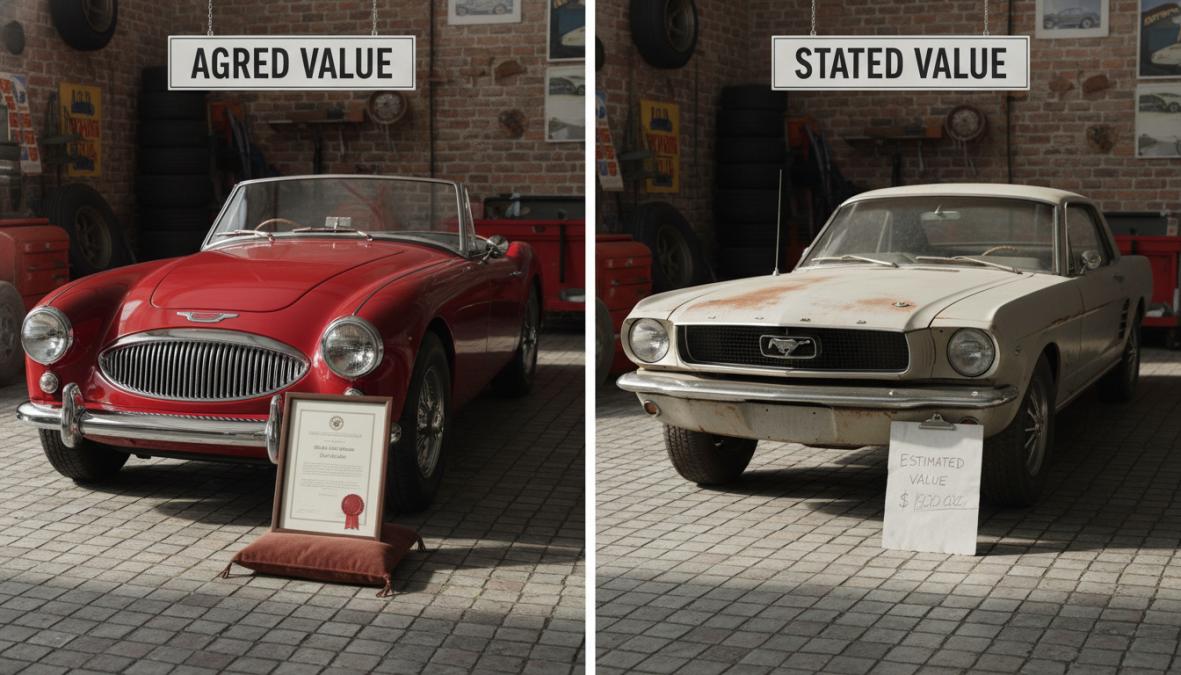
Never accept a stated value policy for a collector vehicle without reading the fine print. Carriers can pay actual cash value even when you’ve declared a higher stated value, leaving you significantly underinsured after years of appreciation.
How Agreed Value Protects You at Total Loss
Agreed value eliminates the depreciation calculation entirely. At total loss, whether from collision, fire, theft, or weather, the carrier pays the full agreed amount with no negotiation and no depreciation schedule. This matters most for vehicles that have appreciated substantially, carry documented restoration costs, or are rare enough that market comparables are scarce. Update your appraisal regularly, especially after completing restoration work or when the broader collector market shifts.
Actual Cash Value: When It Applies and Why It Can Hurt
Actual cash value calculates what the vehicle was worth immediately before the loss, factoring in depreciation and market data. For a 1957 Thunderbird in excellent condition, that can produce a settlement far below collector market value. Some policies default to actual cash value if you fail to maintain a current appraisal or if the vehicle stops meeting eligibility requirements, which is why staying current on documentation is the mechanism that keeps your agreed value intact.
Classic Car Insurance Requirements You Need to Meet
Classic car insurance requirements reflect the genuine risk factors that make collector vehicles insurable at favorable premiums. Meeting them fully is also what keeps your coverage valid when you need it most.
Vehicle Eligibility and Appraisal Standards
Most specialized carriers require the following:
- Vehicle is at least 25 years old (some carriers accept 20 years for special interest vehicles)
- Vehicle is in good to excellent condition, either original or professionally restored
- Vehicle is not used as a primary daily driver
- Annual mileage falls within the carrier’s acceptable range (typically under 5,000 miles per year)
- Vehicle is titled and registered in the policyholder’s name
- A current appraisal from a recognized appraiser is on file
Carriers want documentation from a certified appraiser or recognized valuation service, not a private sale estimate. Organizations like the American Society of Appraisers maintain directories of credentialed vehicle appraisers.
Storage Requirements and Driving Record Expectations
Most policies require the vehicle to be stored in a fully enclosed, lockable structure when not in use. An open carport generally does not qualify; a climate-controlled garage does. Driving record expectations are often stricter than standard auto insurance, carriers typically decline or surcharge applicants with recent at-fault accidents, DUI convictions, or multiple moving violations.
Join a recognized classic car club before applying for coverage. Many specialized carriers offer premium discounts for active club members, and membership signals to the underwriter that you treat the vehicle seriously.
Understanding Classic Car Insurance Mileage Limits
Classic car insurance mileage limits are one of the most misunderstood aspects of collector vehicle coverage, directly affecting both your premium and coverage validity.
Most policies restrict annual mileage to between 1,000 and 5,000 miles, though exact classic car insurance mileage limits vary by carrier and policy tier. Exceeding your limit doesn’t automatically void coverage in most cases, but it can give the carrier grounds to dispute a claim or adjust the settlement. Read your policy language carefully, some policies state the mileage restriction as a condition of coverage, which means a violation could affect a claim outcome.
| Coverage Type | Typical Annual Mileage Limit | Best For |
|---|---|---|
| Show/Exhibition Only | Under 1,000 miles | Showpiece vehicles, trailer queens |
| Pleasure Use | 1,000-3,000 miles | Occasional drives, local events |
| Limited Use | 3,000-5,000 miles | Club members, regional shows |
| Modified Classic | 5,000-7,500 miles | Daily-adjacent use, modified builds |
If you plan to drive the vehicle regularly, a standard auto policy with classic car endorsements may be a better structural fit.
Coverage Types Every Classic Car Policyholder Should Consider
The right coverage combination depends on how you use the vehicle, where it’s stored, and your financial exposure if the vehicle is damaged or stolen.
Liability, Collision, and Comprehensive Insurance Explained
Liability coverage protects you when you’re at fault in an accident causing bodily injury or property damage. It’s legally required in Nevada and applies to classic vehicles just as it does to standard ones. Collision insurance covers damage from a collision with another vehicle or object regardless of fault; under an agreed value policy, a total loss pays the full agreed amount minus your deductible. Comprehensive insurance covers non-collision losses, theft, fire, hail, flood, and vandalism. For Las Vegas owners, comprehensive is particularly relevant given extreme heat events and regional property crime statistics.
Uninsured Motorist, Medical Payments, and Spare Parts Coverage
Uninsured motorist coverage protects you when the at-fault driver carries no insurance or insufficient insurance. Given that a meaningful portion of Nevada drivers carry minimum or no coverage, this protection is practical, not optional. Medical payments coverage handles your own medical expenses after an accident regardless of fault, a low-cost addition that provides immediate coverage without waiting for fault determination.
Spare parts coverage is where classic car policies genuinely differentiate themselves. OEM parts for collector vehicles can be extraordinarily difficult to source and expensive to acquire. Some specialized carriers offer spare parts coverage as a rider protecting a declared inventory of parts stored for maintenance or restoration, especially valuable for vehicles where OEM parts are no longer in production.
According to the Classic Car Club of America’s guidance on vehicle maintenance and parts sourcing, the availability of original parts is a primary factor in both restoration cost and long-term vehicle value.
Tips for Insuring a Classic Car Under Restoration or With Modifications
This is where collectors face the most coverage gaps. A vehicle mid-restoration occupies an awkward middle ground: it’s not fully operational, its value is in flux, and standard eligibility criteria may not apply cleanly.
Work-in-Progress and Restoration Project Policies
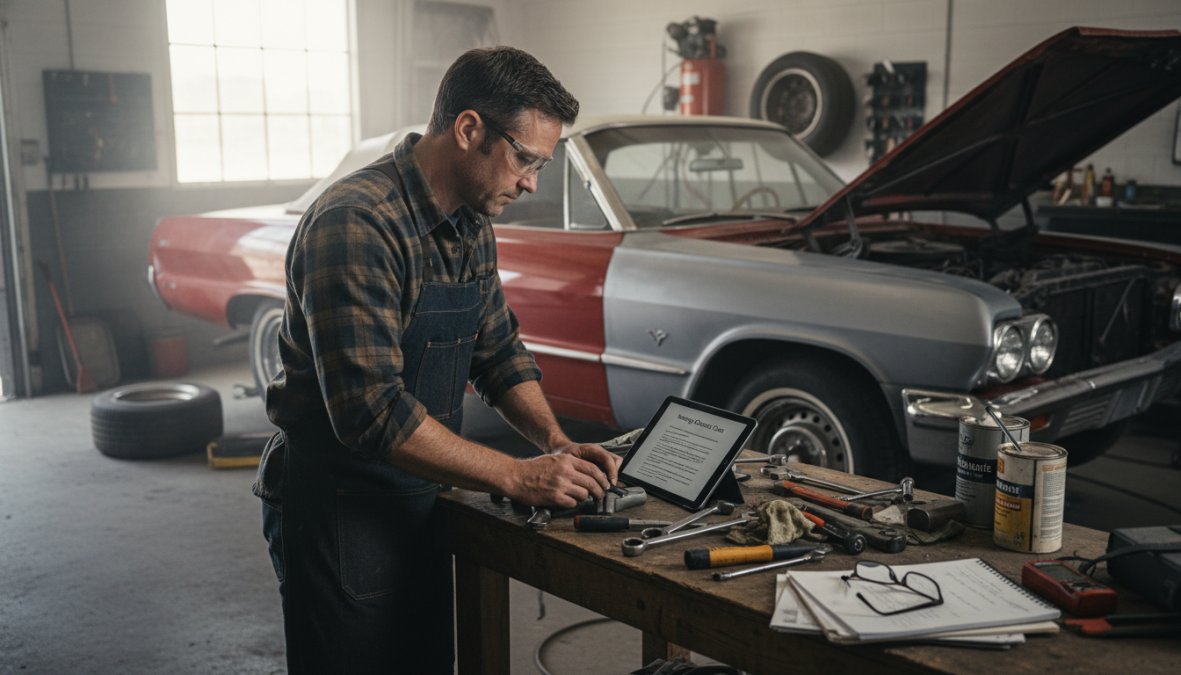
Work-in-progress policies are designed for vehicles undergoing active restoration, providing coverage that adjusts as the project progresses. Key features to look for include:
- Coverage for the vehicle’s current value plus documented restoration costs already invested
- Protection for parts and components stored at the restoration location
- Liability coverage if the vehicle is moved during the restoration process
- Clear terms for what constitutes a "completed" restoration and triggers a transition to a standard collector policy
Not every specialized carrier offers restoration project coverage, some require the vehicle to be in drivable condition before writing a policy. Ask specifically about work-in-progress coverage when shopping, and document restoration costs meticulously with receipts, labor invoices, and photographs.
Document every phase of a restoration with dated photographs and receipts. This paper trail is what converts a disputed claim into a straightforward one, especially when OEM parts with high replacement costs are involved.
Custom Builds, Muscle Cars, and Modified Vehicles
Modified vehicles present a specific underwriting challenge. A vehicle significantly altered from its original configuration, through engine swaps, custom bodywork, or suspension modifications, may not qualify under standard classic car eligibility criteria. Specialized carriers who write custom build policies evaluate the vehicle on its current state, making the agreed value appraisal critical. A professional appraisal from someone who understands the custom car market is essential.
Muscle cars occupy a middle ground. A numbers-matching 1970 Chevelle with original drivetrain is straightforward to insure. The same vehicle with a modern crate engine and aftermarket suspension is a custom build, and the policy structure should reflect that. Misclassifying a modified vehicle under a standard classic car policy can create coverage disputes that surface only at the worst possible moment.
Top Tips for Insuring a Classic Car and Getting the Best Premium
1. Get a professional appraisal before you shop. An independent appraisal gives you a defensible agreed value and prevents the carrier from setting the number lower than the vehicle is worth.
2. Compare specialized carriers, not general insurers. Standard auto carriers can write classic car endorsements, but specialized carriers understand the market and handle claims differently. United Family Insurance compares the market on your behalf, connecting you with carriers who actually specialize in collector vehicles.
3. Document storage conditions. Photograph your garage or storage facility. Carriers reward controlled storage environments with lower premiums.
4. Maintain a clean driving record. Your personal driving history across all vehicles affects your classic car premium.
5. Join a classic car club. Club membership is a premium discount trigger with many specialized carriers and signals responsible ownership.
6. Review your agreed value annually. The collector car market moves. An outdated agreed value means you’re underinsured.
7. Bundle where it makes sense. Multiple collector vehicles may qualify for a fleet policy or multi-vehicle discount.
How to File a Claim for Specialized or OEM Parts
Filing a claim involving OEM or hard-to-source parts requires a deliberate approach, this is where disputes most commonly arise.
Step 1: Document the damage immediately with photographs before any repairs begin.
Step 2: Notify your carrier and confirm whether they require a specialist appraiser. For collector vehicles, insist on a specialist.
Step 3: Obtain repair estimates from shops with documented experience with your specific vehicle type.
Step 4: Source OEM parts through recognized channels and document the sourcing effort. If OEM parts are unavailable, document that fact and the cost of the best available alternative.
Step 5: Keep all receipts and correspondence as your primary evidence in any dispute over parts value.
Nevada-Specific Considerations for Las Vegas Classic Car Owners
Nevada offers a separate DMV registration category for antique vehicles that affects how your vehicle is classified for insurance purposes and what usage restrictions apply. Las Vegas’s extreme summer heat accelerates rubber and seal degradation, UV exposure fades paint and interiors, and occasional flash flooding creates comprehensive coverage exposure that owners in temperate climates don’t face to the same degree. Nevada also has a relatively high rate of uninsured drivers, reinforcing the practical case for strong uninsured motorist coverage on any vehicle you drive publicly.
According to the Nevada Department of Motor Vehicles antique vehicle registration guidelines, vehicles registered as antiques in Nevada are subject to specific usage and inspection requirements that interact directly with your insurance policy terms. Confirm that your policy language aligns with your vehicle’s Nevada registration classification before coverage takes effect. Working with an agent who understands the Nevada market, rather than a national call center, is worth the effort.
Protecting a collector vehicle in Las Vegas requires a policy structure that most general insurers aren’t equipped to provide. United Family Insurance compares the market on your behalf, connecting you with specialized carriers who understand agreed value coverage, OEM parts claims, and the specific risks Las Vegas collectors face. Our expert agents handle the comparison process so you get comprehensive coverage at a price that reflects your vehicle’s actual risk profile, not a generic depreciation formula. Get a quote from United Family Insurance and make sure your classic car is covered the way it deserves to be.
Frequently Asked Questions
What qualifies as a classic car for insurance purposes?
Most specialized carriers define a classic or collector vehicle as one that is at least 20 to 25 years old, maintained in good or restored condition, and driven for historical interest rather than daily commuting. Some insurers also recognize limited-production vehicles, antique cars, and muscle cars regardless of age. Vehicle eligibility criteria vary by carrier, so requesting an appraisal before shopping for an insurance quote is a smart first step.
What is the difference between agreed value and stated value in classic car insurance?
Agreed value means the insurer and policyholder lock in a specific payout amount upfront, if the vehicle is declared a total loss, you receive that full amount with no depreciation deducted. Stated value, by contrast, allows the insurer to pay either the stated amount or actual cash value, whichever is lower. For most classic car owners, an agreed value policy offers significantly stronger financial protection and is the preferred option when insuring a classic car.
What are the mileage restrictions for classic car insurance?
Classic car insurance mileage limits typically range from 1,000 to 5,000 miles per year, though some carriers offer flexible annual mileage plans up to 7,500 miles. These limitations exist because collector vehicles are treated as showpieces rather than everyday drivers. Exceeding your agreed annual mileage can affect your coverage or result in a policy review. Always confirm your mileage allowance when getting an insurance quote and track your odometer throughout the year.
Does classic car insurance cover restoration projects and modifications?
Some specialized carriers do offer coverage for work-in-progress restoration projects, though the terms differ from standard policies. Coverage may be limited during active restoration phases and may require updated appraisals as value increases. For modified vehicles or custom builds, you will typically need to disclose all modifications so the carrier can factor them into the agreed value. Failing to report modifications can jeopardize a claim payout, so transparency with your insurer is essential.
Is classic car insurance cheaper than regular auto insurance?
Classic car insurance premiums are often lower than standard auto insurance because usage is restricted through mileage limitations and the vehicles are typically stored carefully rather than driven daily. However, the premium depends on the agreed value of the vehicle, your driving record, storage requirements, and the level of coverage selected. Comparing quotes from specialized carriers can help you find affordable protection without sacrificing coverage quality for your collector vehicle.
How does the claims process work for rare or OEM parts on a classic car?
Filing a claim for specialized or OEM parts on a vintage automobile can be more complex than a standard auto claim. Many specialized carriers work with approved restoration shops and classic car clubs to source period-correct components. When filing a claim, document the damaged parts thoroughly with photos, provide receipts or appraisal records, and specify whether you require original manufacturer parts or quality reproductions. Choosing a carrier experienced with collector vehicles makes this process significantly smoother.