

Table of Contents
- What Is Classic Car Insurance and Do You Need It?
- Classic Car Insurance Requirements: What Qualifies Your Vehicle
- Agreed Value vs. Stated Value Insurance: Which Protects You More?
- How to Find Affordable Classic Car Insurance: A Step-by-Step Approach
- Collector Car Insurance Discounts You Should Always Ask About
- What Competitors Won’t Tell You: DIY Restoration and Claims Transparency
- How to Find Affordable Classic Car Insurance in Las Vegas, Nevada
- Conclusion: Protect Your Classic Without Overpaying
Last Updated: June 7, 2026
Knowing how to find affordable classic car insurance is one of the most practical things a vintage vehicle owner can do, and United Family Insurance has helped Las Vegas collectors navigate this process without overpaying. Classic car policies work very differently from standard auto coverage, and most owners don’t realize they may be significantly underinsured until they file a claim. Below, we’ll show you exactly how to qualify your vehicle, compare policy types, and secure coverage that actually protects what your car is worth.
Classic car insurance is a specialty product designed for vehicles that have appreciated in value or carry historical significance. According to the Insurance Information Institute’s guidance on specialty auto coverage, standard auto policies pay actual cash value at total loss, factoring in depreciation, which can be a fraction of what a restored classic is actually worth.
What Is Classic Car Insurance and Do You Need It?
Classic car insurance is specialty coverage built for vehicles driven infrequently, stored carefully, and valued differently from standard automobiles. The core difference: standard coverage pays depreciated market value, while collector car insurance pays an agreed value set upfront between you and the insurer.
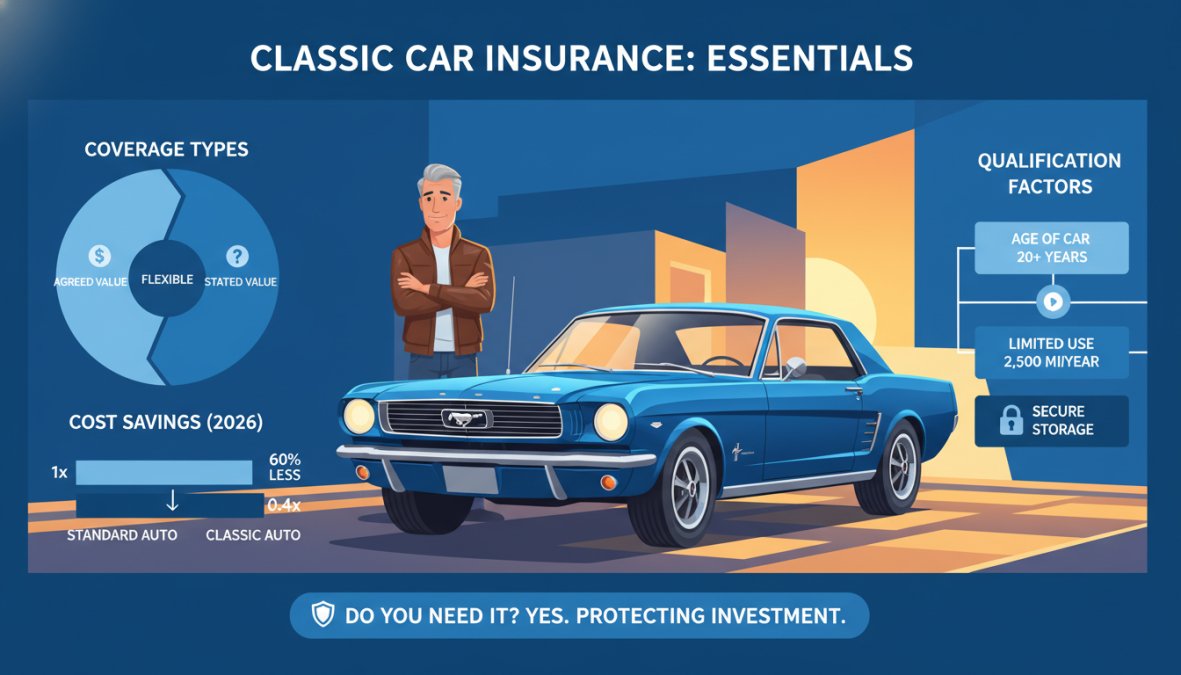
If you own a vehicle for weekend drives, car shows, or display rather than daily commuting, you almost certainly need specialty coverage. A standard auto policy is priced for vehicles driven 12,000-plus miles per year, applying that framework to a vintage car driven a few hundred miles annually leaves you paying for coverage you don’t need while missing protections you do. If your car has appreciated, taken years to restore, or would cost significantly more to replace than a standard insurer would pay, specialty insurance is worth the conversation.
How Specialty Insurance Differs from Standard Auto Coverage
Standard auto insurance is built around depreciation, every year, the insured value drops. Collector car insurance inverts that logic entirely.
Key structural differences include:
- Agreed value settlement: No depreciation deduction on a total loss claim
- Mileage restrictions: Lower annual mileage caps in exchange for lower premiums
- Storage requirements: Policies often require garage storage, reducing risk and cost
- Usage limitations: Coverage limited to pleasure driving, car shows, and club events
- Vehicle appraisal: Many policies require a formal appraisal to establish agreed value
The specialty market also includes roadside assistance tailored to classic vehicles, recognizing that a vintage car may require flatbed transport rather than standard towing.
The single most important structural difference in collector car insurance is agreed value versus actual cash value. Getting this wrong at the policy stage means a standard insurer can legally pay you far less than your car is worth after a total loss.
Classic Car Insurance Requirements: What Qualifies Your Vehicle
Most specialty insurers apply a consistent set of criteria to determine whether a vehicle qualifies for collector car insurance. Meeting these requirements unlocks better coverage terms and, often, lower annual premiums.
Age, Usage, and Storage Requirements
A common benchmark is vehicles 25 years or older for classic designation, with some carriers extending coverage to exotic cars regardless of age. Antique designations sometimes apply to vehicles 45 years or older.
Most specialty policies require the vehicle not be used as primary transportation. Acceptable uses typically include pleasure driving, car club activities, car shows, parades, and occasional maintenance drives. Insurers generally require the vehicle be kept in a locked, enclosed garage when not in use, and some carriers request storage facility photos during underwriting.
Using your classic car as a daily driver, even occasionally, can void your specialty policy or result in a denied claim. If you commute in your vintage vehicle even a few times per week, disclose this to your agent before binding coverage.
Coverage for Modified and Restored Vehicles
Modified and custom vehicles are one of the most misunderstood areas in collector car insurance. A vehicle with significant aftermarket modifications or a non-original drivetrain may not qualify under standard classic car criteria, but specialty insurers do offer coverage for these vehicles.
The key is accurate documentation. Modifications should be listed specifically in the policy, and the agreed value must reflect the cost of custom work. A restomod may actually be worth more than a stock example, your policy needs to reflect that. Custom and exotic cars often require a formal appraisal from a recognized appraiser before coverage is bound.
Agreed Value vs. Stated Value Insurance: Which Protects You More?
Agreed value vs. stated value insurance is the most consequential coverage decision a classic car owner makes, and most buyers don’t fully understand the difference until they file a claim.
Agreed value means the insurer commits to paying a specific dollar amount on a total loss, with no depreciation applied. Stated value sounds similar but works differently: the insurer pays either the stated value or actual cash value at time of loss, whichever is lower, which in practice usually means actual cash value. For a collector vehicle, agreed value coverage is the clear choice.
How Actual Cash Value Policies Can Leave You Short
Actual cash value (ACV) calculates what a vehicle is worth at time of loss, factoring in age, condition, and market depreciation. For a 1969 Camaro that has appreciated due to its condition and provenance, an ACV calculation may produce a figure far below auction value. According to Hagerty’s collector car market guidance, classic vehicle values have trended upward across many segments over the past decade, applying a depreciation formula to an appreciating asset produces a settlement that doesn’t reflect the real market. Always confirm whether a policy settles on agreed value before signing.
How to Find Affordable Classic Car Insurance: A Step-by-Step Approach
Finding affordable classic car insurance requires more than collecting quotes. The price you pay is shaped by how well you’ve documented your vehicle, which policy type you select, and whether you’ve matched coverage to your actual usage patterns.
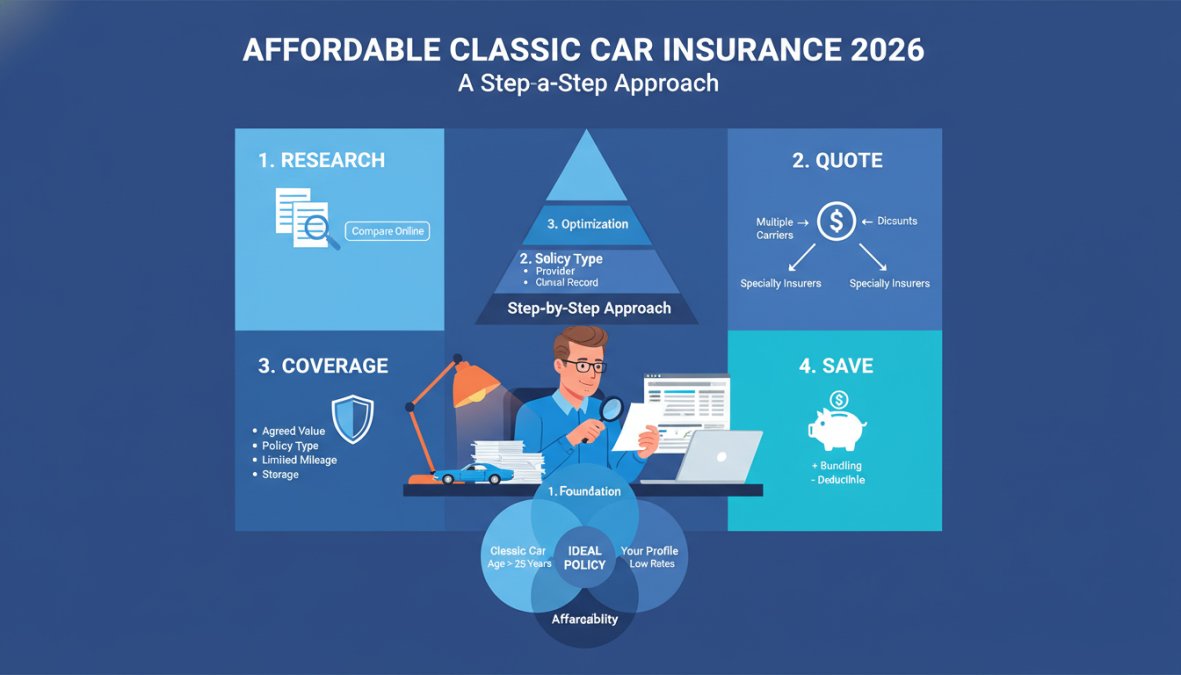
Step 1: Get a Vehicle Appraisal Before You Quote
A professional appraisal is the foundation of any agreed value policy. Without one, you’re either underinsuring your car or paying a premium based on an inflated number you can’t substantiate. The appraisal documents condition, modifications, restoration work, and comparable sales data, it becomes the basis for your agreed value and protects you if a claim is disputed.
Step 2: Compare Specialty Insurers Against Standard Carriers
The comparison worth making is not just premium price but settlement terms, mileage allowances, and covered uses.
| Coverage Factor | Specialty Insurer | Standard Carrier Endorsement |
|---|---|---|
| Settlement method | Agreed value | Stated or ACV |
| Mileage flexibility | Tiered options | Often fixed low cap |
| Restoration coverage | Often available | Rarely offered |
| Car show coverage | Standard inclusion | May require rider |
| Roadside assistance | Classic-specific | Standard towing |
| Annual premium | Often lower | Can be higher for less coverage |
United Family Insurance compares the market on your behalf, providing quotes from multiple specialty and standard carriers without you managing the process. Their agents understand agreed value policies and can identify coverage gaps that generic online quote tools miss.
Step 3: Understand Mileage Restrictions and Limited Use Terms
Mileage restrictions are how specialty insurers price collector car insurance below standard rates. Many policies offer tiered options ranging from 1,000 to 7,500-plus miles per year. Underestimating your mileage to get a lower premium is a coverage risk, if a claim reveals your odometer exceeds your stated mileage, the claim may be reduced or denied. Review limited use terms carefully: driving to a car show is covered; commuting is typically not.
Collector Car Insurance Discounts You Should Always Ask About
The classic car insurance market rewards responsible ownership, and several discount categories many policyholders never request can meaningfully reduce annual premiums.
Car Club Memberships, Bundling, and Multi-Policy Savings
Car club membership is one of the most consistently available discounts in the specialty market, it signals to underwriters that you’re a serious enthusiast who stores and maintains the vehicle responsibly. Additional discount categories worth requesting:
- Multi-vehicle discount: Insuring more than one collector vehicle under the same policy
- Bundling with home or auto: Combining collector car coverage with home or primary auto
- Agreed value discount: Providing a recent professional appraisal supporting the stated value
- Secure storage discount: Documented garage storage with security features
- Low mileage discount: Committing to a lower annual mileage tier
- Lienholder-free discount: Vehicles owned outright sometimes qualify for better terms
According to the National Association of Insurance Commissioners’ consumer guidance on auto discounts, bundling policies with a single carrier is one of the most reliable ways to reduce total insurance costs. United Family Insurance agents are trained to identify applicable discounts during the quoting process.
What Competitors Won’t Tell You: DIY Restoration and Claims Transparency
Most collector car insurance content focuses on finished, show-ready vehicles. Two areas that rarely get adequate coverage are vehicles in active restoration and what actually happens when you file a claim.
Insuring Your Classic During Active Restoration
A vehicle undergoing active restoration presents a genuine coverage challenge. Standard collector car policies typically cover finished vehicles, if your 1957 Chevy Bel Air is disassembled in your garage, a standard policy may not cover individual parts, partially completed work, or the vehicle’s value at various stages.
Options for restoration-phase coverage include:
- Agreed value with restoration documentation: Some specialty insurers write policies on partially restored vehicles with staged value increases
- Scheduled parts coverage: High-value parts such as original engines or rare body panels scheduled separately
- Inland marine coverage: For high-value parts stored separately from the vehicle
- Builder’s risk policies: Available through specialty brokers
Don’t assume your finished-vehicle policy extends to a project car. Ask explicitly, get the answer in writing, and update your policy as the vehicle’s value increases.
Document every stage of your restoration with dated photographs and receipts. This creates an undeniable paper trail that supports your agreed value claim and speeds up the claims process significantly if you ever need to file.
What to Expect During the Claims Process
A straightforward claims process for a collector vehicle should include:
- Direct contact with a claims specialist who understands collector vehicles, not a generalist adjuster unfamiliar with classic car values
- Appraisal review: Your existing appraisal documentation as the primary settlement reference
- Repair shop flexibility: The ability to use a restoration specialist, not just any approved facility
- Agreed value confirmation: Written confirmation that settlement will be based on the agreed value in your policy
Ask any insurer you’re considering: "Who handles my claim if my vehicle is totaled, and what documentation do you use to determine the settlement amount?" The answer tells you a great deal about how the process will actually work.
How to Find Affordable Classic Car Insurance in Las Vegas, Nevada
Las Vegas presents specific considerations for classic car owners that affect both coverage needs and available options. Nevada’s climate, road conditions, and regulatory environment all play a role in how specialty insurance is structured and priced in the region.
Nevada does not mandate agreed value coverage, meaning insurers can offer stated value or ACV policies without restriction. This makes it especially important for Las Vegas collectors to verify their settlement terms rather than assuming agreed value is the default.
The desert climate creates storage conditions that are favorable in some respects and challenging in others. Low humidity reduces rust risk, which insurers view positively. However, extreme heat and UV exposure can damage interiors, rubber seals, and paint, making covered storage a practical necessity that also supports lower premiums. Local car clubs in the Las Vegas area are active, and membership in recognized Nevada collector organizations can support discount eligibility with many specialty carriers.
According to the Nevada Division of Insurance consumer resources, Nevada residents have the right to request a plain-language explanation of any policy term before binding coverage. Use this right, ask your agent to explain exactly how a total loss would be settled before you sign.
United Family Insurance operates in Las Vegas and understands the local market. Their agents compare specialty and standard carriers available in Nevada, identify state-specific discount opportunities, and ensure your policy terms are clearly understood before you commit.
Protecting a classic car in Las Vegas requires more than a standard auto policy, and the difference between the right coverage and the wrong one only becomes clear at claim time. United Family Insurance compares the market on your behalf, with expert agents who understand agreed value policies, specialty underwriting, and the Nevada regulatory environment. Their user-friendly claims platform and commitment to affordable, comprehensive coverage make the process straightforward from quote to settlement. Get a quote from United Family Insurance and protect your classic car with coverage that reflects what it’s actually worth.
Frequently Asked Questions
What qualifies as a classic car for insurance purposes?
Most specialty insurers consider a vehicle a classic if it is at least 20 to 25 years old, maintained in good or restored condition, and used for limited purposes such as car shows, parades, or occasional leisure driving. Some carriers also cover exotic cars and collectible vehicles regardless of age. Meeting classic car insurance requirements typically also involves having a primary daily-use vehicle and storing the classic in a secure, enclosed garage.
Is classic car insurance cheaper than regular auto insurance?
Yes, collector car insurance is often significantly less expensive than standard auto insurance because policies include mileage restrictions and limited use clauses that reduce the insurer's risk exposure. Annual premiums can be quite low compared to everyday vehicle coverage. However, the actual cost depends on the agreed value you set for the vehicle, your driving history, storage conditions, and the level of liability coverage you choose.
What is the difference between agreed value and stated value insurance for classic cars?
With agreed value coverage, you and the insurer lock in a fixed payout amount upfront, if your vehicle is declared a total loss, you receive that full amount with no depreciation deducted. Stated value policies, by contrast, may only pay the lesser of the stated value or actual cash value at the time of the loss, which can leave a policyholder significantly undercompensated. For most classic car owners, agreed value vs stated value insurance is one of the most important decisions they will make.
Do I need an appraisal to get classic car insurance?
A professional vehicle appraisal is strongly recommended before purchasing collector car insurance, especially for rare, restored, or modified vehicles. An appraisal establishes a documented market value that supports your agreed value policy and protects you during the claims process. Without one, you may struggle to justify your vehicle's worth to the insurer in the event of a total loss. Some carriers require a formal appraisal for vehicles above a certain value threshold.
What mileage restrictions apply to classic car insurance policies?
Most collector car insurance policies impose annual mileage restrictions, commonly ranging from 1,000 to 5,000 miles per year, though some carriers offer flexible or unlimited mileage plans at a higher premium. These limitations reflect the limited use nature of classic vehicles and are a key reason why annual premiums stay low. Exceeding your agreed mileage limit could affect your coverage or result in a claim denial, so it is important to track usage carefully and discuss your driving habits with your agent.
Can I get classic car insurance while my vehicle is being restored?
Yes, some specialty insurers offer coverage specifically designed for vehicles undergoing DIY restoration or professional rebuild. This type of policy typically covers the vehicle's current value plus the cost of parts and labor already invested. Standard auto policies rarely cover restoration-phase vehicles adequately. When shopping for how to find affordable classic car insurance during a restoration project, ask carriers explicitly about car restoration coverage and whether your garage or workshop storage qualifies under their underwriting guidelines.