

Table of Contents
- How Much Does Bundling Home and Auto Save
- What Bundling Discounts Actually Look Like
- Get Free Insurance Quotes Online to Compare Your Options
- Average Cost of Homeowners Insurance in Las Vegas and How Bundling Affects It
- Is Bundling Insurance Always Cheaper
- The Break-Even Analysis: When Bundling Makes Financial Sense
- Why Claims Process Matters When You Bundle
- Conclusion
Last Updated: August 18, 2026
How Much Does Bundling Home and Auto Save
Bundling home and auto insurance is one of the most straightforward ways to reduce your overall insurance costs. When you combine multiple policies with the same insurer, you unlock multi-policy discounts that can meaningfully lower your annual premiums. But the real question isn’t whether bundling saves money, it’s how much, and whether it makes sense for your specific situation.
At United Family Insurance, we’ve helped hundreds of Las Vegas residents evaluate bundling options and understand exactly what those savings look like in practice. The discounts vary widely depending on your coverage limits, deductibles, claims history, and the specific carriers you’re comparing. Some policyholders see modest reductions of 10-15% on their combined premiums. Others find savings closer to 25-30% or more. The difference comes down to how aggressively each carrier prices their bundled rates and how your risk profile aligns with their underwriting criteria.
This guide walks you through what bundling discounts actually look like, how to compare your options effectively, and when bundling truly makes financial sense versus when keeping policies separate might be the smarter choice.
What Bundling Discounts Actually Look Like
Multi-policy discounts aren’t created equal. Insurance carriers structure them differently, and understanding those variations helps you spot which offers are genuinely competitive.
Most insurers offer a base bundling discount that applies automatically when you combine home and auto policies. This typically appears as a percentage reduction on your premium, sometimes shown as a discount on each policy, sometimes applied to the total. Some carriers also layer additional discounts on top of the bundled rate. For example, you might get a 15% bundling discount plus another 5% for paying your premium in full upfront, or 3% for setting up automatic payments.
The mechanics matter because they affect how you compare quotes. When you’re looking at two different carriers, one might quote you $1,200 for home and $800 for auto with a 20% bundling discount applied. Another might quote $1,100 for home and $850 for auto with a 15% bundling discount. The first scenario nets you $2,000 annually after the discount. The second gives you $1,955. The difference is small in percentage terms but meaningful in actual dollars over time.
Where bundling gets complicated is when carriers apply different discount structures to different coverage types. Some insurers discount your homeowners policy more aggressively and your auto policy less, or vice versa. This matters if you’re considering dropping one policy later or if you’re comparing quotes where the carriers emphasize different parts of their bundled rate.
The key insight most people miss: a higher starting quote with a larger discount sometimes beats a lower starting quote with a smaller discount. Always compare the final bundled price, not the discount percentage alone.
Get Free Insurance Quotes Online to Compare Your Options
Comparing bundled quotes online is faster than calling agents individually, but you need to approach it strategically to get accurate numbers.
Start by gathering your current policy details: coverage limits on your home (dwelling, personal property, liability), deductibles, and the same information for your auto policy. You’ll also need basic information about your home (age, square footage, construction type, distance from fire hydrant) and vehicles (year, make, model, VIN, annual mileage, driving history).
When you enter this information on quote platforms, be consistent across all carriers. Small variations in how you describe your home or driving habits can throw off the comparison. Some platforms let you request quotes from multiple carriers at once; others require you to visit each insurer’s site individually. The multi-carrier platforms save time but sometimes show older or incomplete rate information.
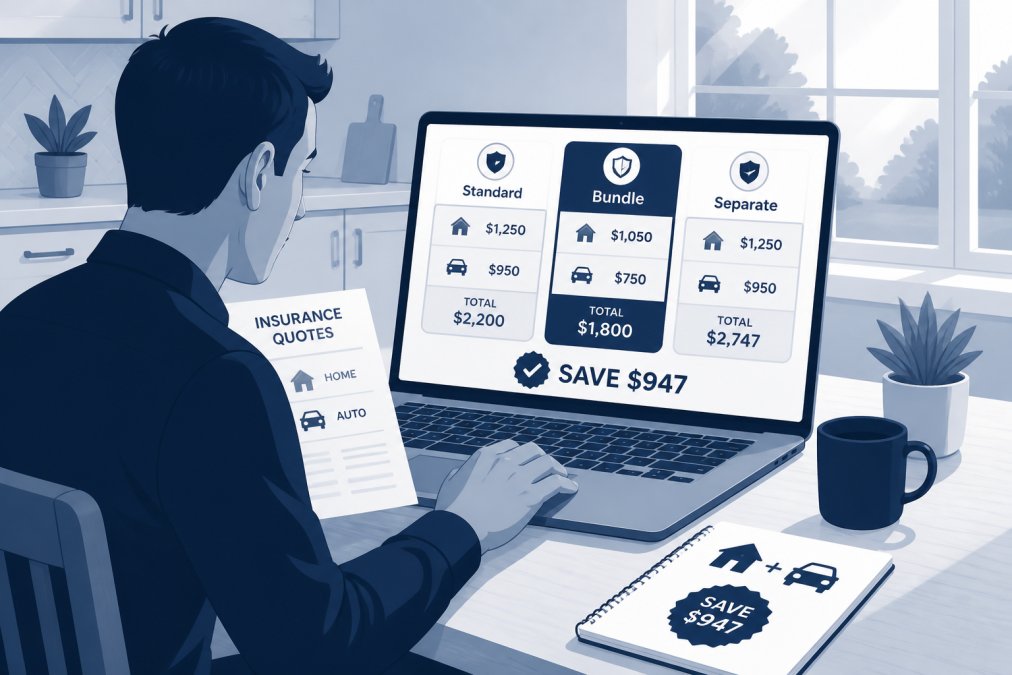
One critical step most people skip: ask each carrier specifically about their bundling discount and any additional discounts you qualify for. Online quotes sometimes don’t automatically apply all available discounts. A quick call or chat with an agent can reveal discounts the initial quote missed, things like low-mileage discounts, safety feature discounts on your home, or discounts for completing a defensive driving course.
Keep a spreadsheet of the quotes you receive. List the carrier name, home premium, auto premium, bundling discount percentage, final bundled price, and any additional discounts mentioned. This makes it easy to spot patterns and identify which carriers are most competitive for your profile. After gathering 4-6 quotes, you’ll have a clear picture of the market range in your area.
The mistake people often make is stopping at the first quote that looks reasonable. Spending 30 minutes to gather multiple quotes can easily reveal $300-500 in annual savings, money that compounds significantly over time.
Average Cost of Homeowners Insurance in Las Vegas and How Bundling Affects It
Homeowners insurance costs in Las Vegas vary based on several factors specific to the region and your individual property. The cost of rebuilding a home in Las Vegas, the frequency of theft and break-ins in your neighborhood, and local weather patterns all influence what insurers charge.
Your home’s age, construction materials, and roof condition matter significantly. Older homes with outdated electrical or plumbing systems typically cost more to insure. Homes with updated roofs and modern systems cost less. The distance from a fire station and the quality of local fire protection services also factor into your premium. Properties in areas with excellent fire protection get better rates than those in remote areas.
When you bundle home and auto, the homeowners portion of your bundled rate depends on these factors plus your claims history and credit-based insurance score. Bundling typically reduces your homeowners premium by a percentage, sometimes 10-15%, sometimes more. The actual savings depend on what the carrier’s base homeowners rate is for your specific property and how aggressively they discount for bundling.
Here’s where bundling gets interesting: some carriers price their standalone homeowners policies very competitively, which means their bundling discount feels less impressive. Others price homeowners higher but offer substantial bundling discounts to attract multi-policy customers. You might find that the carrier with the lowest standalone homeowners quote doesn’t offer the best bundled rate overall.
The local Las Vegas market has several carriers competing for bundled business, which generally keeps rates more competitive than they might be in less densely populated areas. This competition works in your favor when you’re shopping around.
Is Bundling Insurance Always Cheaper
Bundling almost always saves money compared to buying the same coverage from two separate carriers at their standard rates. But the question that matters more is whether bundling with a specific carrier saves you money compared to your best alternative options.
Sometimes the cheapest home insurance comes from Carrier A, and the cheapest auto insurance comes from Carrier B. In that scenario, bundling with either carrier might cost more than splitting your policies. The bundling discount from Carrier A might not be large enough to offset the fact that you’re paying a higher base rate for auto insurance. The same logic applies in reverse.
This is where the break-even analysis becomes essential. Before you commit to bundling, you need to know whether the discount you’re getting actually beats your best alternative split-policy scenario.
Another situation where bundling might not make sense: if you have complex coverage needs that don’t align well with a single carrier’s strengths. For example, if you own a rental property or need specialized motorcycle coverage, you might find better rates and more appropriate coverage with specialists rather than a general carrier offering bundled discounts.
The honest answer is that bundling saves money for most people, but not for everyone. The only way to know for certain is to compare your best bundled quote against your best alternative split-policy quotes.
The Break-Even Analysis: When Bundling Makes Financial Sense
A break-even analysis tells you exactly how much you need to save with bundling to justify switching carriers or consolidating policies.
Start by calculating your current annual insurance costs. If you’re paying $1,200 for homeowners and $900 for auto with your current carriers, your total is $2,100 per year. Now, get a bundled quote from another carrier. Let’s say it’s $1,800 annually after the bundling discount.
The potential savings is $300 per year. But switching involves a transition cost: you’ll need to cancel your current policies (which might trigger early cancellation fees), set up new policies, and potentially experience a brief gap in coverage if timing overlaps poorly. Some carriers offer incentives to offset these switching costs, things like waiving the first month’s premium or offering a small bonus credit.

The real break-even point comes when your annual savings exceed the switching costs and any rate increases you might face if you need to file a claim. If switching costs you $50 and you’re saving $300 per year, you break even in about two months. If you’re saving only $100 per year but switching costs $75, you break even in nine months.
This is why the timing of your policy renewal matters. If you’re six months into a policy, switching might trigger cancellation fees. If you’re approaching renewal, switching at renewal eliminates those fees entirely. Many carriers will also honor your renewal date if you switch before your current policy expires, which simplifies the transition.
The longer you stay with a bundled carrier, the more valuable the savings become. A $300 annual savings compounds to $1,500 over five years. That justifies even moderately inconvenient switching processes.
United Family Insurance helps clients work through this analysis by comparing their current costs against bundled options and calculating the realistic break-even timeline. Our agents can also identify additional discounts you might qualify for that further improve the bundled rate.
Why Claims Process Matters When You Bundle
This is the part most guides skip, but it’s critical: bundling consolidates your coverage with one carrier, which means your claims process runs through a single company.
When you file a claim, you interact with one claims adjuster, one claims system, and one set of processes. This can be significantly simpler than managing claims across multiple carriers. You don’t have to coordinate between two different companies, track multiple claim numbers, or explain your situation twice.
But there’s a friction point people don’t anticipate: if you’re unhappy with how one claim is handled, you can’t simply switch that one policy to another carrier mid-year without losing your bundling discount. You’re locked into the relationship for the duration of your policy term.
This is why the claims process quality matters more when you bundle. Before you commit to a bundled policy, spend time researching how that carrier handles claims. Read customer reviews specifically about claims experiences, not just general service. Ask the agent directly: How long does claim resolution typically take? What’s the process if you disagree with the adjuster’s assessment? Can you request a different adjuster if needed?
United Family Insurance clients have reported smooth claims experiences, with our agents available to help navigate the process and answer questions. But you should verify this aligns with your expectations before bundling.
The flip side: bundling can actually improve claims handling because your agent has visibility into your entire insurance profile. If you file a home claim, your agent knows about your auto coverage and can ensure nothing is overlooked in the settlement.
| Bundling Scenario | Pros | Cons | Best For |
|---|---|---|---|
| Bundling with one carrier | Single claims process, one agent, coordinated coverage | Less flexibility if unhappy, locked into one company | Most homeowners seeking simplicity |
| Splitting home and auto | Can switch one policy independently, shop each separately | Two claims processes, two agents, higher total cost | Those with specialized needs or complex situations |
| Bundling plus specialty policies | Comprehensive coverage, multiple discounts | More complex to manage overall | Owners of rental properties or specialty vehicles |
Conclusion
Bundling home and auto insurance typically saves money through multi-policy discounts, but the actual amount depends on your specific situation, the carriers you’re comparing, and your coverage needs. The key is comparing your best bundled quote against your best alternative split-policy options rather than assuming bundling is automatically cheaper.
United Family Insurance helps Las Vegas residents navigate this decision by comparing quotes across multiple carriers and identifying which bundling option truly maximizes your savings. Our agents work with you to understand your coverage needs, calculate realistic break-even timelines, and ensure you understand the claims process before you commit. Get a free quote and see exactly how much bundling could save you, with no obligation to switch.
Frequently Asked Questions
Is it a good idea to combine home and auto insurance?
Combining home and auto insurance typically saves 15-25% on premiums through multi-policy discounts. The financial benefit depends on your current coverage gaps, claims history, and the insurance carrier's underwriting practices. If you currently have separate policies with different carriers, consolidating with one insurer often reduces your total annual cost. However, the decision should also factor in coverage quality, customer service, and claims process efficiency, not price alone.
How much is homeowners insurance on a $400,000 house in Las Vegas?
Homeowners insurance costs vary significantly based on your home's age, construction type, deductible selection, and coverage limits. In Las Vegas, factors like proximity to wildfire zones, local building codes, and your credit-based insurance score influence premiums. Rather than relying on national averages, getting free insurance quotes online from multiple carriers gives you accurate pricing for your specific property and situation. This approach also lets you see how bundling with auto insurance affects your homeowners rate.
What are the downsides of bundling insurance?
While bundling saves money, potential downsides include less flexibility if one policy doesn't meet your needs, potential rate increases after the introductory discount period, and reduced negotiating power if you're unhappy with one line of coverage. Some specialized coverage, like high-value jewelry or classic car protection, may not be available through the same carrier. Additionally, if your claims history with one policy becomes problematic, it can affect your entire bundled rate. Evaluate whether the savings justify any reduction in customization or coverage options.
Does bundling home and auto insurance always result in the lowest premium?
No. Bundling is typically cheaper than separate policies, but it's not always the lowest-cost option for every person. Your claims history, credit-based insurance score, and the specific risk assessment by each carrier determine your actual premium. Sometimes a specialized carrier offers better rates on one type of coverage even if their bundled rate is higher overall. This is why getting free insurance quotes online from multiple carriers is essential, it reveals whether bundling with one company beats shopping individual policies with different insurers.