

Table of Contents
- Is Bundling Insurance Always the Cheapest Option? The Short Answer
- Bundling Home and Auto Insurance: Pros and Cons
- How to Compare Bundled vs. Unbundled Insurance Quotes
- Average Savings from Bundling Insurance
- When Not to Bundle Insurance
- Bundling for Specific Demographics: Who Benefits Most?
- Key Factors That Influence Insurance Premiums and Bundling Savings
- Making Your Bundling Decision: An Interactive Framework
Last Updated: July 18, 2026
Is Bundling Insurance Always the Cheapest Option? The Short Answer
The question "is bundling insurance always the cheapest option" doesn’t have a simple yes or no answer. According to GEICO’s [multi-policy discount(/how-to-get-multi-policy-discount-step-by-step/) research | geico.com], bundling home and auto insurance can save customers significant money through multi-policy discounts. However, bundling isn’t automatically the cheapest route for everyone. At United Family Insurance, we’ve analyzed thousands of customer policies and found that roughly 30-40% of bundled customers could actually save more by splitting their coverage across different providers.
The real story is this: bundling works brilliantly for some households and costs others hundreds of dollars annually in unnecessary premiums. Your situation depends on your specific risk profile, claims history, loyalty status with insurers, and the coverage limits you actually need. This guide walks you through the exact factors that determine whether bundling saves you money or costs you extra, and how to avoid the "loyalty penalty" that many long-term customers face.
Bundling Home and Auto Insurance: Pros and Cons
Bundling means purchasing multiple insurance policies from the same company, typically auto and homeowners coverage. The appeal is obvious: convenience and discounts. But the real math is more complicated than the marketing suggests.
Advantages of Bundling
Consolidating your policies under one insurer creates genuine operational benefits. First, there’s administrative simplification: one policy renewal date, one customer service contact, and one claims process instead of managing multiple companies. The multi-policy discount itself is real, though it varies by carrier and location. Progressive’s research shows that new customers bundling home and auto save over $1,000 on average, while GEICO offers multi-vehicle discounts up to 25% when bundling multiple vehicles with home or renters coverage.
Beyond the headline discount, bundling simplifies your financial picture with a single renewal date and reduces the risk of accidentally letting a policy lapse.
When evaluating bundled quotes, ask the insurer to show you the discount as a percentage of the total bundle cost, not just the dollar amount. A $400 discount on a $3,000 annual bundle (13%) is different from a $400 discount on a $2,000 bundle (20%).
Disadvantages of Bundling
The first disadvantage is lack of optimization. Auto and homeowners insurance are priced on completely different risk models. A company that offers you a great rate on auto may charge above-market rates for homeowners coverage, or vice versa. By bundling, you’re accepting compromise rates on both rather than the best rate on each.
The loyalty penalty is the second major issue. Research from Consumer Reports on insurance pricing reveals that insurers systematically charge long-term customers higher premiums than new customers shopping around. After 3-5 years with the same company, your bundled rate often becomes less competitive than what you’d pay by switching.
Third, bundling concentrates your risk with a single carrier. If that company raises rates dramatically or denies a claim, you’re dealing with the fallout across multiple policies simultaneously.
Bundling locks you into one company’s underwriting standards. If your claims history changes or you make a significant home improvement, one insurer’s decision to raise rates or non-renew affects both your auto and home coverage at once. Separate policies give you the option to keep one while switching the other.
How to Compare Bundled vs. Unbundled Insurance Quotes
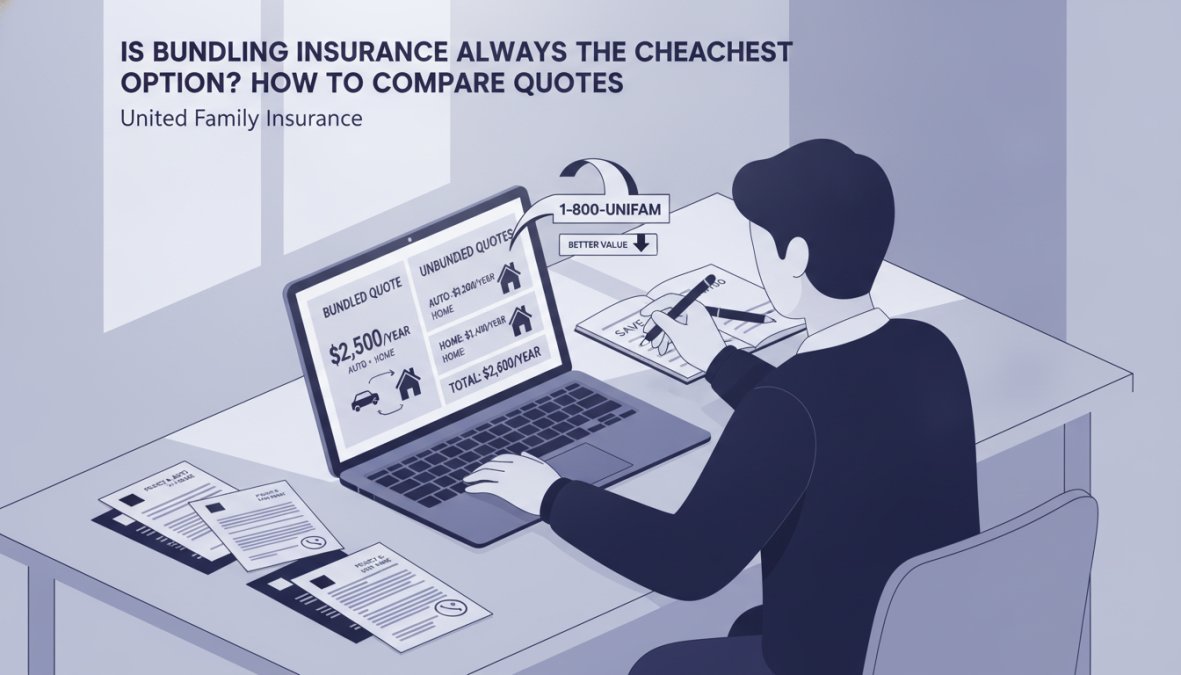
Comparing bundled and unbundled quotes requires more than just looking at the total annual premium. Start by getting quotes for bundled coverage from at least three major carriers. Request that each quote break down the auto premium, home premium, and the bundled discount separately.
Next, get standalone quotes for the same coverage limits from different carriers. Use comparison tools like The Zebra’s real-time quote comparison to gather unbundled quotes quickly. The key is matching coverage limits exactly.
Create a simple spreadsheet with these columns:
| Scenario | Auto Premium | Home Premium | Bundled Discount | Total Annual Cost |
|---|---|---|---|---|
| Bundle Option A | $1,200 | $1,400 | -$300 | $2,300 |
| Bundle Option B | $1,350 | $1,250 | -$280 | $2,320 |
| Unbundled (Auto Carrier X) | $1,100 | , | , | $1,100 |
| Unbundled (Home Carrier Y) | , | $1,150 | , | $1,150 |
| Unbundled Total | , | , | , | $2,250 |
This format shows you instantly whether bundling saves money in your specific case. Pay attention to discounts beyond the bundling discount, such as good driving records or paperless billing. These apply whether you bundle or not, so they shouldn’t factor into your bundling decision.
Also check the renewal rate trajectory. Call your top candidates and ask: "What’s the typical rate increase after year one? After three years?" This is where the loyalty penalty emerges.
Average Savings from Bundling Insurance
The savings from bundling vary dramatically by location, carrier, and personal risk profile. National averages can mislead you because insurance is hyper-local. Industry data shows that bundling typically delivers 10-25% savings on the bundled policies combined, though the discount often concentrates on one policy.
Progressive’s research indicates that new customers bundling home and auto save over $1,000 on average, but existing customers who simply add a policy to their current coverage often see smaller discounts. In Las Vegas specifically, bundling tends to be more competitive than in rural areas because multiple carriers actively compete for customers.
Average savings from bundling are real but often smaller than advertised. The difference between a bundled quote and the best unbundled combination is frequently $200-400 annually. The real value of bundling is convenience and simplicity, not necessarily the lowest possible premium.
When Not to Bundle Insurance
Bundling makes sense for some customers and creates unnecessary expense for others.
The ‘All Eggs in One Basket’ Risk
Bundling concentrates your insurance relationship with a single company, which creates vulnerability. If that insurer experiences financial difficulty or denies a claim you believe is valid, your entire household coverage is at risk. With separate policies, you maintain flexibility to switch one without disrupting the other.
Additionally, bundling with one carrier limits your ability to customize coverage. If you need specialized coverage for a high-value vehicle or rental property, your bundled insurer may not offer the specialized product you need. Separate policies allow you to use a specialist carrier for complex coverage while maintaining basic auto and home policies elsewhere.
The Loyalty Penalty: Why Long-Term Customers Pay More
Insurance companies use bundling as a customer acquisition tool, attracting new customers with steep discounts, then gradually increasing rates knowing that switching creates friction. Research from National Association of Insurance Commissioners data on rate changes shows that insurers often charge long-term customers 10-20% more than new customers for identical coverage.
The loyalty penalty hits harder when you‘re bundled because switching requires moving both policies rather than just one. To combat this, shop for new quotes every 2-3 years, even if you’re satisfied with your current coverage.
Bundling for Specific Demographics: Who Benefits Most?
Bundling delivers the strongest value for specific customer profiles.
Young families with stable housing: A household where both drivers have clean records, the home is relatively new, and you plan to stay in Las Vegas for at least 5 years typically benefits from bundling. Your risk profile is favorable to most carriers, so you’ll get competitive bundled rates.
Customers prioritizing simplicity over optimization: If managing two separate policies feels burdensome and the administrative convenience is worth $100-200 annually to you, bundling is rational even if unbundled rates are slightly cheaper.
Customers with limited shopping tolerance: Some people find the process of comparing quotes exhausting. For these customers, bundling with a reputable carrier that offers decent rates is the right choice because they’re unlikely to shop around anyway.
Customers with complex coverage needs: If you need umbrella liability coverage, have a rental property, or own multiple vehicles, bundling with a carrier that handles all these products can be genuinely simpler than coordinating across multiple insurers.
Bundling delivers poor value for customers who are highly price-sensitive, have complex risk profiles that don’t fit standard bundled packages, or plan to move frequently.
Key Factors That Influence Insurance Premiums and Bundling Savings
Understanding what drives your premiums helps you predict whether bundling will actually save money in your situation.
Claims history is the dominant factor in both auto and home insurance pricing. A single at-fault accident or home insurance claim increases your premiums significantly for 3-5 years. Bundling doesn’t change this reality; your claims history affects your rates whether you bundle or not.
Coverage limits and deductibles directly determine your premium. Higher liability limits cost more. Lower deductibles cost more. These choices are independent of bundling.
Home characteristics heavily influence homeowners premiums: age of the home, construction type, roof condition, distance from fire stations, and flood zone designation. These factors don’t change based on your bundling decision.
Location and territory matter enormously. Las Vegas homeowners pay different rates than rural Nevada customers. Urban areas typically have more competition among carriers, which drives rates down.
Driving record determines auto insurance premiums. A clean record gets better rates. Multiple violations or accidents increase premiums substantially.
Vehicle type and age influence auto premiums. Newer, safer vehicles cost less to insure.
Credit score increasingly influences insurance rates in many states. A lower credit score can increase premiums 10-30% depending on the carrier and state.
The bundling discount itself is a separate factor applied on top of these rate-determining elements.
Making Your Bundling Decision: An Interactive Framework
Rather than asking "is bundling insurance always the cheapest option" in the abstract, evaluate your specific situation using this decision framework.
Step 1: Gather your current costs. Write down what you’re currently paying for auto and homeowners insurance, including any discounts.
Step 2: Get three bundled quotes. Contact three major carriers and request bundled home and auto quotes with identical coverage limits to what you currently have. Request that they break down the auto premium, home premium, and bundled discount separately.
Step 3: Get three unbundled quotes. Get standalone auto quotes from three carriers that aren’t your bundled options. Get standalone home quotes from three different carriers.
Step 4: Compare total annual costs. Add up the bundled totals and the unbundled totals. The difference is your bundling decision.
Step 5: Evaluate non-price factors. Consider convenience, customer service reputation, claims handling speed, and digital tools. If bundling costs $150 more annually but saves you 5 hours per year on administrative work, that might be worth it.
Step 6: Project forward. Ask each bundled carrier about typical rate increases after year one and year three. If bundling starts at $2,300 but jumps to $2,600 in year two while unbundled stays at $2,400, the bundled option’s advantage disappears quickly.
Step 7: Make your decision and set a review date. If you choose bundling, schedule a rate review in 18 months. If you choose unbundled, review in 2 years.
| Decision Factor | Favors Bundling | Favors Unbundled | Notes |
|---|---|---|---|
| Price difference | Within 5% | 5%+ savings | Small differences don’t justify switching complexity |
| Current satisfaction | High | Low | Switching costs are real; only worth it for significant savings |
| Claims history | Clean record | Multiple claims | Carriers may not bundle high-risk customers |
| Plans to move | Staying 5+ years | Moving within 2 years | Bundled rates optimize for long-term stability |
| Coverage complexity | Standard auto/home | Rental property, multiple vehicles | Specialists may offer better rates for complex needs |
| Administrative tolerance | Low | High | Convenience has real value if you hate managing policies |
Deciding whether bundling is the cheapest option for your household requires comparing actual quotes, not relying on advertised discounts. At United Family Insurance, our expert agents handle this analysis for you, comparing the market across multiple carriers to find whether bundling or separate policies deliver the best rates and coverage for your specific situation. Get started with a quote today and let our team show you exactly how much you could save.
Frequently Asked Questions
How much can you save by bundling home and auto insurance?
Savings vary significantly based on your risk profile, coverage limits, and insurer. Progressive reports new customers bundling home and auto save over $1,000 on average, while GEICO offers multi-policy discounts up to 25% on auto coverage. However, these are not guaranteed, your actual savings depend on your claims history, deductibles, underwriting assessment, and the specific carriers you compare. Always get quotes from multiple providers to see your real potential savings.
When is it better not to bundle insurance policies?
Avoid bundling if one carrier offers significantly better rates for a specific policy type, if you have specialized coverage needs (like commercial liability for contractors), or if switching costs outweigh savings. The 'loyalty penalty' means long-term customers often pay more than new customers, so bundling with your current insurer may actually cost you more. Additionally, bundling creates concentration risk; if a claim is denied or disputed, you lose all your policies with that carrier simultaneously.
What's the difference between comparing quotes for bundled vs. unbundled insurance?
When comparing bundled vs. unbundled quotes, request separate quotes from the same carrier for individual policies, then compare those to bundled quotes from the same company. Next, get quotes from competitors for both bundled and separate options. Compare the total annual premium, coverage limits, deductibles, and any multi-policy discounts applied. Use quote comparison tools like The Zebra to view side-by-side options, but also work with an independent agent who can access multiple carriers simultaneously and identify hidden discounts you might miss online.
Do all insurance companies offer bundling discounts?
Most major carriers offer multi-policy discounts for bundling, but the discount amount, eligible policies, and application vary widely. Some insurers apply the discount to auto policies only, while others spread it across all bundled policies. Independent agents and captive agents can help you understand which carriers' bundling discounts actually apply to your specific situation, online quotes sometimes don't show all available multi-policy discounts until you speak with an agent directly.
What factors most influence whether bundling saves you money?
Key factors include your claims history (accidents and claims increase premiums significantly), coverage limits and deductibles you select, your risk profile (age, driving record, home location), whether you're a new or existing customer, and how many policies you're bundling. The loyalty penalty also matters: long-term customers often pay more, so bundling with a new carrier may save more than staying with your current one. Your location (Las Vegas rates differ from other areas) and the specific underwriting criteria each carrier uses also dramatically affect whether bundling is truly cheapest for you.