

Table of Contents
- What Is Insurance Bundling and How Does It Work?
- How to Bundle Home and Auto Insurance: Step-by-Step
- Understanding the Multi-Policy Insurance Discount
- Is Bundling Insurance Worth It for Las Vegas Homeowners?
- How Claims History Affects Your Insurance Bundle
- How to Switch Insurance Providers Without a Coverage Gap
- How to Bundle Home and Auto Insurance with United Family Insurance
- Conclusion
Last Updated: June 3, 2026
Knowing how to bundle home and auto insurance is one of the most straightforward ways Las Vegas homeowners can reduce their annual insurance costs without sacrificing coverage quality. United Family Insurance has helped Nevada families compare bundled options across multiple carriers, and the savings are consistently meaningful. Below, we’ll show you exactly how the bundling process works, what to watch for, and when it actually makes sense to keep your policies separate.
Here’s what most guides get wrong: they treat bundling as an automatic win. The reality is more nuanced. Bundling is the right move for most policyholders, but not all of them. Understanding that distinction before you call an agent will save you time and protect you from overpaying.
According to the Insurance Information Institute’s homeowner and auto insurance guidance, policyholders who bundle home and auto coverage with a single carrier typically qualify for multi-policy discounts that can represent a meaningful reduction on both premiums. The exact savings vary by carrier, zip code, and claims history, but the financial protection logic is sound: insurers reward loyalty and consolidated risk with lower annual premiums.
What Is Insurance Bundling and How Does It Work?
Insurance bundling is the practice of purchasing two or more insurance policies, such as homeowners insurance and auto insurance, from the same carrier in exchange for a discounted rate on both. The insurer reduces your premium because managing multiple policies under one policyholder is more efficient for their underwriting and claims operations.
The mechanics are simple. When you request a bundled quote, the insurance provider runs a combined risk assessment on both your property and your vehicle. If you qualify, they apply a multi-policy discount to one or both premiums, reducing your total annual cost. The discount is built into the pricing structure, not added as a rebate after the fact.
What bundling also delivers is convenience. A single insurance carrier means one renewal date, one point of contact for claims, and one platform for policy management. For Las Vegas homeowners juggling multiple financial responsibilities, that consolidation has real value beyond the dollar savings.
The most common bundle pairing is homeowners insurance plus auto insurance, but the same logic applies to renters insurance, condo insurance, and in some cases an umbrella policy. Many carriers extend the multi-policy discount across three or more products.
Insurance bundling is not just about the discount. Consolidated policy management, a single claims contact, and aligned renewal dates are underrated benefits that add up over time.
How to Bundle Home and Auto Insurance: Step-by-Step
The process of bundling home and auto insurance is more systematic than most people expect. Rushing through it, or accepting the first bundled quote you receive, is the most common mistake policyholders make.
Total Time: Approximately 2-3 hours across one to two days

Step 1: Gather Your Current Policy Information
Before requesting any quotes, collect the following from your existing policies:
- Current annual premiums for both home and auto
- Coverage limits and deductible amounts on each policy
- Your claims history for the past three to five years
- Your home’s square footage, year built, and construction type
- Vehicle make, model, year, and VIN for each car
- Your current insurance carrier names and policy numbers
Having this information ready prevents delays and ensures you’re comparing apples to apples when quotes come back. A common mistake is requesting quotes without knowing your current deductible, which makes it impossible to evaluate whether a bundled offer actually improves your coverage.
Step 2: Compare Bundled Quotes from Multiple Carriers
Request bundled quotes from at least three insurance carriers. This is non-negotiable. The multi-policy discount varies significantly between providers, and the carrier with the lowest standalone auto rate is not always the one offering the best bundle value.
When comparing, ask each carrier to show you:
- The individual premium for each policy
- The discount applied for bundling
- The combined total after the multi-policy discount
This breakdown makes the comparison transparent. Some carriers advertise large bundle discounts but start from higher base rates, which can make the final number less competitive than it appears.
Step 3: Review Coverage Limits and Deductibles
Savings only matter if the coverage is actually equivalent. Before finalizing any bundle, confirm that the new policy matches or improves on your current coverage limits for liability coverage, dwelling replacement cost, and comprehensive and collision on your vehicle.
Pay particular attention to the deductible. A bundled policy with a higher deductible will show a lower premium, but you’re absorbing more financial risk per claim. That trade-off may be acceptable, but it should be a conscious decision.
Step 4: Confirm Your Bundled Discount and Finalize
Once you’ve selected a carrier, ask for written confirmation of the multi-policy discount applied to each policy. Review the effective dates carefully. Your new policies should activate before your existing ones expire to avoid any coverage gap.
Ask your new carrier to send a confirmation email listing the exact discount percentage applied to each policy. This protects you if a billing error occurs at renewal and makes it easy to verify the discount is still in place each year.
Understanding the Multi-Policy Insurance Discount
The multi-policy insurance discount is the core financial incentive behind bundling, and it works differently than most policyholders assume. The discount is not a flat rebate. It is built into the underwriting model, meaning the carrier prices both policies lower from the start when they know you’re bringing them multiple lines of business.
Carriers justify this pricing because bundled policyholders tend to stay longer, file claims at similar or lower rates than single-policy customers, and require less administrative overhead. The insurer’s reduced acquisition cost per customer gets passed back as a lower premium.
The discount percentage varies by carrier and by state. Nevada’s insurance market is competitive, which generally works in favor of Las Vegas policyholders seeking bundled quotes. The gap between the best and worst bundle offers in a given market can be substantial, which is why comparison shopping is essential.
Types of Policies You Can Bundle Together
Most major carriers allow policyholders to bundle across several product lines. Common combinations include:
| Bundle Combination | Typical Discount Applied To |
|---|---|
| Homeowners + Auto | Both policies |
| Renters + Auto | Both policies |
| Condo Insurance + Auto | Both policies |
| Home + Auto + Umbrella Policy | All three policies |
| Home + Auto + Life | Home and auto |
An umbrella policy is worth considering when bundling. It extends your liability coverage beyond the limits of your home and auto policies and is typically inexpensive relative to the protection it provides. Many carriers offer an additional discount when you add it to an existing bundle.
Is Bundling Insurance Worth It for Las Vegas Homeowners?
Bundling insurance is worth it for most Las Vegas homeowners, but the answer depends on your specific situation. Nevada’s climate, property values, and local insurance market all factor into whether a bundled policy delivers genuine value or just the appearance of savings.
According to the Nevada Division of Insurance consumer resources, Nevada policyholders have access to a competitive market with multiple carriers licensed to write both homeowners and auto insurance in the state. That competition generally means better bundle pricing than less competitive markets.
When Bundling Makes Strong Financial Sense
Bundling delivers the clearest value when:
- You currently carry both homeowners and auto insurance as separate policies with different carriers
- Your claims history is clean or minimal, which qualifies you for better base rates
- You own your home outright or carry a standard mortgage (non-specialty property)
- You drive standard vehicles without high-risk modifications
- You want simplified policy management with a single renewal date
For most Las Vegas families in these circumstances, bundling home and auto insurance with a single carrier will reduce their combined annual premium and simplify their coverage management simultaneously.
When NOT to Bundle: Situations to Watch For
This is the part most insurance guides skip. Bundling is not always the right move.
Avoid bundling when:
- Your current standalone policies are already priced below what any bundled quote can match. This happens when you qualified for specialized discounts (military, professional association, loyalty programs) that a new carrier cannot replicate.
- Your home is a non-standard property. High-value homes, older construction, homes with flat roofs or pools, or properties in flood-prone areas of Nevada may be better served by a specialty homeowners carrier that does not write auto insurance.
- Your vehicle carries a high-risk classification. Some carriers that excel at homeowners underwriting are less competitive on high-risk auto, meaning their bundle discount does not overcome their higher auto base rate.
- You are in the middle of an active claims period. Switching carriers during or immediately after a claim can complicate your claims history and may affect your eligibility for certain discounts.
Never cancel your existing policies before your new bundled coverage is confirmed in writing and the effective date is set. A single day without coverage can create complications with your mortgage lender and leave you financially exposed.
How Claims History Affects Your Insurance Bundle
Claims history is one of the most significant underwriting factors in bundle pricing, and it affects both sides of your bundle simultaneously. This is a dynamic that catches many policyholders off guard.
When you bundle with a single carrier, your auto claims history and your homeowners claims history are visible to the same underwriter. A single at-fault accident or a homeowners claim can affect the pricing on both policies at renewal, not just the one where the claim occurred.
This is a meaningful consideration. With separate carriers, a homeowners claim affects only your homeowners premium. A bundled policyholder faces potential premium increases across both policies from a single event.
The practical implication: if you have a recent claims history on either your home or vehicle, get quotes with full disclosure of that history before bundling. Some carriers are more forgiving of claims than others, and the right carrier for a policyholder with one recent claim is not necessarily the same as the right carrier for a clean-history policyholder.
As documented in the Insurance Information Institute’s guide to claims and premiums, claims frequency and severity are the primary factors carriers use to adjust renewal premiums. Understanding this before you bundle helps you set realistic expectations for long-term costs.
How to Switch Insurance Providers Without a Coverage Gap
Switching insurance providers is where policyholders most often make expensive mistakes. A coverage gap, even one that lasts a single day, can create problems with mortgage lenders, vehicle lenders, and your own financial protection.
The step-by-step process for switching cleanly is straightforward when you follow it in order.
Step-by-Step Cancellation Guide
-
Finalize your new bundled policy first. Do not cancel existing coverage until your new policy is active and you have written confirmation of the effective date.
-
Set the new policy start date to match or precede your cancellation date. Overlap by one day if possible to eliminate any gap risk.
-
Notify your current carriers in writing. Most carriers accept email or written notice. Specify the cancellation date explicitly.
-
Request a prorated refund for unused premium. If you’ve paid your current premium in advance, you’re entitled to a refund for the unused portion. This typically arrives within two to four weeks.
-
Confirm cancellation in writing. Get written confirmation from your old carriers that both policies have been cancelled and that no future billing will occur.
-
Update your mortgage lender and auto lender. Both require proof of continuous coverage. Send them your new policy declarations page promptly to avoid escrow complications.
-
Verify your new carrier has received payment and issued policy documents. Do not assume the policy is active until you have the declarations page in hand.
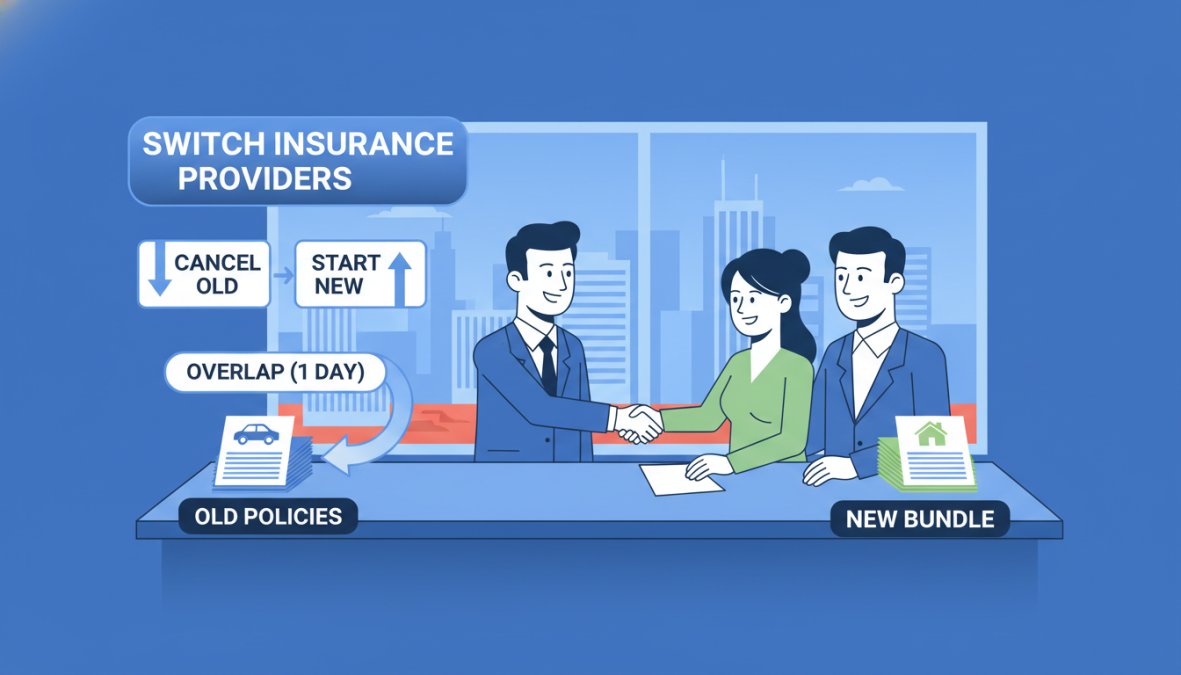
Mortgage lenders monitor your homeowners insurance continuously. If they detect a lapse, they may force-place their own coverage at a significantly higher cost and charge it to your escrow account. Avoid this by overlapping coverage dates.
How to Bundle Home and Auto Insurance with United Family Insurance
United Family Insurance approaches bundling differently from direct carriers. Rather than offering you a single carrier’s products, the United Family Insurance team compares the market on your behalf, reviewing options from multiple insurance providers to find the combination that delivers the best coverage at the most competitive combined premium.
This matters because the best homeowners carrier for a Las Vegas property is not always the same carrier offering the best auto rate. By comparing across the market, United Family Insurance can identify whether a true bundle with one carrier beats a strategically paired set of policies from two carriers, something a single-carrier agent cannot objectively evaluate.
The process is designed for convenience. Expert agents handle the quote comparison, coverage analysis, and policy coordination. You provide your current policy information and coverage goals, and the team returns with options that have already been vetted for coverage quality and pricing. According to the National Association of Insurance Commissioners consumer guidance, working with a licensed agent who compares multiple carriers is one of the most effective ways for consumers to secure competitive insurance pricing.
For Las Vegas homeowners looking for bundled insurance near me, United Family Insurance serves the broader Nevada market with the specific local knowledge that affects property underwriting in the region.
Conclusion
Bundling home and auto insurance is a practical, proven way to reduce your annual insurance costs and simplify your coverage, but only when the numbers actually support it. The biggest risk is accepting a bundled quote without comparing it rigorously against your current coverage and alternative options.
Frequently Asked Questions
Is it always cheaper to bundle home and auto insurance?
Bundling home and auto insurance often reduces your annual premium through a multi-policy discount, but it is not always the cheapest option for every policyholder. In some cases, purchasing separate policies from different insurance carriers, each specializing in a specific product, can result in lower combined costs. Always compare bundled quotes against individual quotes before committing to a combined policy.
What are the disadvantages of bundling home and auto insurance?
The main disadvantage is that bundling locks you into one insurance provider, which may limit your flexibility. If one policy has a rate increase, it can affect your entire bundle. Additionally, a claims history on one policy could influence underwriting decisions on the other. Some carriers also offer stronger coverage for homeowners insurance or auto insurance individually, so bundling may mean accepting a weaker product in one area.
Can I bundle insurance if I rent my home?
Yes. Renters insurance can typically be bundled with auto insurance to earn a multi-policy discount, similar to how homeowners insurance bundles work. Renters insurance provides financial protection for your personal belongings and liability coverage, and combining it with your auto policy through one insurance provider often simplifies policy management and reduces your overall premium costs.
What happens to my insurance if I switch providers mid-term?
When you switch insurance providers mid-term, your existing insurer will typically issue a prorated refund for any unused portion of your annual premium. To avoid a coverage gap, always activate your new bundled policy before canceling the old one. Notify your lender if your homeowners insurance is tied to a mortgage escrow account, as they will need updated proof of coverage from your new insurance carrier.
Do I need to use the same insurance company for home and auto to get a discount?
Yes, the multi-policy insurance discount requires both policies to be held with the same insurance carrier. The discount is applied because the insurer rewards you for consolidating your business with them. However, working with an independent agent or a market-comparison service like United Family Insurance allows you to shop multiple carriers simultaneously to find the best bundled rate for your specific zip code and situation.
How do I switch to a bundled policy without losing coverage?
To switch insurance providers and bundle your policies without a coverage gap, first secure your new bundled quote and confirm your new policy start date. Do not cancel your existing policies until the new coverage is active. Notify any lienholders, such as your mortgage lender or auto loan provider, of the change. Then formally cancel your old policies in writing and confirm receipt of any prorated premium refund.
Finding the right bundle requires comparing the market, not just accepting the first offer. United Family Insurance compares multiple carriers on your behalf, provides expert guidance on coverage limits and deductibles, and helps Las Vegas homeowners secure affordable, comprehensive protection without the legwork. Get your bundled quote from United Family Insurance and see what the market actually offers for your home and vehicle.