

Table of Contents
- What Is a Multi-Policy Discount?
- How Multi-Policy Discounts Work
- Insurance Bundling Benefits You Should Know
- Step-by-Step: How to Get a Multi-Policy Discount
- Common Policy Combinations for Maximum Savings
- Maximizing Insurance Savings: Break-Even Analysis
- Common Mistakes to Avoid When Bundling Policies
- Canceling Old Policies: A Step-by-Step Checklist
Last Updated: July 16, 2026
What Is a Multi-Policy Discount?
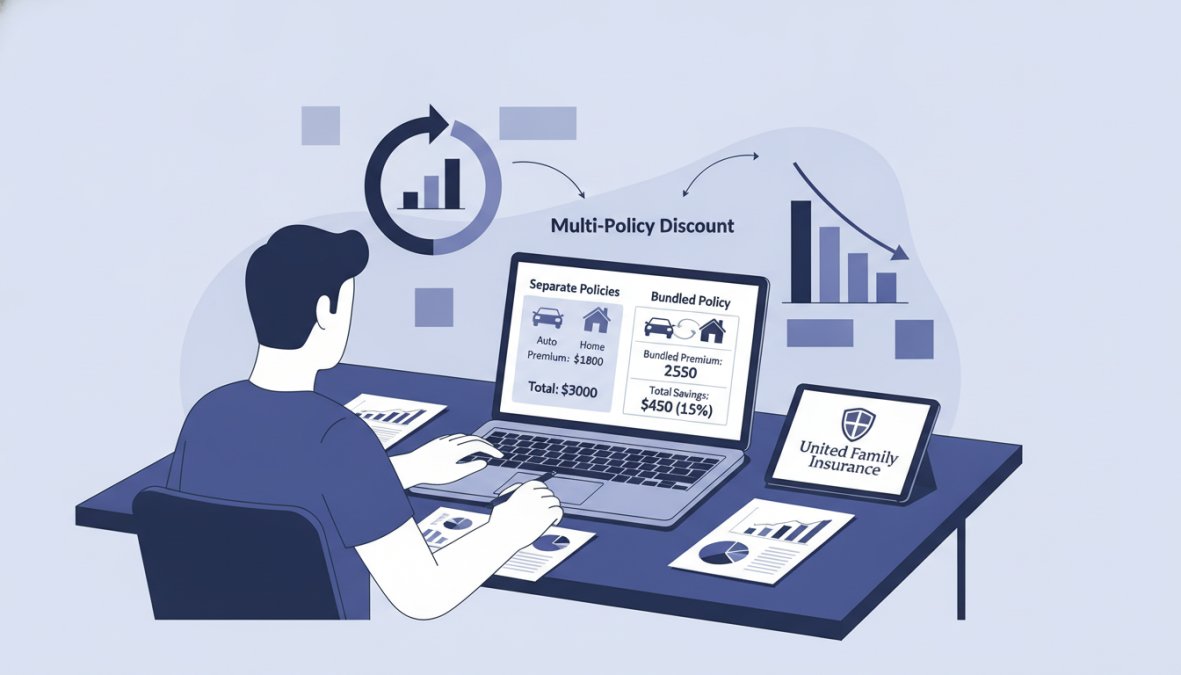
A multi-policy discount is a reduction in your insurance premiums when you bundle two or more policies with the same carrier. Consolidating auto, home, renters, life, or other policies under one company makes you a more valuable customer, and carriers reward that loyalty with bundled pricing. Instead of paying separate premiums, you receive a combined rate reflecting the savings the insurance company gains from reduced administrative costs.
How Multi-Policy Discounts Work
Bundling requires underwriting review, coverage alignment, and careful pricing calculation. The insurance carrier reassesses your entire risk profile as a single customer rather than isolated policyholders.
Risk Assessment and Underwriting
Each policy you add triggers a fresh underwriting review. The carrier examines your claims history, credit score, driving record, property condition, and other risk factors across all policies simultaneously. A clean record across all policies signals low risk and unlocks maximum savings. Credit scores also factor into underwriting, many carriers use credit-based insurance scores to predict claim likelihood, offering preferential pricing to bundled customers with strong scores.
Coverage Limits and Deductibles
Bundling doesn’t force standardized coverage. You maintain control over deductibles and coverage limits on each policy. However, carriers often offer additional discounts when you align deductibles across policies, for example, choosing a $1,000 deductible on both auto and home coverage can unlock an extra 5-10% discount on top of base bundling savings.
Request a “bundling optimization review” from your agent. They can show you which deductible and coverage combinations unlock the most savings without leaving you underprotected.
Insurance Bundling Benefits You Should Know
Bundling delivers benefits beyond premium discounts. Simplified management ranks as the top non-financial benefit, one login portal, one renewal date, one claims process instead of tracking multiple carriers.
Loyalty discounts stack on top of bundling discounts. After maintaining bundled coverage for 3-5 years without claims, many carriers offer additional retention discounts that can exceed initial bundling savings over time.
Better claims experience emerges when one carrier handles multiple claims. A single carrier coordinates coverage, deductibles, and payouts more efficiently than juggling multiple insurers. Access to higher coverage limits also becomes easier, a $1 million umbrella policy through your bundled carrier might cost less than a $500,000 policy purchased separately.
Step-by-Step: How to Get a Multi-Policy Discount
Step 1: Assess Your Current Coverage
Inventory your existing policies and document coverage types, policy numbers, coverage limits, deductibles, and premium amounts. Create a spreadsheet listing each policy type, current carrier, coverage limits, deductibles, annual premium, renewal date, and any claims filed in the past 5 years. This inventory shows exactly what you’re paying across carriers and provides the foundation for comparing bundled quotes.
Also assess coverage gaps. Many people discover they’re underprotected in certain areas while shopping for bundles. Adding a $500K life policy and $1M umbrella coverage might actually cost less than your current fragmented setup.
Step 2: Gather Your Policy Information
Bundling quotes require detailed information. For auto insurance, gather driver’s license numbers, vehicle identification numbers (VINs), current coverage limits and deductibles, driving records, and current annual mileage. For home or renters insurance, collect property address, year built, square footage, roof material and age, heating/cooling system type, current coverage limits, deductible amount, and any claims filed in the past 5 years. For life insurance, document current coverage amounts, type, health conditions, and occupational hazards.
Don’t assume your current coverage limits are adequate. Many customers discover during bundling that their home is underinsured for replacement cost. Bundling is a good time to correct this, and carriers often offer bundling discounts that offset the higher coverage cost.
Step 3: Get Quotes from Multi-Policy Insurance Companies
With your information gathered, reach out to carriers offering bundling. Request quotes showing individual policy premiums if purchased separately, bundled pricing for all policies combined, the bundling discount percentage or dollar amount, and any additional discounts you qualify for (good driver, safety features, claims-free, etc.). Compare at least three carriers to see the full market range.
Step 4: Compare Your Bundle Options
Create a comparison table examining the breakdown across each policy type. Beyond price, evaluate discount flexibility, claims process, customer service availability, financial stability, and digital tools. The cheapest option isn’t always the best if claims take months to settle or customer service is unavailable when you need it.
Step 5: Review Eligibility Criteria
Confirm you meet the carrier’s eligibility requirements. Most carriers require a minimum of two policies, clean driving record (typically no major violations in the past 3-5 years), acceptable claims history, valid driver’s license for all household drivers, and property in acceptable condition. Credit score requirements vary significantly, if your credit score is lower, seek carriers that don’t weight credit heavily in bundling decisions.
Step 6: Finalize and Enroll in Your Bundle
Complete an application consolidating information from all policies you’re bundling. Review the application carefully, errors or omissions can lead to coverage gaps or claim denials. Once submitted, underwriting typically takes 3-7 business days. If approved, you’ll receive policy documents and can choose your effective date.
Common Policy Combinations for Maximum Savings
Home and Auto Insurance Bundle
Home and auto bundling is the most popular combination and typically offers the largest discount, often 15-25% off combined premiums. Carriers favor this pairing because homeowners are statistically lower-risk drivers and more conscientious about property maintenance.
When bundling home and auto, consider aligning your deductibles at $1,000 on both policies, which often unlocks an additional 5% discount. Home-and-auto bundles also qualify for additional discounts: paperless billing (5-10%), auto-pay enrollment (3-5%), safety features (10-15%), and home security systems (10-15%).
Adding Life and Umbrella Coverage
Once you’ve bundled home and auto, adding life and umbrella coverage extends your savings and closes protection gaps. Term life insurance bundled with auto and home typically costs $30-60 monthly for a 35-year-old in good health, with bundling discounts making it even more affordable.
Umbrella coverage is the hidden gem of bundling. A $1 million umbrella policy bundled with home and auto might cost $150-250 annually, far cheaper than purchasing it separately. For Las Vegas residents, umbrella coverage is particularly valuable if you host gatherings, have a pool, or operate a home-based business.
The most valuable bundle isn’t always the most policies, it’s the combination that closes your coverage gaps at the lowest total cost.
Maximizing Insurance Savings: Break-Even Analysis
A multi-policy discount is only valuable if savings exceed switching costs. Calculate early cancellation fees, rate lock loss, claims discount loss, and deductible changes. Then calculate annual savings and determine months to break even.
Example: You pay $3,600 annually across three policies. A bundled quote is $2,800 annually ($800 in annual savings or $67/month). Your current auto policy has a $150 early cancellation fee. Break-even: $150 ÷ $67 = 2.2 months. After that, you’re saving $800 annually.
However, if switching costs are $400 and monthly savings are only $30, you won’t break even for 13 months. Understanding the true financial impact helps you make an informed decision.
Common Mistakes to Avoid When Bundling Policies
Not Reviewing Your Coverage Limits
The biggest mistake is bundling without reviewing whether coverage limits are adequate. Your home’s replacement cost may have increased since your last review. Bundling is the perfect time to request a replacement cost estimate and adjust coverage accordingly. Similarly, auto liability limits of $100K per person / $300K per accident may be inadequate today. Increasing to $250K/$500K provides meaningful protection, and bundling discounts often offset the increased premium.
Ignoring Your Claims History
Review your claims history across all policies before applying for bundled quotes. Contact current carriers and request a copy of your claims report. If you have recent claims, disclose them upfront when requesting quotes, some carriers are more forgiving than others. A claim from three years ago impacts eligibility less than a claim from six months ago.
Overlooking Credit Score Impact
Credit-based insurance scores affect bundling eligibility and discount rates. If your credit score is below 650, some carriers will deny bundling discounts or charge a surcharge. Check your credit score before applying. If it’s low, focus your search on carriers that don’t weight credit heavily.
Canceling Old Policies: A Step-by-Step Checklist
Once bundled policies are active, cancel old policies with previous carriers. Timing matters, cancel too early and you might have coverage gaps; delay too long and you’ll overlap premiums.
Pre-Cancellation: Confirm new bundled policies are active, review policy documents, test the new carrier’s online portal, confirm you have new policy numbers and customer service contact information, and update vehicle registration with the new insurance company name (required in Nevada).
Cancellation Process: Contact each previous carrier’s customer service line, request cancellation effective the day new coverage begins, confirm the cancellation date in writing via email, ask about early cancellation fees, request a final bill showing any refund due, and ask for a cancellation confirmation letter.
Post-Cancellation: Verify policies show "cancelled" within 3-5 business days, confirm refunds appear in your bank account within 7-10 days, file cancellation letters, and update auto registration if you’ve switched auto insurance.
The key is synchronizing cancellation with activation. Driving without insurance in Nevada is illegal and can result in fines and license suspension. If there’s any uncertainty about timing, request that your new carrier confirm coverage activation before you cancel old policies.
Navigating bundling decisions requires balancing savings against coverage adequacy and switching logistics. United Family Insurance simplifies this process by comparing the market on your behalf, providing expert guidance on coverage limits, and managing enrollment seamlessly. Their agents have deep knowledge of Nevada insurance regulations and can help Las Vegas residents identify bundling combinations that maximize savings while ensuring comprehensive protection.
Frequently Asked Questions
What is a multi-policy discount and how much can I save?
A multi-policy discount is a reduced premium offered by insurance carriers when you bundle multiple policies with the same company. Instead of paying separate premiums for auto, home, life, and other coverage, bundled pricing combines your policies into one discounted package. Your actual savings depend on your coverage limits, claims history, location, and the specific insurance carrier's underwriting criteria. United Family Insurance helps you compare market options to find the best bundled rates available.
What types of insurance policies can be bundled for a multi-policy discount?
Common bundled policies include homeowners insurance, auto insurance, renters insurance, life insurance, and motorcycle insurance. Most insurance carriers allow you to combine any two or more of these coverage types. The more policies you bundle, the greater your potential discount. An independent broker or insurance agent can help you determine which combinations work best for your specific needs and maximize your savings.
How do credit scores affect my eligibility for a multi-policy discount?
Credit scores play a significant role in insurance underwriting and bundle eligibility. Many insurance carriers use credit-based insurance scores to assess risk and determine your discount percentage. A higher credit score typically qualifies you for better rates and larger discounts. If your credit score is lower, you may still qualify for bundling, but your discount amount could be reduced. It's important to ask your insurance agent how your credit score impacts your specific quote.
Can I bundle policies with different insurance carriers?
While most multi-policy discounts require all policies to be with the same insurance carrier, some independent brokers and agents can help you coordinate coverage across multiple companies. However, you'll typically receive the largest discounts by consolidating all your policies under one carrier. United Family Insurance compares the market on your behalf to find the best bundled option that fits your needs and budget.