
Table of Contents
- Best Home Insurance Companies for Nevada: Top 9 Compared
- United Family Insurance – Best for Comparing the Nevada Market
- Farmers Insurance – Best for Competitive Premiums
- State Farm – Best for Customer Satisfaction
- Allstate – Best for Specialized Protection Features
- USAA – Best for Military Families
- Travelers – Best for Clean-Claims Homeowners
- Liberty Mutual – Best for Customizable Coverage
- American Family Insurance – Best for Local Agent Support
- Progressive – Best for Fast Online Quotes
- Average Cost of Homeowners Insurance in Nevada
- Nevada-Specific Risks Every Homeowner Should Understand
- Is Earthquake Insurance Necessary in Nevada?
- HOA-Specific Insurance Requirements for Nevada Homeowners
- How to Lower Home Insurance Premiums in Nevada
- How to Choose the Best Home Insurance Companies for Nevada
- Conclusion
Last Updated: June 18, 2026
Finding the best home insurance companies for nevada is harder than it looks. Nevada homeowners face an unusual combination of risks: wildfire corridors near Lake Tahoe and Reno, flash flood channels cutting through Las Vegas neighborhoods, and seismic activity that most policies quietly exclude. At United Family Insurance, we compare the market on your behalf so you’re not left sorting through a dozen carrier websites. Below, we break down the top nine options, what each one actually does well, and what most guides skip entirely.
Most comparisons rank carriers by price alone. The cheapest premium means nothing if your policy excludes the specific peril that damages your home. The sections below address coverage depth, Nevada-specific risks, HOA requirements, and the post-disaster claims process, the factors that determine whether your policy actually pays out.
Best Home Insurance Companies for Nevada: Top 9 Compared
No single carrier dominates every category. The right fit depends on your risk profile, location, and whether you’re a military family, a first-time buyer, or a homeowner with a spotless claims history.
| Provider | Best For | Standout Feature | Pricing |
|---|---|---|---|
| United Family Insurance | Market comparison shoppers | Compares multiple carriers for you | Contact for quote |
| Farmers Insurance | Competitive premiums | Bundling and claim-free discounts | Contact for quote |
| State Farm | Customer satisfaction | Ting electrical fire prevention program | Contact for quote |
| Allstate | Specialized protection | Claim RateGuard feature | Contact for quote |
| USAA | Military families | Tailored military benefits | Contact for quote |
| Travelers | Clean-claims homeowners | Preferred pricing for low-risk profiles | Contact for quote |
| Liberty Mutual | Customizable coverage | Personal property replacement cost add-on | Contact for quote |
| American Family Insurance | Local agent support | Flexible policy structures | Contact for quote |
| Progressive | Fast online quotes | Direct and independent agent channels | Contact for quote |

United Family Insurance – Best for Comparing the Nevada Market
United Family Insurance is the top pick for Nevada homeowners who want expert guidance without spending hours on carrier websites. Rather than locking you into a single carrier, United Family Insurance compares the market on your behalf, matching your home’s risk profile against multiple providers, with potential savings of up to 58% compared to going direct.
Pros:
- Compares multiple carriers simultaneously, saving significant time
- Expert agents provide personalized advice rather than automated quotes
- User-friendly platform for filing and tracking claims
- Potential savings of up to 58% compared to going direct
Cons:
- Not a direct carrier, so final policy terms depend on the matched insurer
This model matters especially in Nevada, where wildfire zone classifications and flood map designations can shift your premium dramatically depending on which carrier’s underwriting criteria apply to your property.
When working with a market-comparison agent, ask them to run quotes under both actual cash value and replacement cost dwelling coverage. The premium difference is often smaller than homeowners expect, and replacement cost coverage can save tens of thousands after a total loss.
Farmers Insurance – Best for Competitive Premiums
Farmers consistently ranks among the more affordable options for Nevada homeowners, particularly for those who bundle home and auto policies. Their discount programs include claim-free rewards and multi-policy bundling, worth a serious look if you haven’t filed a claim in several years.
Pros:
- Highly competitive annual premium rates relative to Nevada averages
- Wide variety of discount programs, including bundling and loyalty rewards
Cons:
- Availability of specific discounts varies by ZIP code within Nevada
State Farm – Best for Customer Satisfaction
State Farm’s Nevada presence includes a dense local agent network, and their "Ting" program, which monitors your home’s electrical system to help prevent fires, is a genuinely useful perk most competitors don’t offer.
Pros:
- Strong, consistently high customer satisfaction ratings
- Free Ting electrical monitoring program reduces fire risk
Cons:
- Claims handling experiences can vary depending on the specific adjuster assigned
Allstate – Best for Specialized Protection Features
Allstate’s Claim RateGuard feature prevents your premium from automatically increasing after a claim. Combined with their Claim-Free Rewards program, Allstate protects policyholders who file while also rewarding those who don’t.
Pros:
- Claim RateGuard prevents rate increases after a single claim
- Optional add-ons for water backup, building code upgrades, and service lines
Cons:
- Base premiums tend to run higher than budget-focused carriers

USAA – Best for Military Families
USAA is restricted to military members, veterans, and eligible family members, but for those who qualify, it’s one of the strongest options in Nevada, with rates tailored to the military community and a consistently excellent service reputation.
Pros:
- Excellent customer service and claims support
- Competitive rates specifically designed for military households
Cons:
- Membership eligibility is required, excluding most Nevada homeowners
Travelers – Best for Clean-Claims Homeowners
Travelers rewards low-risk policyholders with preferred pricing. If you’ve owned your home for several years without filing a claim, Travelers’ underwriting model will likely generate a more competitive quote than carriers that spread risk more broadly.
Pros:
- Strong claims handling with in-house professionals for faster processing
- Preferred pricing for homeowners with minimal claims history
Cons:
- Rates become less competitive for properties in high-risk wildfire or flood zones
Liberty Mutual – Best for Customizable Coverage
Liberty Mutual’s build-your-own approach lets you add endorsements for the specific risks that apply to your property. For Nevada homeowners near flash flood channels or wildfire-adjacent areas, this means you’re not paying for blanket coverage that doesn’t match your actual exposure.
Pros:
- Highly customizable policy structure
- Convenient mobile app for policy management and claims filing
Cons:
- Adding multiple endorsements can push the total premium above comparable bundled policies

American Family Insurance – Best for Local Agent Support
American Family’s strength is its local presence. Their Nevada agents take time to understand individual homeowner situations, particularly valuable for first-time buyers navigating policy limits and coverage exclusions.
Pros:
- Strong local agent network with personalized planning support
- Flexible policy structures with bundling discounts available
Cons:
- Agent availability varies by city, with stronger coverage in larger Nevada markets
Progressive – Best for Fast Online Quotes
Progressive’s online quote tool is fast and intuitive for homeowners who want a baseline number before speaking with an agent. Note that policies are often underwritten by affiliated partners, so confirm the actual carrier behind your policy.
Pros:
- Fast, intuitive online quoting process
- Strong auto-home bundling incentives
Cons:
- Policies are frequently underwritten by third-party affiliates, which can complicate claims
Average Cost of Homeowners Insurance in Nevada
Nevada homeowners generally pay less than the national average, though that gap has been narrowing as wildfire risk and construction costs rise. Premiums vary considerably by location, Las Vegas properties are typically priced differently than homes near Lake Tahoe or in rural counties. According to the Nevada Division of Insurance consumer resources, insurers must follow state-regulated underwriting and rating guidelines that affect how carriers price policies for Nevada residents.
What Factors Affect Your Nevada Home Insurance Rate
- Dwelling coverage limits: Higher replacement cost coverage means a higher premium. Ensure coverage reflects current construction costs, not your purchase price.
- Deductible amount: A higher deductible lowers your annual premium but increases out-of-pocket costs after a loss.
- Credit-based insurance score: Most Nevada carriers use this in underwriting. Improving your credit score often translates directly to a lower premium.
- Home age and construction type: Older homes with outdated electrical, plumbing, or roofing typically cost more to insure.
- Proximity to fire stations and hydrants: Homes farther from fire protection carry higher rates.
- Claims history: A recent claim, particularly for water damage or fire, signals higher risk to underwriters.
- Policy limits and endorsements: Adding loss of use, personal property, or liability coverage above standard limits increases your premium.
Your credit-based insurance score is one of the most actionable levers Nevada homeowners have. Improving your credit profile before shopping can meaningfully reduce your annual premium across multiple carriers.
Nevada-Specific Risks Every Homeowner Should Understand
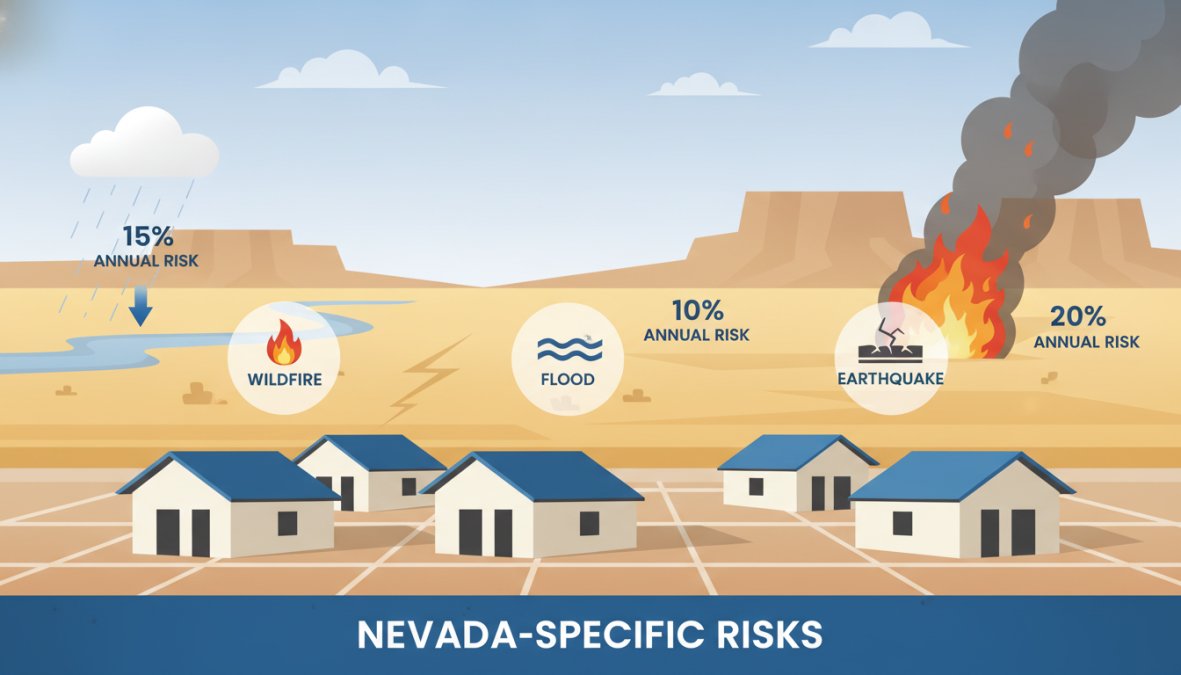
Nevada’s geography creates a risk profile that surprises many first-time homeowners. The state includes dense wildland-urban interface zones, flash flood corridors, and enough seismic activity to make earthquake coverage worth a serious conversation.
Wildfire Risk in Nevada and How It Affects Your Policy
Wildfire risk is concentrated in northern Nevada, near Reno, Sparks, and communities bordering Lake Tahoe, but dry conditions and seasonal winds create fire conditions statewide during summer months. Carriers in high-risk zones may apply higher fire-specific deductibles, restrict coverage for certain construction types, or decline to renew policies entirely. According to the Insurance Information Institute’s wildfire resource center, homeowners in wildfire-prone areas should review dwelling coverage annually to ensure it reflects current rebuilding costs, which have risen sharply in recent years. Underwriting criteria vary widely between insurers, which is where an independent agent adds real value.
Flash Floods, Sewer Backup, and Sump Pump Failure
Standard homeowners insurance does not cover flood damage, a gap that catches Nevada homeowners off guard, particularly in Las Vegas, where desert topography channels rainfall into fast-moving flash floods. Flood insurance through the National Flood Insurance Program is the primary mechanism for covering these losses. Sewer backup and sump pump failure are separate endorsements covering water damage from inside your home’s drainage system. Sewer backup coverage is relatively inexpensive to add and covers one of the most common and costly water damage claims Nevada homeowners face.
Is Earthquake Insurance Necessary in Nevada?
Standard homeowners policies exclude earthquake damage entirely, and Nevada sits on an active seismic zone with moderate activity recorded regularly across the state. For Las Vegas homeowners the risk is lower but not zero; for Reno and rural northern Nevada homeowners, the case for coverage is considerably stronger. Earthquake policies typically carry deductibles expressed as a percentage of dwelling coverage rather than a flat dollar amount, factor that into your cost-benefit calculation before deciding.
HOA-Specific Insurance Requirements for Nevada Homeowners
If you own a condo or home within a homeowners association, your insurance situation is more complex than a standard single-family home. HOA master policies cover the building’s exterior and common areas, but the coverage type matters: a "bare walls in" policy leaves interior fixtures, flooring, and improvements as your responsibility, while an "all-in" policy covers those elements. The difference determines how much individual dwelling coverage you actually need. Nevada law under NRS 116 governs HOA operations and includes provisions affecting insurance requirements, review your HOA’s CC&Rs and master policy declarations carefully before purchasing your individual policy.
Never assume your HOA’s master policy covers your personal property or liability. Even in “all-in” HOA structures, personal property, loss of use, and liability protection remain the individual homeowner’s responsibility. Gaps here are expensive.
How to Lower Home Insurance Premiums in Nevada
The most effective approach is to shop the market rather than accept your renewal quote passively. Carriers adjust underwriting criteria and pricing regularly, and the most competitive carrier three years ago may not be today.
Discounts to Ask Your Insurer About
- Multi-policy discount: Bundling home and auto typically generates the largest single discount available.
- Claim-free discount: No claims in the past three to five years often qualifies for preferred pricing.
- New home discount: Recently constructed homes with modern systems qualify for lower rates.
- Security system discount: Monitored alarm systems, deadbolts, and smoke detectors reduce your risk profile.
- Loyalty discount: Some carriers reward long-term policyholders, though weigh this against shopping the market.
- Paperless billing discount: A small but easy discount available from most carriers.
Wildfire Mitigation Steps That Can Reduce Your Premium
Carriers increasingly offer premium reductions for documented wildfire mitigation work in higher-risk zones. Steps that may qualify include:
- Creating a defensible space of at least 30 feet by removing dead vegetation
- Installing ember-resistant vents and non-combustible roofing materials
- Replacing wood decking with composite or concrete alternatives
- Clearing gutters and roof valleys of debris
Document every step with photographs and receipts. Some carriers require a formal inspection through programs aligned with the Insurance Institute for Business and Home Safety’s Wildfire Prepared Home standard. That documentation can unlock meaningful premium reductions and, in some markets, makes the difference between getting coverage and being declined.
How to Choose the Best Home Insurance Companies for Nevada
Choosing the best home insurance companies for nevada comes down to matching your specific risk profile to the right carrier’s underwriting criteria. Use this checklist before making a final decision:
- Confirm the carrier writes policies in your specific Nevada ZIP code
- Verify dwelling coverage reflects current local rebuilding costs, not purchase price
- Check whether flood insurance is needed separately based on your FEMA flood map zone
- Ask about earthquake endorsements if you’re in northern Nevada
- Review HOA master policy type before setting individual dwelling coverage limits
- Compare deductibles, including any separate wildfire or wind deductibles
- Confirm personal property coverage type (actual cash value vs. replacement cost)
- Ask about all applicable discounts before accepting the quoted premium
What to Do After a Disaster: Nevada Claims Process Overview
Understanding the claims process before a disaster means you move faster when it counts.
- Document the damage immediately. Photograph and video everything before any cleanup or temporary repairs.
- Notify your insurer promptly. Most policies require reporting within a specific timeframe; delayed notification can reduce your settlement.
- Prevent further damage. Take reasonable steps to prevent additional loss and keep receipts for emergency expenses.
- Work with the assigned adjuster. You have the right to get independent repair estimates.
- Understand your loss of use coverage. Know your policy limits for temporary housing before you need them.
- Review the settlement offer carefully. If it doesn’t cover documented losses, you can dispute it. Nevada’s Division of Insurance handles consumer complaints under NRS 686A.700 and provides mediation resources, a tool many homeowners don’t know exists until after a frustrating settlement experience.
Conclusion
Nevada homeowners face a complex insurance environment: wildfire exposure, flash flood risk, earthquake activity, and HOA-specific coverage gaps all require more than a quick online quote to navigate. United Family Insurance takes that complexity off your plate by comparing the market on your behalf, matching your property’s risk profile to the right carrier rather than defaulting to a single option. With expert agent guidance, a user-friendly claims platform, and the potential to save significantly on your annual premium, getting a quote from United Family Insurance is the most efficient first step a Nevada homeowner can take.
Frequently Asked Questions
How much is home insurance in Nevada on average?
Home insurance costs in Nevada vary based on location, home value, coverage limits, and risk factors like wildfire proximity. Las Vegas and other urban areas tend to have different rate profiles than rural or high-elevation zones near Lake Tahoe. The best way to find an accurate figure for your specific home is to compare multiple quotes side by side, which an independent agent or a market-comparison service like United Family Insurance can do on your behalf.
Is home insurance required in Nevada?
Nevada law does not legally require homeowners insurance. However, if you have a mortgage, your lender will almost certainly require you to carry at least a standard homeowners policy with dwelling coverage to protect their financial interest in the property. Additionally, HOA communities in Nevada may impose their own insurance requirements on top of any lender mandates, making coverage practically necessary for most Nevada homeowners.
Does standard Nevada home insurance cover flood damage from flash floods?
No. Standard homeowners insurance policies in Nevada, as in all U.S. states, exclude flood damage, including damage from flash floods, which are a notable risk in areas like Las Vegas. To cover flood-related losses, you need a separate flood insurance policy, typically through the National Flood Insurance Program (NFIP) or a private flood insurer. Sewer backup and sump pump failure coverage are also separate add-ons worth considering for Nevada homeowners.
Is earthquake insurance necessary in Nevada?
Nevada sits in a seismically active region, making earthquake insurance worth serious consideration. Standard homeowners policies exclude earthquake damage. While major quakes are less frequent than in California, Nevada does experience seismic activity, and repair costs after even a moderate earthquake can be substantial. Homeowners near fault lines or in northern Nevada should weigh the cost of a separate earthquake endorsement or standalone policy against their potential out-of-pocket exposure.
How can I lower my home insurance premiums in Nevada?
Several strategies can help reduce your annual premium in Nevada: bundle your home and auto policies for a multi-policy discount, raise your deductible if you can absorb a higher out-of-pocket cost, maintain a strong credit-based insurance score, install security systems or fire-resistant roofing, and take wildfire mitigation steps like clearing defensible space. Working with an independent agent who can compare multiple carriers ensures you find the most competitive rate for your specific risk profile.
Get a quote from United Family Insurance today and let our agents find the coverage that actually fits your home, your location, and your budget.