

Table of Contents
- Why Older Homes Cost More to Insure
- Step 1: Shop Around for Competitive Quotes from Multiple Carriers
- Step 2: Upgrade Electrical Wiring for Home Insurance Savings
- Step 3: Does a New Roof Lower Home Insurance Premiums?
- Step 4: How to Get a Wind Mitigation Inspection
- Step 5: Understand Replacement Cost vs. Market Value in Your Policy
- Step 6: Increase Your Deductible Strategically
- Step 7: Bundle Home and Auto Policies for Multi-Policy Discounts
Last Updated: July 9, 2026
Older homes carry charm that newer properties lack, but also significantly higher insurance premiums. Insurers view homes built before 1980 as higher-risk due to outdated electrical systems, aging roofs, and deteriorating plumbing. The good news: your age-related premium penalty isn’t permanent. United Family Insurance has helped countless homeowners reduce costs through targeted improvements and strategic policy adjustments. Below, we’ll show you which upgrades insurers reward most, how to negotiate better rates, and which policy changes save money without leaving you underinsured.
Why Older Homes Cost More to Insure
Insurance companies assess risk differently for homes built decades ago. Historical claims data shows older homes file more claims for electrical fires, water damage, and roof failures, prompting higher premiums.
Common Structural Risks Insurers Assess
Underwriters evaluate specific risk factors when pricing older home policies. Knob-and-tube wiring, common in homes built before 1950, presents an active fire hazard that many insurers won’t cover at standard rates. Galvanized steel pipes, standard in pre-1980 homes, corrode and cause slow leaks damaging walls and foundations. Asbestos-containing materials in insulation and pipe wrapping create liability exposure. Wood shake or deteriorating asphalt roofs fail faster than modern materials, leading to water damage claims. Outdated HVAC systems, original plumbing fixtures, and fuse boxes instead of circuit breakers all signal higher claims risk.
How Age Affects Your Underwriting and Risk Assessment
When you apply for a home insurance quote, the underwriter flags your property for manual review if built before 1980. They’ll request documentation of electrical upgrades, roof replacement dates, plumbing repairs, and foundation condition. If you can’t provide evidence of modernization, they’ll assume original systems remain and price accordingly. Some insurers simply decline homes with certain combinations of risk factors, knob-and-tube wiring plus an original roof is an automatic decline at many carriers.
Older homes without documented upgrades face not just higher premiums, but actual coverage denials. Some insurers won’t quote homes with knob-and-tube wiring at any price. Before shopping rates, verify which carriers will even consider your property.
Step 1: Shop Around for Competitive Quotes from Multiple Carriers
The single biggest mistake older homeowners make is accepting their current insurer’s renewal quote without shopping. Insurance carriers price older homes differently based on their own claims experience. One carrier might decline your home entirely; another might quote it at 40% less than your current insurer.
Gather specific information upfront: exact construction year, square footage, foundation type, roof material and age, electrical system type, last major plumbing upgrade, and claims history from the past five years.
Compare Captive Agents vs. Independent Agents
Captive agents represent a single insurance company and can negotiate exceptions for older homes, but can only quote one carrier. Independent agents represent multiple carriers and can shop your home across their entire panel in one conversation. For older homes, this matters significantly, an independent agent knows which carriers are most competitive for pre-1980 homes.
United Family Insurance compares the market on your behalf, which is especially valuable for older homes where underwriting variation is extreme. Rather than calling five different agents, you provide your information once and our agents present you with the most competitive options.
What Information to Gather Before Requesting Quotes
Compile this documentation before contacting any agent:
- Exact year of construction
- Square footage
- Foundation type and condition
- Roof material, approximate age, and last replacement date
- Electrical system type
- Plumbing material
- Number of bathrooms and kitchens
- HVAC system type and age
- Any additions or renovations with dates
- Claims history for the past five years
- Current coverage limits and deductible
- Security measures: alarm systems, deadbolts, fire extinguishers
Request quotes from at least three different carriers. For older homes in Las Vegas, rate variation between carriers can exceed 50% for identical coverage. One hour of shopping can save hundreds annually.
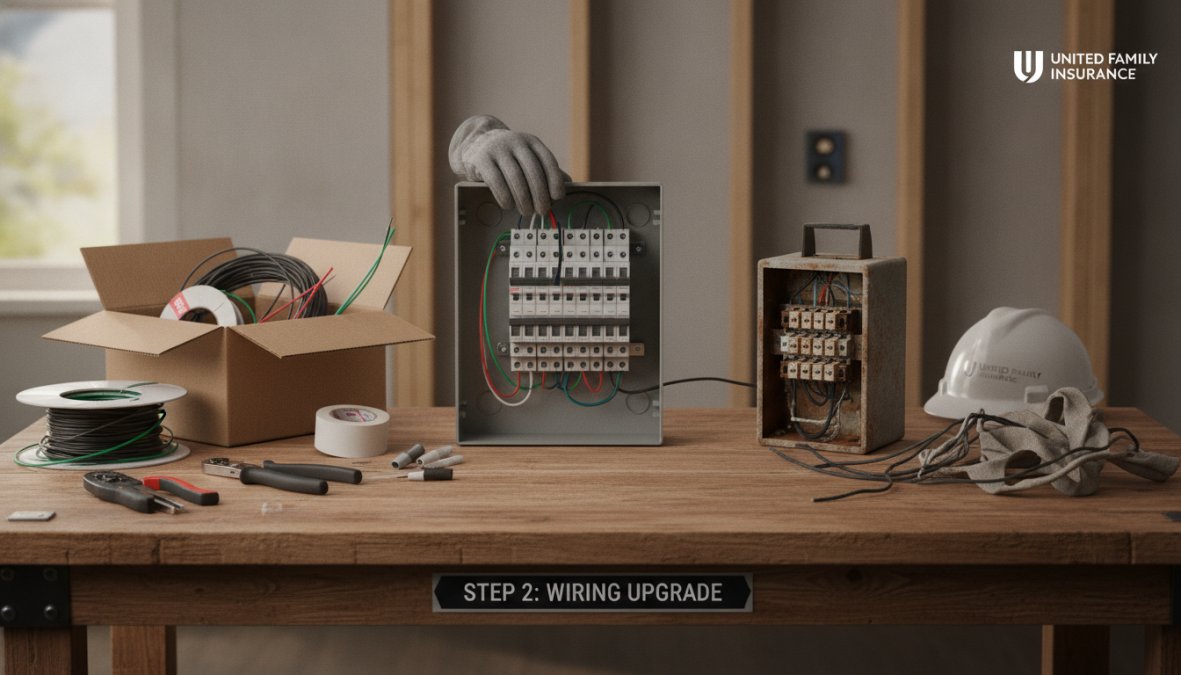
Step 2: Upgrade Electrical Wiring for Home Insurance Savings
Electrical wiring is the single most expensive upgrade that insurers reward. It’s also one of the most consequential for safety.
Knob-and-Tube Wiring: Why Insurers Penalize It
Knob-and-tube wiring, installed in most homes built before 1950, consists of individual copper wires supported by ceramic knobs and run through ceramic tubes. When amperage exceeds the wire’s capacity, insulation degrades and creates fire risk. Many carriers won’t quote homes with knob-and-tube at all. Those that do charge premiums 20-40% higher than for homes with modern wiring. Upgrading from knob-and-tube to modern romex wiring typically costs $8,000-$15,000 but generates premium savings of $300-$600 annually.
Modern Upgrades That Lower Premiums
Complete replacement of knob-and-tube systems satisfies insurers and applies standard rates. Adding a modern circuit breaker panel (if you still have a fuse box) provides a modest 5-10% discount.
Step 3: Does a New Roof Lower Home Insurance Premiums?
Your roof is your home’s first defense against weather and the single most common source of insurance claims on older homes. A new roof qualifies for premium discounts at virtually every carrier, but the discount depends on the roof material and proper certification.
Roof Certification and Wind Mitigation
A new roof alone doesn’t automatically lower your premium. You need a roof certification from a licensed roofing contractor or inspector stating the roof’s material, installation date, and expected lifespan. Wind mitigation inspections document how well your roof resists high winds by examining roof fastening patterns, overhang bracing, and sealing. A home with superior wind resistance qualifies for wind mitigation discounts reaching 15-20%.
Materials That Qualify for Discounts
Asphalt composition shingles qualify for standard new-roof discounts of 5-10%. Metal roofs, impact-resistant shingles, and tile roofs qualify for larger discounts of 10-15% because they resist wind and hail damage better. If you’re replacing your roof anyway, choosing an impact-resistant material makes financial sense. A metal roof costs 20-30% more than asphalt but generates larger insurance discounts and lasts 50+ years versus 20-25 years for composition shingles.
Older homes with wood shake roofs face particular challenges. Many insurers won’t quote homes with wood shake roofs due to fire risk. Replacing it with composition shingles or metal is a prerequisite for getting insured.
A new roof is one of the few upgrades that generates immediate, substantial insurance discounts. If your roof is 20+ years old, replacing it pays for itself partly through insurance savings.
Step 4: How to Get a Wind Mitigation Inspection
Wind mitigation inspections document how well your home resists wind damage. They’re particularly valuable in Las Vegas, where rare but intense windstorms can cause significant damage.
What Inspectors Evaluate and Document
Wind mitigation inspectors examine your roof’s fastening pattern, roof-to-wall connections, soffit and fascia bracing, and gable end bracing. They evaluate window and door strength and document your home’s overall structural integrity: foundation condition, wall bracing, and whether the home sits on piers or a slab. The inspection takes 2-3 hours and produces a detailed report with photographs and ratings for each component.
Using Inspection Results to Negotiate Lower Rates
Once you have a wind mitigation report, provide it to your insurance carrier immediately. The carrier’s underwriter will review the report and apply applicable discounts to your renewal quote. If your current carrier doesn’t offer meaningful discounts, use it when shopping quotes with other carriers. Some carriers offer 10-15% discounts for homes with strong wind mitigation ratings. The inspection typically costs $150-$300, and the premium savings often exceed that cost in a single year.
Step 5: Understand Replacement Cost vs. Market Value in Your Policy
Your policy’s coverage limits determine how much the insurer will pay if your home is destroyed. Two different calculation methods exist, producing dramatically different payouts for older homes.
The Actual Cash Value Trap for Older Homes
Actual Cash Value (ACV) means the insurer pays the replacement cost minus depreciation. For a 50-year-old home, depreciation is substantial. If your home would cost $400,000 to rebuild today but the insurer applies 50% depreciation due to age, they pay you $200,000. That won’t actually rebuild your home.
How Rebuilding Costs Affect Your Coverage and Premiums
Replacement Cost Value (RCV) means the insurer pays whatever it actually costs to rebuild your home, without depreciation deduction. For a $400,000 rebuild, you get $400,000, even if your home is 80 years old. RCV coverage costs 15-25% more than ACV but is the only way to be properly insured.
For older homes, RCV is essential. A charming 1920s home might sell for $350,000 but cost $500,000 to rebuild to the same standard. ACV coverage would leave you $150,000+ short. When shopping insurance quotes, always request RCV quotes, not ACV.
Never accept ACV coverage on an older home. The depreciation penalty is severe, and you’ll be underinsured. Demand RCV coverage, even if it costs more.
Step 6: Increase Your Deductible Strategically
Your deductible is the amount you pay out of pocket before insurance kicks in. Higher deductibles lower your premium. For older homes already paying elevated rates, raising your deductible can generate meaningful savings.
Finding the Right Deductible Balance for Older Homes
Standard deductibles are $500 or $1,000. Raising to $2,500 or $5,000 can reduce your premium by 15-25%, depending on your carrier. If raising your deductible from $1,000 to $2,500 saves you $200 annually, you break even after 7.5 years of claims-free operation.
The risk is that you must have cash reserves to cover your deductible if a claim occurs. A reasonable approach for older homeowners is to raise your deductible to the highest amount you can comfortably pay out of pocket, usually $2,500 for most households.
Step 7: Bundle Home and Auto Policies for Multi-Policy Discounts
Bundling your home and auto insurance with the same carrier generates discounts that can reduce your total insurance costs by 15-25%. For older homeowners already paying elevated home insurance rates, bundling can meaningfully offset those costs.
Comparing Bundled Insurance Rates Across Carriers
When shopping quotes, always request bundled rates, not home-only quotes. A carrier that quotes you $1,800 for home insurance alone might offer you home plus auto for $2,400 combined, a $600 discount on the auto policy that makes the overall package competitive. Independent agents can compare bundled rates across carriers simultaneously, making it easy to see which carrier offers the best overall package.
| Strategy | Premium Impact | Implementation Time | Best For |
|---|---|---|---|
| Shop multiple carriers | Save 20-40% | 2-3 hours | All older homeowners |
| Upgrade electrical wiring | Save $300-600/year | 2-4 weeks | Homes with knob-and-tube |
| New roof + certification | Save 5-15% | 2-4 months | Roofs 20+ years old |
| Wind mitigation inspection | Save 10-15% | 1 week | Homes in wind-prone areas |
| Switch to RCV coverage | Higher premium, proper coverage | Immediate | All older homeowners |
| Raise deductible to $2,500 | Save 15-20% | Immediate | Homeowners with emergency funds |
| Bundle home and auto | Save 15-25% combined | 1-2 weeks | Homeowners with both policies |
Applying These Strategies in Las Vegas
Las Vegas homeowners face specific insurance challenges that older homes amplify. The region’s intense summer heat stresses aging HVAC systems and electrical wiring. Rare but severe windstorms can cause roof damage on homes with original or aging roofing. Water damage from burst pipes is common in older homes where galvanized plumbing corrodes over decades.
Your insurance carrier’s local claims experience matters. A carrier that insures thousands of older homes in Las Vegas understands the specific risks and may price more competitively than a national carrier with limited local data. Ask agents which carriers have strong presence in Las Vegas and experience with older homes in the area.
Nevada’s FAIR plan (Fair Access to Insurance Requirements) exists as a backstop for homeowners who can’t get coverage in the standard market. If you’re declined by multiple carriers, the FAIR plan provides basic coverage, though at higher cost.
Las Vegas has specific weather risks that affect older homes differently. Ask your agent which upgrades (roof, electrical, wind mitigation) generate the largest discounts with carriers active in your area. Local knowledge matters more than national averages.
Annual Review and Maintenance
Lowering your insurance costs isn’t a one-time project. Annual reviews keep your coverage aligned with your home’s actual condition and your carrier’s current pricing.
Each year before renewal, update your carrier on any improvements you’ve made. A new roof, electrical upgrade, or security system installed during the policy year should trigger a mid-year review and premium adjustment. Also review your coverage limits annually. As your home ages, rebuilding costs may increase due to inflation. If you locked in a $350,000 replacement cost limit five years ago but rebuilding would now cost $450,000, you’re underinsured.
Finally, shop quotes every 2-3 years, even if you’re happy with your current carrier. Insurance markets shift, carriers adjust their underwriting for older homes, and new discounts become available.
Lowering your home insurance costs for older homes requires understanding why insurers charge more and addressing the specific risks they identify. Whether through targeted upgrades like electrical wiring replacement, strategic policy adjustments like switching to replacement cost coverage, or simply shopping multiple carriers, older homeowners have real options for reducing premiums.
United Family Insurance specializes in comparing the market for homeowners with older properties, identifying which carriers offer the best rates for your specific home, and ensuring you’re properly covered without overpaying. Our expert agents save you time by handling the shopping on your behalf and securing protection for your most valuable asset. Get a quote today and discover how much you could save on your older home’s insurance.
Frequently Asked Questions
Why is home insurance more expensive for older homes?
Older homes typically have higher premiums due to outdated electrical wiring, aging plumbing systems, and increased structural risks. Insurers conduct a thorough risk assessment of properties built with materials like knob-and-tube wiring or galvanized pipes, which are more prone to failure. Additionally, older homes may have higher rebuilding costs relative to market value, affecting your policy limits and overall underwriting costs.
Does upgrading electrical and plumbing lower home insurance premiums?
Yes. Modern electrical and plumbing upgrades significantly reduce premiums because they lower fire and water damage risk. Replacing knob-and-tube wiring with modern electrical systems is especially valuable to insurers. Similarly, upgrading galvanized pipes to copper or PEX reduces burst and corrosion risk. Document all upgrades and provide receipts to your insurance carrier, many will apply immediate premium reductions once improvements are verified.
What's the difference between replacement cost and actual cash value for older homes?
Replacement cost covers the full expense to rebuild your home with new materials, regardless of age. Actual cash value (ACV) subtracts depreciation, meaning older homes receive less payout. For older homes, replacement cost coverage is critical, ACV policies can leave significant coverage gaps when rebuilding costs exceed market value. Review your policy limits carefully and ask your insurance carrier about replacement cost endorsements to avoid being underinsured.
Can I get discounts on home insurance for an older home?
Absolutely. Common discounts include bundling home and auto policies for multi-policy discounts, installing security systems or smart home devices, improving your credit-based insurance score, and obtaining a wind mitigation inspection. Specific upgrades like new roofs, electrical rewiring, and plumbing improvements can also qualify for premium reductions. Shop around with multiple carriers, different insurers weight these factors differently, so your best rate may vary by company.