
Table of Contents
- Is Flood Insurance Worth It in Las Vegas? The Short Answer
- Understanding Flood Risk in Las Vegas: Topography and Flash Flood History
- Does Your Homeowners Insurance Cover Floods in Las Vegas?
- Las Vegas Flood Zone Map: Identifying Your Risk Level
- Cost of Flood Insurance in Las Vegas: What You’ll Actually Pay
- How the National Flood Insurance Program Works in Nevada
- Common Myths About Flood Insurance in Las Vegas
- Making the Decision: Is Flood Insurance Worth It for Your Las Vegas Home?
Last Updated: July 6, 2026
Is Flood Insurance Worth It in Las Vegas? The Short Answer
Whether is flood insurance worth it in Las Vegas depends on your location, property value, and risk tolerance. For properties in high-risk flood zones or those with mortgages in flood-prone areas, flood insurance is essential and often legally required. For low-risk properties, it becomes a personal financial decision weighing potential catastrophic loss against annual premiums. Standard homeowners insurance does not cover flood damage, leaving many Las Vegas residents exposed during monsoon season and flash flood events.
Las Vegas experiences unique flood risks that many residents underestimate. The city sits in a valley with limited natural drainage, and summer monsoon season (June through September) brings intense, localized downpours that overwhelm storm systems. In 2023, parts of the valley experienced flash flooding causing millions in damage. This guide will help you determine whether flood insurance makes financial sense for your home and explain how to assess your personal flood risk.
Understanding Flood Risk in Las Vegas: Topography and Flash Flood History
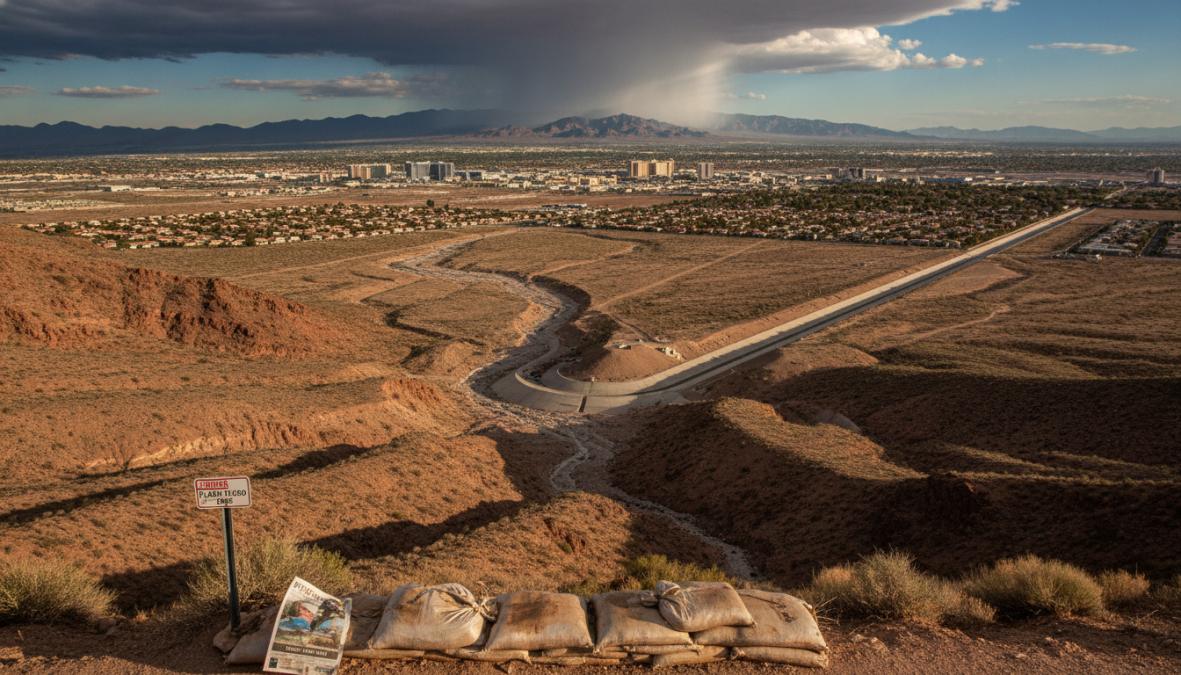
Las Vegas’s geography creates surprising flood vulnerabilities despite the desert climate. The city sits in a basin surrounded by mountains that channel water toward developed areas during heavy rains. Flash floods can occur within minutes of intense precipitation, leaving residents little time to prepare.
The Clark County Regional Flood Control District manages an extensive network of channels and detention basins, but these systems have limits. During monsoon season, afternoon thunderstorms can drop several inches of rain in less than an hour. Neighborhoods near washes, the dry riverbeds crisscrossing the valley, face particular risk. Historical events include the 1999 flood that damaged over 2,000 properties and the 2023 monsoon storms that caught many homeowners off guard.
What makes Las Vegas flooding especially dangerous is its unpredictability. A neighborhood might go years without significant water damage, then experience catastrophic flooding from a single storm cell. This creates false security among residents who’ve lived through dry years without incident.
Does Your Homeowners Insurance Cover Floods in Las Vegas?
The answer is no. Standard homeowners insurance policies explicitly exclude flood damage, regardless of how your policy is written. Flood coverage must be purchased separately through the National Flood Insurance Program or private flood insurance providers.
This distinction matters enormously. Homeowners often discover too late that water damage from flooding is not covered. If you have a mortgage on your property in a designated flood zone, your lender will require flood insurance before closing. Even if you own your home outright, the financial risk of uninsured flood damage can be devastating.
A single flood event can cost $30,000 to $100,000+ in repairs and restoration. Without flood insurance, you absorb this entire cost yourself.
The gap between what homeowners think is covered and what actually is covered represents one of the biggest insurance blind spots in Las Vegas.
Las Vegas Flood Zone Map: Identifying Your Risk Level
The Federal Emergency Management Agency (FEMA) designates flood zones based on statistical risk. Understanding your zone is the first step in determining whether flood insurance makes sense for you.
High-Risk Zones (Special Flood Hazard Areas): These areas have a 1% annual chance of flooding, often called the "100-year flood zone." Properties here face significant exposure and must carry flood insurance if they have federally backed mortgages. Over a 30-year mortgage, the statistical probability of at least one flood event is roughly 26%.
Moderate-Risk Zones (0.2% to 1% annual chance): These areas have lower but still meaningful flood probability. Some lenders require flood insurance; others don’t. The decision becomes more discretionary.
Low-Risk Zones (less than 0.2% annual chance): These areas face minimal statistical flood risk. Flood insurance is optional and often economically difficult to justify based on pure probability.
To find your flood zone, visit the FEMA Flood Map Service Center and enter your address. Many Las Vegas neighborhoods have mixed zones, with some properties in high-risk areas while nearby homes sit in low-risk zones.
Request an elevation certificate from a surveyor if you’re in a moderate-risk zone. This document can lower your insurance premiums significantly.
Cost of Flood Insurance in Las Vegas: What You’ll Actually Pay
Flood insurance premiums in Las Vegas vary dramatically based on risk zone, property elevation, and coverage amounts. For high-risk zones, annual premiums typically range from $1,200 to $3,500+ depending on elevation. Moderate-risk properties pay $300-$800 per year. Low-risk properties might pay $150-$400 annually.
| Risk Zone | Typical Annual Premium | Coverage Limit | Deductible |
|---|---|---|---|
| High-Risk (1% chance) | $1,200-$3,500 | $250,000 structure / $100,000 contents | $1,000-$5,000 |
| Moderate-Risk (0.2%-1%) | $300-$800 | $250,000 structure / $100,000 contents | $500-$1,500 |
| Low-Risk (below 0.2%) | $150-$400 | $250,000 structure / $100,000 contents | $250-$500 |
A critical detail: flood insurance policies include a 30-day waiting period. Coverage does not begin until 30 days after purchase. You cannot wait for a storm forecast to buy a policy; coverage must be continuous.
How the National Flood Insurance Program Works in Nevada
The National Flood Insurance Program (NFIP), administered by FEMA, is the primary flood insurance provider in Nevada. The NFIP operates as a federally backed insurance pool, providing stability since the federal government ultimately backs policies. Rates are set by federal formula rather than competitive market forces.
NFIP policies cover structural damage to your home and personal property inside it. Coverage limits max out at $250,000 for the structure and $100,000 for contents. The program does not cover pools, decks, landscaping, detached garages, or items in basements in most cases.
The NFIP is reliable and widely available, but it’s not a complete solution for high-value homes. Many Las Vegas residents combine NFIP coverage with private flood insurance for comprehensive protection.
Private flood insurance has become increasingly available in Nevada since 2016. These policies sometimes offer better rates for low-risk properties or higher limits, but private insurers are more selective about which properties they’ll cover.
Common Myths About Flood Insurance in Las Vegas
Myth 1: "I live in the desert, so flooding isn’t a real risk." Las Vegas receives most annual precipitation during monsoon season in just a few months. When storms hit, dry ground cannot absorb water quickly, and urban development limits natural drainage. Flash flooding is absolutely a real risk.
Myth 2: "My homeowners insurance covers flood damage." This is false. Homeowners insurance explicitly excludes flood.
Myth 3: "Flood insurance is too expensive to be worth it." For a $500,000 home in a high-risk zone, a $2,000 annual premium represents 0.4% of property value, reasonable insurance against a $50,000-$100,000+ potential loss.
Myth 4: "I can wait to buy flood insurance until a storm is forecast." Policies include a 30-day waiting period. Coverage must be continuous.
Myth 5: "Flood insurance will cover everything if my home floods." Coverage has limits, exclusions, and deductibles. Supplemental coverage may be necessary for high-value homes.
Making the Decision: Is Flood Insurance Worth It for Your Las Vegas Home?
The decision involves three key factors: your flood zone, property value, and financial capacity to absorb a loss.
For high-risk zone properties: Flood insurance is almost always worth it. Your annual probability of flooding is 1%, and potential loss is catastrophic. Most lenders require it anyway. The cost of premiums is far lower than the expected value of potential flood damage.
For moderate-risk zone properties: The calculation becomes more nuanced. A $400 annual premium on a property with a potential $75,000 flood loss represents reasonable insurance. However, if you have substantial savings and can absorb a flood loss without financial hardship, you might choose to self-insure.
For low-risk zone properties: The economic case for flood insurance weakens significantly. A $200 annual premium on a property with minimal historical flood risk requires high loss probability to justify mathematically. However, some homeowners still carry policies for catastrophic risk protection.
Consider your neighborhood’s specific history. Some Las Vegas neighborhoods have experienced multiple flood events while statistically similar areas nearby have remained dry. Talk to longtime neighbors and check Clark County Regional Flood Control District records for your specific area.
Flood risk in Las Vegas is real but manageable with proper information and planning. Whether flood insurance is worth it depends on your specific circumstances, but the cost of being wrong, facing a catastrophic loss with no insurance, is too high for most homeowners. If you’re in a high-risk zone or have significant equity in your home, flood insurance is essential. If you’re uncertain about your flood risk or coverage options, consult with an insurance professional who can review your specific property and neighborhood.
Frequently Asked Questions
Does standard homeowners insurance cover flood damage in Las Vegas?
No. Standard homeowners insurance policies explicitly exclude rising water and flood damage. To protect against floods in Las Vegas, you need a separate flood insurance policy through the National Flood Insurance Program (NFIP) or a private insurer. Even if you live in a low-risk area, a single flash flood event could result in thousands of dollars in uninsured losses. Homeowners insurance covers water damage from burst pipes or roof leaks, but not from external flooding.
How much does flood insurance cost in Las Vegas?
Flood insurance costs in Las Vegas vary significantly based on your property's flood zone designation, elevation, and coverage limits. High-risk properties in FEMA flood zones typically pay $800-$2,000+ annually, while moderate-risk and low-risk properties may pay $200-$600 per year. Your deductible choice and the age of your home also affect premiums. Getting quotes from multiple insurers through United Family Insurance can help you compare rates and find affordable coverage tailored to your specific risk level.
Is flood insurance required in Las Vegas?
Flood insurance is required only if you have a federally backed mortgage on a property in a high-risk flood zone (FEMA Special Flood Hazard Area). However, even if it's not required, flood insurance may be worth it in Las Vegas due to the region's flash flood history and monsoon season risks. The Clark County Regional Flood Control District manages drainage, but catastrophic events can still overwhelm infrastructure. Lenders in moderate and low-risk zones may not require it, but it remains a valuable safety net.
What is the difference between FEMA flood zones and actual flood risk in Las Vegas?
FEMA flood zones are based on historical data and modeling, but they don't always reflect current risk or local geography. Las Vegas's monsoon season, rapid urban development, and desert topography create flash flood risks that may not align perfectly with FEMA maps. The Clark County Regional Flood Control District provides additional local risk assessments. Even properties in low-risk FEMA zones can experience significant water damage from intense monsoons. Consulting a local insurance agent and checking both FEMA and county flood maps gives you the most accurate picture of your property's true exposure.
How do I check if my Las Vegas property is in a flood zone?
You can check your flood zone status using the FEMA Flood Map Service Center online by entering your address. The Clark County Regional Flood Control District also provides local flood risk information and maps. Your property's flood zone designation determines whether flood insurance is required by your lender and affects your premium. An elevation certificate from a surveyor provides additional detail about your home's height relative to flood levels. United Family Insurance agents can help you interpret these maps and determine the right coverage for your specific location.