

Table of Contents
- How to File a Home Insurance Claim: The Step-by-Step Process
- How to Document Home Damage for Insurance: What You Need
- Understanding the Home Insurance Claim Process Timeline
- What to Expect From Your Claims Adjuster
- Should I Hire a Public Adjuster for My Home Insurance Claim?
- Common Home Insurance Claim Denial Reasons, And How to Appeal
- Will Filing a Home Insurance Claim Raise Your Premium?
- Conclusion: Filing Your Home Insurance Claim With Confidence
Last Updated: June 17, 2026
Knowing how to file a home insurance claim correctly can mean the difference between a full settlement and a frustrating denial. This guide from United Family Insurance walks Las Vegas homeowners through every step of the claims process, from the moment damage occurs to the day your settlement check arrives. We cover what adjusters look for, how to appeal a denial, and whether hiring a public adjuster is worth it.
Documentation, timing, and communication are the three variables that most directly influence your settlement outcome. Get those right, and the process moves in your favor.
How to File a Home Insurance Claim: The Step-by-Step Process
Filing a home insurance claim is the formal process by which a policyholder notifies their insurance carrier of a covered loss and requests financial compensation under their homeowners insurance policy. The process begins the moment damage occurs and concludes with a settlement payment or denial letter.
Total Time: 1-4 weeks depending on claim complexity
Difficulty: Beginner to Intermediate
Step 1: Ensure Safety and Prevent Further Damage
Your first obligation after a covered loss is to ensure everyone in the home is safe. Once confirmed, your policy requires you to take reasonable steps to prevent further damage, a condition called mitigation. If a storm blows out a window and you leave it open, the resulting water damage may not be covered.
Practical mitigation steps include:
- Covering broken windows or roof openings with tarps
- Shutting off the main water supply if a pipe has burst
- Moving undamaged belongings away from the affected area
- Boarding up structural openings to prevent vandalism or weather intrusion
Keep receipts for every temporary repair, these expenses are typically reimbursable. According to the Insurance Information Institute on protecting your home after a disaster, policyholders who document emergency mitigation costs recover them at significantly higher rates than those who don’t.
Do NOT make permanent repairs before your claims adjuster has inspected the damage. Doing so can give the insurance carrier grounds to dispute the cause or extent of the loss, putting your entire claim at risk.
Step 2: Contact Your Insurance Agent or Carrier
Call your insurance agent or the carrier’s claims line as soon as possible. Most policies require prompt notification, and delayed reporting can complicate your claim if damage worsens in the interim.
When you call, have the following ready:
- Your policy number
- The date and time the incident occurred
- A brief description of what happened (fire, water damage, vandalism, etc.)
- Your contact information and the best time to reach you
Your agent will initiate the claim or direct you to the carrier’s claims department. Either way, the clock starts here.
Step 3: File the Claim and Get Your Claim Number
Once you’ve reported the loss, the carrier assigns a claim number, write it down immediately, as it’s the reference point for every subsequent communication. You’ll also be asked to complete a proof of loss form: a sworn statement detailing the incident, the property damaged, and the estimated value of the loss. Complete it accurately and thoroughly. Errors or omissions are one of the most common reasons claims are delayed.
How to Document Home Damage for Insurance: What You Need
Thorough documentation is the single most important thing a homeowner can do to protect their claim. The goal is to create an undeniable record of the damage before anything is moved, cleaned, or repaired.
Walk through the entire affected area and capture every angle with photos and video. Don’t just photograph the obvious damage, photograph the surrounding context as well.
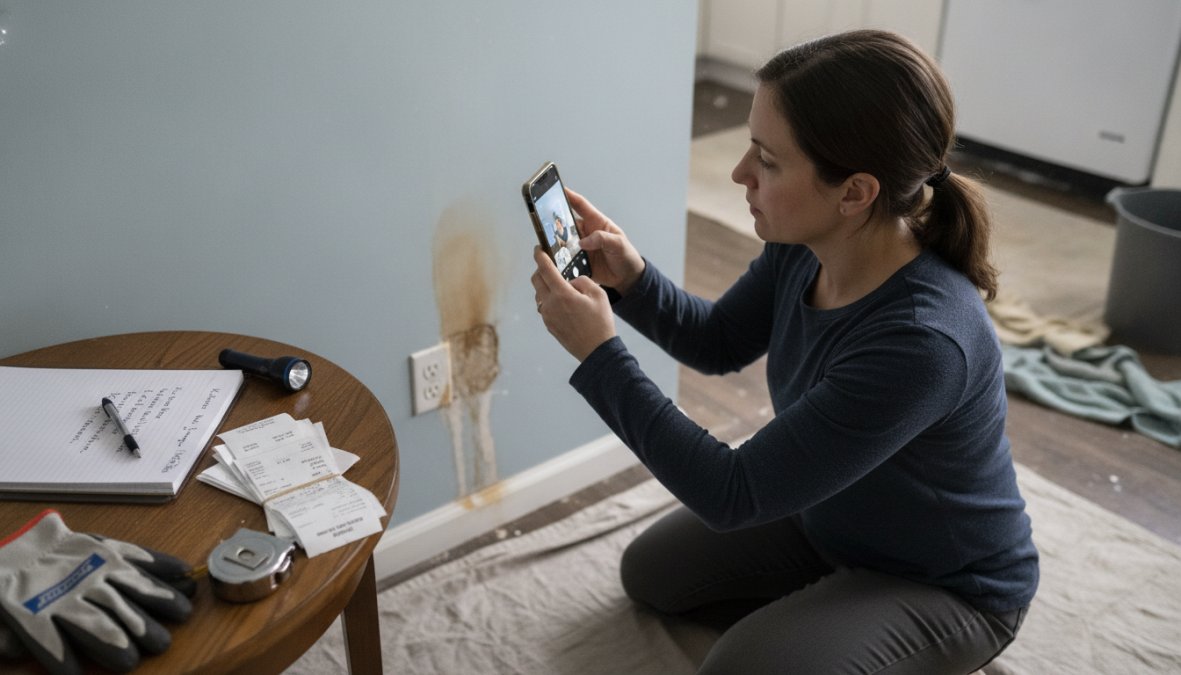
Your documentation package should include:
- Photos and video of all damaged areas, taken before any cleanup
- A written inventory of damaged or destroyed personal property, including descriptions, approximate age, and estimated replacement cost
- Receipts, credit card statements, or bank records establishing what you paid for items
- Contractor estimates for structural damage repair
- An incident report if the damage involved a crime or emergency services
The more specific your documentation, the harder it is for an adjuster to dispute your claim.
Using a Home Inventory Template to Strengthen Your Claim
A home inventory is a pre-loss record of your belongings. Homeowners who maintain one typically receive faster, more complete settlements because they can prove ownership and value without reconstructing records from memory.
Use this basic template for each room:
| Item | Description | Purchase Year | Estimated Value | Receipt/Proof |
|---|---|---|---|---|
| Living room TV | 65" OLED, Brand X | 2023 | $1,200 | Credit card statement |
| Sectional sofa | Gray fabric, Brand Y | 2022 | $1,800 | Original receipt |
| Area rug | 8×10, wool | 2021 | $400 | None |
Store your inventory in a cloud service so it survives even if the home is destroyed. The NAIC consumer guidance on home inventories recommends updating it annually and after any major purchase.
Video walkthroughs of your home, narrated room by room, are one of the most effective inventory formats. They’re harder to dispute than a spreadsheet and take less than 30 minutes to create.
Understanding the Home Insurance Claim Process Timeline
The home insurance claim process timeline varies based on claim complexity, the carrier, and how quickly the policyholder provides documentation. Most straightforward claims resolve within 30 to 60 days; complex claims involving structural damage or disputes can stretch to 90 days or longer.
Here’s a general timeline of what to expect:
- Day 1-3: Report the loss, receive your claim number
- Day 3-10: Claims adjuster is assigned and contacts you to schedule an inspection
- Day 7-14: Adjuster inspects the property and prepares their assessment
- Day 14-21: Carrier reviews the adjuster’s report and issues a coverage decision
- Day 21-45: Settlement offer is made; repairs begin after approval
- Day 30-60: Final payment issued (may be split between ACV and recoverable depreciation)
Nevada law requires insurance carriers to acknowledge a claim within a specific timeframe after receiving notice. If your carrier is unresponsive, the Nevada Division of Insurance handles consumer complaints and can intervene on your behalf.
What to Expect From Your Claims Adjuster
A claims adjuster is a licensed professional employed by or contracted to the insurance carrier to evaluate the scope and cost of your loss. They assess the damage, determine whether the cause is a covered peril, and calculate a repair estimate.
The company adjuster works for the carrier, not for you. Their job is to produce an accurate assessment, but their employer has a financial interest in limiting payouts. Come prepared.
During the inspection:
- Walk the adjuster through all damage personally, don’t let them inspect alone
- Point out damage that may not be immediately visible, such as water intrusion behind walls
- Provide your own documentation and contractor estimates
- Ask for a copy of their report before accepting any settlement
If the adjuster’s estimate differs significantly from your contractor’s, you have the right to dispute it. Most policies include an appraisal clause allowing both parties to appoint independent appraisers to resolve disagreements.
Should I Hire a Public Adjuster for My Home Insurance Claim?
A public adjuster is an independent professional who represents the policyholder, not the carrier, in the claims process. They typically charge 5% to 15% of the final settlement, a fee that can be well worth it if they secure a materially higher payout.

When a public adjuster makes sense:
- Your claim involves significant structural damage
- The carrier has already made a low settlement offer
- You don’t have time to manage documentation and negotiation
- Your claim has been partially denied
When you probably don’t need one:
- The damage is minor and clearly covered
- The carrier’s estimate aligns with your contractor’s
- Your claim is straightforward (a single burst pipe, minor wind damage)
Public adjusters are paid only when you are paid, aligning their incentives with yours. The National Association of Public Insurance Adjusters on choosing a public adjuster maintains a directory of licensed professionals and guidance on vetting credentials.
Common Home Insurance Claim Denial Reasons and How to Appeal
The most common reasons a homeowner insurance claim is denied:
- Excluded peril: The cause of damage isn’t covered (floods, earthquakes, and normal wear and tear are typically excluded from standard homeowners insurance)
- Lapsed policy: The policy was not active at the time of the loss
- Late reporting: The claim was filed outside the policy’s reporting window
- Insufficient documentation: The policyholder couldn’t substantiate the loss
- Failure to mitigate: The homeowner didn’t take reasonable steps to prevent additional damage
If your claim is denied, request the denial in writing with the specific policy language cited. Then:
- Review your policy against the denial reason, carriers sometimes misapply exclusions.
- Gather additional documentation that addresses the denial reason directly.
- File a formal written appeal with your carrier’s claims department.
- Contact the Nevada Division of Insurance if the denial appears improper.
- Consult a public adjuster or insurance attorney for large disputed claims.
A denial is not the end of the road. Many homeowners who appeal with better documentation receive partial or full reversals. The key is to respond in writing and cite specific policy language, not just general disagreement.
Most carriers have a formal internal appeals process. If internal appeals fail, Nevada policyholders can request mediation or file a complaint with the state insurance commissioner.
Will Filing a Home Insurance Claim Raise Your Premium?
Filing a home insurance claim can raise your premium at renewal, depending on the type of claim, your claims history, your carrier’s rating model, and your tenure as a policyholder. Water damage and liability claims tend to trigger larger increases than weather-related claims, which carriers often treat as non-fault events. Filing multiple claims in a short period is the fastest way to see a meaningful rate increase, and can prompt a carrier to non-renew your policy.
This creates a real decision point for smaller losses. If the damage is close to your deductible, paying out of pocket may be smarter. For example, if your deductible is $1,500 and the damage totals $1,800, you’d receive only $300 from the claim. If that triggers a $200 annual premium increase, you’ve broken even in 18 months and paid more over any longer horizon.
This is exactly the kind of analysis the team at United Family Insurance can help Las Vegas homeowners work through before deciding whether to file. The Nevada Division of Insurance consumer resources for homeowners also provides state-specific guidance on how rate increases are regulated and what protections policyholders have at renewal.
Conclusion: Filing Your Home Insurance Claim With Confidence
The claims process rewards preparation. Homeowners who document thoroughly, communicate promptly, and understand their policy terms consistently achieve better outcomes than those who treat the process as an afterthought.
Filing a home insurance claim in Las Vegas or anywhere in Nevada doesn’t have to feel like a fight. United Family Insurance works on your behalf, comparing coverage options across the market to make sure you have the right protection before a loss occurs and the right support when it does. Our expert agents provide clear guidance on policy terms, deductibles, and coverage limits so there are no surprises when you need your policy most. Get a quote from United Family Insurance today and make sure your home is protected by a policy that actually works for you.
Frequently Asked Questions
What is the first step in filing a home insurance claim?
The first step when filing a home insurance claim is to ensure everyone in the home is safe and then take immediate action to prevent further damage, such as covering a broken window or tarping a damaged roof. These temporary repairs are important because most homeowners insurance policies require policyholders to mitigate losses. After securing the property, contact your insurance agent or carrier as soon as possible to report the covered loss and begin the claims process.
How long do you have to file a home insurance claim?
Most homeowners insurance policies require you to file a claim promptly after a covered loss, though specific timeframes vary by insurance carrier and state. In Nevada, it is generally best practice to file within days of the incident rather than weeks. Waiting too long can complicate your claim, as it becomes harder to document the damage accurately and insurers may question whether you took steps to prevent further damage. Always review your policy language or ask your insurance agent about your specific deadline.
Does filing a home insurance claim increase my premiums?
Filing a home insurance claim can raise your premium at renewal, though the impact depends on factors like your claims history, the type and size of the loss, and your insurance carrier's policies. A single small claim may have little effect, while multiple claims in a short period can significantly increase your out-of-pocket expenses over time. For minor damage that falls close to your deductible amount, it may be worth paying out of pocket to avoid a premium increase. Talk to your insurance agent before deciding.
What documents do I need to file a home insurance claim?
When filing a home insurance claim, you will typically need photos and videos of the property damage, a list of damaged or destroyed items with estimated values, receipts or proof of purchase where available, any police or incident report if applicable, and repair estimates from a licensed contractor. Having a home inventory prepared in advance makes this process much faster. Your insurance carrier may also request a completed proof of loss form, so gathering thorough documentation from the start helps avoid delays in your settlement.
What are the most common reasons a home insurance claim is denied?
Common home insurance claim denial reasons include filing for damage caused by excluded perils such as flooding or normal wear and tear, failing to maintain the property, not mitigating further damage after a loss, or submitting a claim after the policy lapsed. Insufficient documentation is another frequent issue. If your claim is denied, you have the right to appeal the decision. Review the denial letter carefully, gather additional evidence, and consider consulting a public adjuster or attorney if the disputed amount is significant.
Should I hire a public adjuster to help with my home insurance claim?
A public adjuster is an independent professional who represents the policyholder, not the insurance carrier, during the claims process. Hiring one can be beneficial for large or complex claims involving significant structural damage, where negotiating a fair settlement requires expertise. Public adjusters typically charge a percentage of the final settlement, so for smaller claims the cost may outweigh the benefit. For straightforward claims, working directly with your insurance agent and a trusted contractor is usually sufficient to reach a fair resolution.