
Last Updated: November 26, 2026
Quick Summary
To get flood insurance in high-risk areas, first confirm your FEMA flood zone code, then compare National Flood Insurance Program and private carrier quotes at matching limits and deductibles. Buy early, because the standard NFIP waiting period is 30 days before coverage takes effect.
- Standard homeowners insurance excludes flood damage, so flood policies are sold separately.
- FEMA’s Flood Map Service Center returns the zone code for a specific address.
- Lenders require flood coverage for federally backed loans on homes in the Special Flood Hazard Area.
- The NFIP caps residential building coverage at $250,000 and contents at $100,000.
- Private flood policies often have waiting periods of 15 days or less, and some offer immediate coverage.
Table of Contents
- Why High-Risk Flood Zones Need Their Own Coverage
- How to Read FEMA Flood Zone Codes Before You Buy
- When a Mortgage Lender Requires Flood Insurance
- National Flood Insurance Program vs. Private Carriers
- How to Get a Flood Insurance Quote Step by Step
- Step 1: Verify the Flood Zone and Property Details
- Step 2: Compare NFIP and Private Options Side by Side
- Step 3: Confirm Coverage, Exclusions, and Limits
- Step 4: Verify Nevada Availability and Carrier Eligibility
- Step 5: Meet the Lender’s Requirements
- Step 6: Plan for the Waiting Period
- Step 7: Review the Quote and Apply
- The Flood Insurance Waiting Period and Effective Date
- Start Your High-Risk Flood Coverage Review
- Frequently Asked Questions
Why High-Risk Flood Zones Need Their Own Coverage
Flood insurance for high-risk areas works differently from standard coverage, and that difference matters most when water reaches your door. One in four flood insurance claims comes from homes outside high-risk flood zones, according to Flood Insurance Guru’s Texas flood insurance analysis.
We help Las Vegas homeowners sort real risk from map labels. Here is the core idea: standard homeowners insurance does not pay for rising water. Flood coverage is a separate policy, and high-risk zones carry their own rules, costs, and lender requirements.
Below, we walk through exactly how to buy that coverage, step by step.
What Standard Homeowners Insurance Leaves Out
Homeowners insurance covers wind, fire, hail, and sudden pipe bursts. It does not cover flooding. That gap surprises a lot of people after a storm.
Nevada’s desert setting makes this easy to forget. But flash flooding in the Las Vegas valley is a real, recurring event, and it does not check a map before it arrives. If you want the full breakdown of what each policy handles, see our guide on homeowners insurance vs flood insurance.
The short version:
- Homeowners policies exclude flood damage
- Flood policies are sold separately
- A mortgage lender may require flood coverage even if you never expected it
Our article on whether flood insurance is included in homeowners insurance covers that gap in more depth.
How to Read FEMA Flood Zone Codes Before You Buy
FEMA flood zone codes tell you how likely flooding is at a specific address, and they drive your coverage requirements and pricing. The riskiest zones sit inside the Special Flood Hazard Area (SFHA), where the annual chance of flooding is at least 1 percent.
Here is how the codes sort out:
| Zone | Risk Level | Flood Insurance Required? |
|---|---|---|
| A, AE, AH, AO | High (SFHA) | Yes, for federally backed loans |
| V, VE | High coastal hazard | Yes, for federally backed loans |
| B, C, X (shaded) | Moderate | No, but recommended |
| X (unshaded) | Minimal | No, but recommended |
How to Check a Las Vegas Address
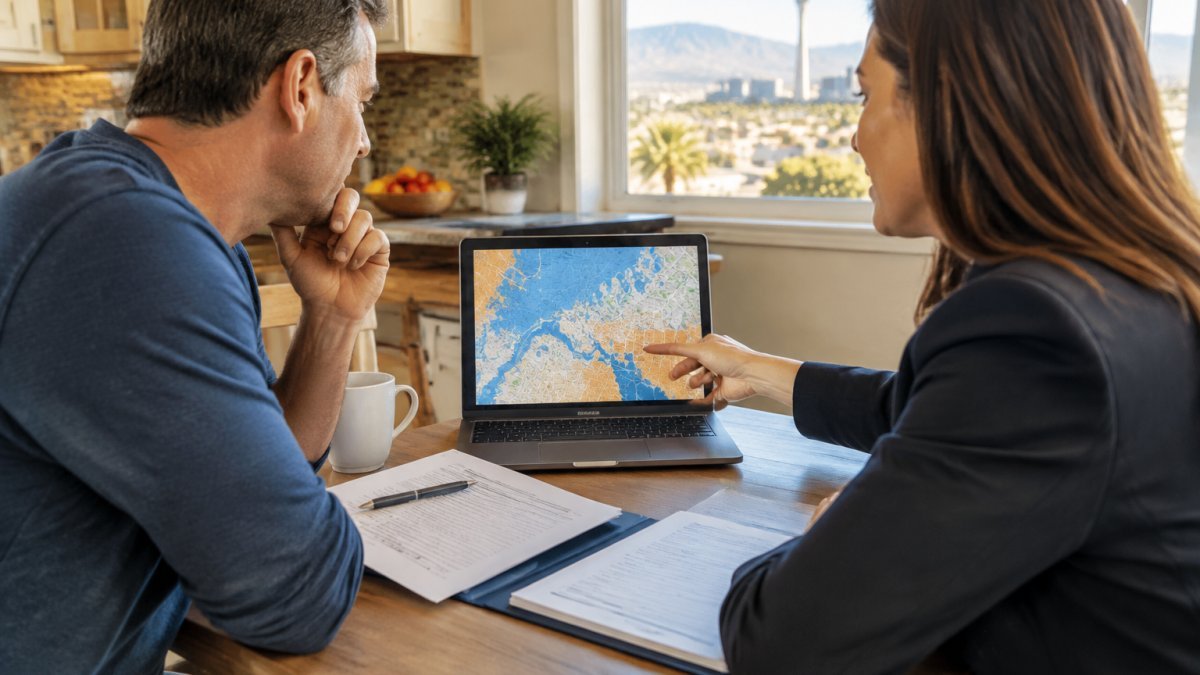
Start with FEMA’s Flood Map Service Center, the official public tool for address-level flood zone lookups. Enter the full street address, and the tool returns the effective FIRM panel, the zone code, and a link to the map.
For Las Vegas properties, two local layers matter as much as the FEMA panel. Clark County’s Regional Flood Control District publishes local flood hazard maps and drainage information that reflect desert storm patterns, intense, short-duration rainfall that can channel water through washes and streets far from a mapped river. The City of Las Vegas and Clark County planning departments also maintain floodplain management contacts who can confirm whether a property has a history of floodplain permits or elevation certificates.
A practical sequence for a Las Vegas address:
- Pull the FEMA zone code from the Flood Map Service Center.
- Cross-check the property against Clark County Regional Flood Control District maps for local wash and drainage exposure.
- Ask the seller or landlord for any elevation certificate, prior flood claims, or floodplain permit history.
- Confirm the effective map date, FEMA periodically revises panels, and a zone change can move a property into or out of the SFHA.
Watch out: a lender’s flood determination and FEMA’s public map can disagree if the lender uses a different map date or a private flood zone determination service. If the results conflict, request the lender’s determination in writing and compare the panel numbers.
High-Risk Codes and the Special Flood Hazard Area
The SFHA is the band of land FEMA expects to flood in a major event. If your home sits inside it, you face two realities: lenders require coverage, and premiums run higher.
But a non-SFHA address is not a free pass. The National Association of Realtors’ flood insurance guidance notes that homes outside high-risk zones can still buy flood insurance.
If you are unsure whether your address sits inside or outside the SFHA, the zone code from the Flood Map Service Center is the starting point, not the final answer.
When a Mortgage Lender Requires Flood Insurance
A mortgage lender requires flood insurance when the property sits in a mapped high-risk zone and the loan is federally backed. This is a legal requirement, not a lender preference.
If your home is in an SFHA and the loan is federally backed, expect the lender to ask for proof of coverage before closing.
What lenders typically want:
- Coverage that matches the loan balance or the maximum available
- A policy in place by closing day
- Proof sent directly to the loan servicer
Watch out: letting a policy lapse can trigger force-placed coverage, which usually costs more than a policy you shop for yourself.
National Flood Insurance Program vs. Private Carriers
You have two main paths to coverage: the National Flood Insurance Program (NFIP) or a private carrier. Each has trade-offs.
The NFIP is the federal program, backed by FEMA and sold through participating insurers. It caps building coverage at $250,000 and contents coverage at $100,000 for residential properties.
Private flood insurance is growing. According to the Insurance Information Institute’s flood insurance facts, 35 percent of purchasers in its cited data bought private coverage, while 43 percent bought through the NFIP.
For a deeper look at local options, explore alternatives to standard flood insurance in Nevada.
How to Get a Flood Insurance Quote Step by Step
Getting a flood insurance quote can be quick once you have your details ready. But for a high-risk property, the quote is only one part of the job. The harder work is confirming that the policy you are quoted actually covers what you need, that the carrier is eligible to write in Nevada, and that the coverage will be active before your lender’s deadline.
Here is the purchase checklist we walk Las Vegas clients through.
Step 1: Verify the Flood Zone and Property Details
Pull your property details, address, build year, square footage, construction type, and foundation type. Then confirm the flood zone from FEMA’s Flood Map Service Center and cross-check local Clark County Regional Flood Control District maps. The zone code drives both eligibility and pricing, so an error here carries through the entire quote.
Step 2: Compare NFIP and Private Options Side by Side
The NFIP is the federal program, backed by FEMA and sold through participating insurers. It caps building coverage at $250,000 and contents coverage at $100,000 for residential properties. Private flood insurance is growing.
For a high-risk property, ask for both quotes at the same coverage limits and deductibles so the comparison is apples to apples. A private quote with a lower premium but a narrower definition of flood can cost more after a claim.
Step 3: Confirm Coverage, Exclusions, and Limits
Before you compare price, confirm what each policy actually covers. Building coverage pays to repair or rebuild the structure; contents coverage pays for belongings. Common exclusions include damage from earth movement, sewer backup unless specifically endorsed, and property outside the insured building.
Watch out: a policy that covers the building but not contents can leave a high-risk homeowner underinsured after a total loss. Ask the agent to show the building limit, contents limit, and deductible for each quote in writing.
Step 4: Verify Nevada Availability and Carrier Eligibility
Private carriers vary, and some limit eligibility by zone, property type, or occupancy. Ask the agent to confirm in writing that the carrier is authorized to write flood coverage for your specific address and that the policy form is approved for use in Nevada.
If standard options are unavailable, an independent agent can check surplus lines carriers and specialty flood markets. A common pattern is that high-risk or nonstandard properties need a surplus lines policy, which may carry different consumer protections than an admitted carrier policy.
Step 5: Meet the Lender’s Requirements
If your loan is federally backed and the property is in an SFHA, the lender will require proof of coverage before closing. Confirm the required coverage amount, the effective date, and where the proof of coverage must be sent. A policy that starts after closing day does not satisfy the lender.
Step 6: Plan for the Waiting Period
Most flood policies do not start the day you buy them. The standard NFIP waiting period is 30 days before coverage takes effect. Private carriers can move faster. Brown & Brown’s flood insurance guide notes that private flood policies often have waiting periods of 15 days or less, and some offer immediate coverage.
Why the delay matters: a policy bought the day before a storm will not pay for that storm. If you are closing on a home in a high-risk zone, start the quote early so coverage is active by your closing date.
Step 7: Review the Quote and Apply
Compare the quotes on total annual premium, deductible, building and contents limits, exclusions, and waiting period, not price alone. Then apply and pay. Keep a copy of the policy declarations page and the proof of coverage sent to your lender.
If you want help estimating costs before you start, read our guide on how to estimate flood insurance costs. For a deeper look at local options, explore alternatives to standard flood insurance in Nevada.
The Flood Insurance Waiting Period and Effective Date
Most flood policies do not start the day you buy them. The standard NFIP waiting period is 30 days before coverage takes effect.
Private carriers can move faster. Brown & Brown’s flood insurance guide notes that private flood policies often have waiting periods of 15 days or less, and some offer immediate coverage.
Why the delay matters: a policy bought the day before a storm will not pay for that storm. Plan ahead.
Start Your High-Risk Flood Coverage Review
High-risk flood coverage is not complicated once you know the steps.
That is where we come in. United Family Insurance compares the market on your behalf, so you see NFIP and private quotes side by side without the legwork.
Las Vegas homeowners can check whether flood coverage is worth it for your home, or call us to start a review.
Flood risk in the Las Vegas valley does not wait for a map to agree. Get a clear read on your exposure and the right policy before the next storm season.
Frequently Asked Questions
Can I get flood insurance if my home is in a high-risk flood zone?
Yes. Homes in high-risk zones, including Special Flood Hazard Areas, can be insured through the National Flood Insurance Program or a private carrier. Coverage limits for both programs are set by the program or carrier; confirm current limits with the agent or FEMA’s official source. An agent can confirm which options your property qualifies for and what documentation the carrier needs.
How long does the flood insurance waiting period last?
Waiting periods vary by program and carrier, so coverage bought today may not pay for a storm next week. Confirm the effective date in writing before you pay.
Does homeowners insurance cover flood damage?
Standard homeowners policies exclude flood damage, which is why separate flood insurance exists. Water that enters from outside, such as rising water, storm surge, or flash flooding, falls under flood coverage. A burst pipe inside the home is usually handled differently. Flood claims can come from homes outside high-risk flood zones, so a low-risk map designation is not proof you are safe.
How do I get a flood insurance quote for a high-risk property?
Start with your address and its FEMA flood zone, then gather the building details: year built, construction type, occupancy, and the elevation certificate if one exists. An agent uses those details to request quotes from NFIP-participating insurers and private carriers. Comparing both routes shows you the coverage limits, deductibles, and waiting periods before you commit.
