

Table of Contents
- What Is General Liability Insurance Coverage?
- What Does General Liability Insurance Cover? The 4 Core Protections
- General Liability Insurance Examples: Real-World Scenarios
- What Does General Liability Insurance Not Cover?
- General Liability vs. Professional Liability: Key Differences
- Who Needs General Liability Insurance? Industry-Specific Risk Profiles
- Certificates of Insurance (COI): What They Are and Why They Matter
- How to File a General Liability Insurance Claim: Step-by-Step
- How to Get General Liability Insurance Coverage in Las Vegas
- Conclusion
Last Updated: May 26, 2026
Understanding what is general liability insurance coverage is one of the most practical steps any business owner can take before opening their doors. At United Family Insurance, we work with Las Vegas business owners every day who discover they were underinsured only after something went wrong. General liability insurance coverage protects your business from third-party claims involving bodily injury, property damage, and personal injury, and without it, a single lawsuit can threaten everything you’ve built. Below, we’ll show you exactly what this coverage includes, what it excludes, and how to make sure your policy actually fits your risk.
Most guides stop at the definition. This one goes further.
What Is General Liability Insurance Coverage?
Commercial general liability (CGL) insurance is a policy that protects a business from financial losses caused by third-party claims of bodily injury, property damage, or personal and advertising injury arising from business operations. It covers legal defense costs, settlements, and court judgments, so you’re not paying out of pocket when a customer, vendor, or visitor brings a claim against you.
The “third-party” distinction matters. General liability does not cover your own employees (that’s workers’ compensation) or your own property (that’s commercial property insurance). It covers claims made by people outside your business.
According to the Insurance Information Institute’s overview of commercial liability, general liability is the foundational policy that most businesses purchase first, and for good reason. It addresses the most common risks businesses face daily.
How Commercial General Liability (CGL) Works
A CGL policy activates when a covered claim is filed against your business. The insurer steps in to pay for legal defense, even if the claim turns out to be groundless. If a settlement or judgment is reached, the insurer pays up to your policy limits.
Every CGL policy has two key financial thresholds:
- Per-occurrence limit: The maximum the insurer pays for a single covered event
- Aggregate limit: The total the insurer pays across all claims during the policy period
Most small businesses carry per-occurrence limits between $1 million and $2 million, with aggregate limits at double that. Your premium, the amount you pay for coverage, depends on your industry, revenue, location, and claims history.
Claims-Made vs. Occurrence Policies: Which One Do You Need?
This is the part most business owners get wrong, and the mistake can be expensive.
An occurrence policy covers claims for incidents that happen during the policy period, regardless of when the claim is actually filed. If a customer slips in your store in 2026 and files a lawsuit in 2028, an occurrence policy still covers it.
A claims-made policy only covers claims filed while the policy is active. If your policy lapses or you switch insurers, you lose coverage for past incidents unless you purchase a “tail” endorsement. Claims-made policies are more common in professional liability contexts, but some CGL policies are written this way.
For most small businesses, an occurrence policy offers cleaner, more predictable protection.
What Does General Liability Insurance Cover? The 4 Core Protections
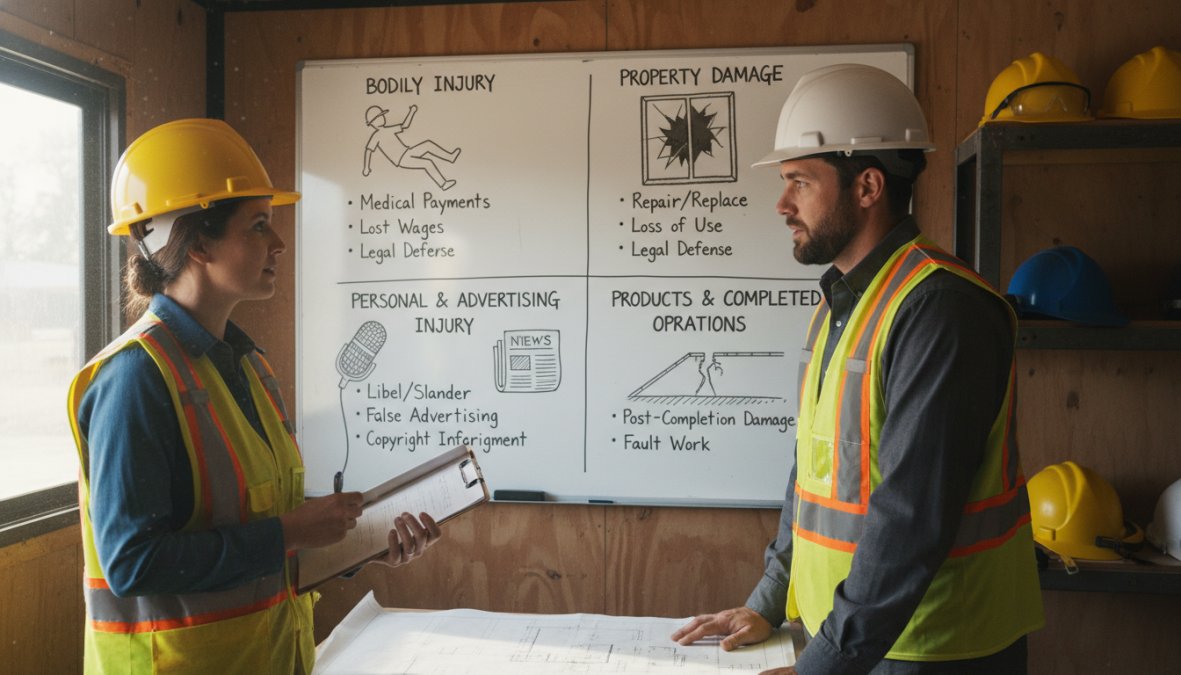
General liability insurance coverage is built around four distinct insuring agreements. Understanding each one tells you exactly what you’re buying.
A business owner in a hard hat reviewing documents with an insurance agent at a construction site office, both pointing at a policy binder on a desk, is a common scene in industries where these protections matter most.
Bodily Injury and Property Damage
Bodily injury and property damage coverage is the core of any CGL policy. It pays for claims where your business operations cause physical harm to a person or damage to someone else’s property.
Common examples include:
- A customer trips over a display in your retail store and breaks their wrist
- A contractor accidentally damages a client’s flooring during a renovation
- A delivery driver working for your business backs into a parked car
This coverage includes legal defense costs, which can run into tens of thousands of dollars even for claims that never reach a courtroom. Premises liability, the risk that comes from owning or operating a physical location, falls squarely under this protection.
Many business owners assume their commercial property insurance covers third-party injuries on their premises. It does not. Bodily injury claims require general liability coverage, and confusing the two can leave you exposed to full litigation costs.
Personal and Advertising Injury (Slander, Libel, False Advertising)
Personal and advertising injury coverage protects your business from non-physical harm claims. This includes slander, libel, copyright infringement in your advertising, false advertising claims, and wrongful eviction.
This protection matters more than most small business owners realize. A competitor who claims your marketing materials misrepresent their product, or a former tenant who alleges wrongful eviction, can file a costly claim that has nothing to do with physical injury. CGL covers the legal defense and any resulting settlement.
Products-Completed Operations Coverage
Products-completed operations coverage addresses claims that arise after your product has been sold or your service has been completed. If a contractor finishes a job and the work later causes water damage, or a food product causes illness after it leaves your facility, this coverage responds.
This is a distinct insuring agreement, not an add-on. Many businesses that sell physical products or perform contracted work underestimate how long their liability exposure extends after the transaction closes.
Medical Payments Coverage
Medical payments coverage, sometimes called “med pay,” is a no-fault benefit. It pays for immediate medical expenses for someone injured on your premises or by your operations, regardless of whether your business was legally at fault.
The practical value here is goodwill and claim prevention. Paying a visitor’s emergency room bill quickly often prevents a larger bodily injury lawsuit from developing. Med pay limits are typically lower than bodily injury limits, but they serve a different purpose.
General Liability Insurance Examples: Real-World Scenarios
Abstract definitions only go so far. Here’s how general liability insurance coverage plays out in practice.
Scenario 1: Slip and fall at a retail store. A customer slips on a wet floor near the entrance of a Las Vegas boutique. They fracture their ankle and require surgery. The customer files a bodily injury claim. General liability covers the medical bills, the attorney fees for defending the claim, and any settlement.
Scenario 2: Advertising injury for a small business. A marketing agency creates a social media campaign for a client that inadvertently uses a competitor’s trademarked slogan. The competitor files a lawsuit alleging false advertising. The agency’s CGL policy covers the legal defense and settlement under the personal and advertising injury provision.
Scenario 3: Contractor property damage. A plumber working in a commercial building accidentally ruptures a pipe, flooding two floors of office space. The building owner files a property damage claim. The plumber’s general liability policy covers the cost of repairs up to the policy limit.
Scenario 4: Product liability after delivery. A catering company provides food for a corporate event. Several attendees become ill afterward. The company’s products-completed operations coverage responds to the resulting liability claims.
Keep documentation of every job, service, or sale. Dated records, signed contracts, and photos are your best defense when a claim arises months or years after the work was completed.
What Does General Liability Insurance Not Cover?
Knowing what general liability insurance does not cover is as important as knowing what it does. This is where many businesses discover gaps at the worst possible time.
Common exclusions include:
- Employee injuries: Covered by workers’ compensation, not CGL
- Professional errors and omissions: A doctor’s misdiagnosis or an accountant’s filing error requires professional liability (errors and omissions) insurance
- Intentional acts: Deliberate damage or fraud is excluded from coverage
- Auto accidents: Commercial auto insurance covers vehicles used for business
- Cyber incidents: Data breaches and cyberattacks require separate cyber insurance
- Contractual liability beyond assumed risk: Some indemnification clauses in contracts may not be covered without specific endorsements
- Your own business property: Commercial property insurance handles this
The pattern here is clear. General liability covers third-party claims from accidents and unintentional harm. Everything else needs its own policy.
When You Need Additional Policies: BOP, Umbrella, and More
A business owner’s policy (BOP) bundles general liability with commercial property insurance into a single, often discounted package. Many small businesses in Las Vegas find a BOP more cost-effective than buying each policy separately.
For businesses with higher risk exposure, excess liability or umbrella insurance adds a layer of coverage above your CGL policy limits. If a judgment exceeds your per-occurrence limit, an umbrella policy covers the difference up to its own limit.
Professional liability (errors and omissions) insurance, workers’ compensation, and cyber insurance each address specific risks that CGL explicitly excludes. A complete risk management strategy typically involves several coordinated policies.
General Liability vs. Professional Liability: Key Differences
The most common confusion in business insurance is between general liability and professional liability. They cover fundamentally different risks.
| Feature | General Liability | Professional Liability |
|---|---|---|
| Covers | Physical injury, property damage, advertising injury | Errors, omissions, negligent professional advice |
| Who needs it | All businesses | Service providers, consultants, healthcare, legal |
| Trigger | Accident or unintentional harm | Failure to perform professional duties |
| Policy type | Usually occurrence | Usually claims-made |
| Defense coverage | Yes | Yes |
General liability covers what happens in the physical world. Professional liability covers what happens in the professional judgment world. A contractor who drops a tool and breaks a client’s window needs general liability. A financial advisor who gives bad investment advice needs professional liability.
Many businesses need both.
General liability and professional liability are not interchangeable. Buying one without the other leaves a significant gap if your business provides any form of advice, design, or specialized service.
Who Needs General Liability Insurance? Industry-Specific Risk Profiles
Almost every business that interacts with customers, vendors, or the public needs general liability coverage. But “almost every business” is where most guides stop, and it’s not useful. The risk profile, the required limits, and the specific CGL provisions that matter most vary dramatically by industry. Here’s a practical breakdown by sector.

Contractors and Construction: The Highest-Stakes Category
Construction is consistently among the industries with the highest general liability claim frequency and severity. The dominant exposures are bodily injury on job sites and property damage to client structures, both covered under the core CGL insuring agreement. But the provision that matters most here is products-completed operations coverage, which extends liability protection after the job is finished.
Why does this matter so much in construction? Because structural defects, water intrusion from improper flashing, or electrical faults often don’t surface until months or years after project completion. Without products-completed operations coverage, a contractor’s CGL policy may not respond to those delayed claims at all.
Nevada-specific requirement: The Nevada State Contractors Board (NSCB) requires licensed contractors to carry minimum general liability limits as a condition of licensure. Residential contractors and commercial contractors face different thresholds, and failing to maintain continuous coverage can result in license suspension. Always verify current NSCB minimums with your agent, as they are subject to revision.
What contractors should watch for:
- Subcontractor liability: If you hire uninsured subs, their work may become your liability. Require certificates of insurance from every subcontractor.
- Additional insured requirements: General contractors routinely require subs to name them as additional insureds. This requires a specific endorsement, not just a COI.
- Waiver of subrogation: Many construction contracts require this endorsement, which prevents your insurer from pursuing the other party after paying a claim.
Retail and Hospitality: Premises Liability Is the Primary Risk
For retail stores, restaurants, hotels, and entertainment venues, the dominant CGL exposure is premises liability, the risk that someone is injured on your property. Slip-and-fall claims are the most common trigger, and Las Vegas’s volume of foot traffic in retail corridors and entertainment venues amplifies this exposure significantly compared to lower-traffic markets.
The practical implication: premises liability claims are highly sensitive to documentation. Whether a wet floor sign was posted, whether a hazard was reported and not addressed, and whether security footage was preserved all affect claim outcomes. Your CGL policy pays the defense and settlement costs, but your internal incident response procedures determine how defensible the claim is.
Hospitality-specific considerations:
- Liquor liability: Standard CGL policies typically exclude or limit coverage for claims arising from alcohol service. Nevada’s dram shop laws create real exposure for bars, restaurants, and event venues. A separate liquor liability endorsement or standalone policy is often necessary.
- Event venues: If your space hosts third-party events, your CGL should specifically cover premises operations for those events. Confirm this with your insurer.
Restaurants and Food Service: The Long Tail of Products Liability
Food service businesses face a liability exposure that extends well past the point of sale. A foodborne illness claim, whether from contamination, improper storage, or cross-contact with allergens, typically surfaces days after the customer leaves your establishment. This is precisely the scenario products-completed operations coverage is designed to address.
Advertising injury is also a real risk in this sector. Menu descriptions that make health claims, branding that resembles a competitor’s, or social media content that references other businesses can all generate personal and advertising injury claims.
Practical risk management note: Maintain dated temperature logs, supplier invoices, and food handling records. In a products liability claim, documentation of your food safety practices is often the difference between a defensible claim and a costly settlement.
Professional Services: Marketing, IT, Consulting, and Creative Agencies
Professional service firms often underestimate their CGL exposure because they don’t have a physical storefront or handle physical products. But the personal and advertising injury provision is highly relevant here.
A marketing agency that creates content using a competitor’s trademarked imagery, an IT firm whose technician accidentally damages a client’s server room, or a consultant whose team member causes a slip-and-fall during an on-site visit, all of these are CGL claims, not professional liability claims.
The distinction matters because professional liability (errors and omissions) covers the quality of your advice and deliverables. CGL covers the physical and reputational harm that happens around your work. Most professional service firms need both, and buying only one leaves a meaningful gap.
Key CGL provisions for professional services:
- Advertising injury coverage for content, campaigns, and branded materials
- Premises and operations coverage for client-site visits
- Products-completed operations if you deliver physical goods alongside services (printed materials, hardware, packaged software)
Healthcare-Adjacent Businesses: Gyms, Spas, and Wellness Centers
Businesses in the wellness sector, gyms, yoga studios, massage therapy practices, med spas, sit at the intersection of bodily injury risk and professional liability risk. CGL covers the physical injury side: a client who falls on wet tile near a pool, a guest who is injured by equipment, or a visitor who slips in a locker room.
What CGL does not cover is the professional advice side: a personal trainer who designs a program that injures a client, or an esthetician whose treatment causes a skin reaction. Those claims fall under professional liability, which requires a separate policy.
The practical split: If the harm is caused by a physical condition of your premises or your operations, CGL responds. If the harm is caused by the professional judgment or technique of your staff, professional liability responds. Many wellness businesses need both.
E-Commerce and Product Sellers: A Growing and Underinsured Category
Online sellers, especially those who manufacture, import, or private-label physical products, carry significant products liability exposure that many don’t recognize until a claim arrives. If your product causes injury or property damage after it’s purchased, regardless of whether you manufactured it or simply sold it, you can be named in a products liability lawsuit.
This is one of the most underinsured categories among small businesses. Many e-commerce operators assume that because they don’t have a physical storefront, their liability exposure is low. In practice, the products-completed operations provision of a CGL policy is the primary protection for this risk.
Platform requirements: Major e-commerce platforms and wholesale buyers increasingly require sellers to carry CGL with minimum limits and to name the platform or buyer as an additional insured. Failure to provide a compliant certificate of insurance can result in account suspension or contract termination.
According to the U.S. Small Business Administration’s guide to business insurance, general liability insurance is one of the most commonly required coverages for businesses seeking contracts, licenses, or commercial leases. Nevada-specific licensing boards frequently list it as a prerequisite, and the requirement extends across industries from contractors to food service to professional services.
The industry you’re in determines which CGL provisions matter most, not just whether you need coverage. A contractor’s most critical provision is products-completed operations. A retailer’s is premises liability. A marketer’s is advertising injury. Buying a generic policy without confirming that the right provisions are active for your industry is one of the most common and costly mistakes small business owners make.
Certificates of Insurance (COI): What They Are and Why They Matter
A Certificate of Insurance (COI) is a one-page document that summarizes your insurance coverage, including policy limits, effective dates, and the insurer’s name. It does not confer coverage itself. It simply proves that a valid policy exists.
Why does this matter? Because clients, landlords, general contractors, and government agencies routinely require proof of insurance before doing business with you. In a litigious environment like commercial construction or event services, a COI is often the first document requested.
What a standard COI includes:
- Insured’s name and address
- Insurance company name and NAIC number
- Policy type and policy number
- Policy effective and expiration dates
- Per-occurrence and aggregate limits
- Certificate holder (the party requesting proof)
- Additional insured endorsements, if applicable
The “additional insured” endorsement is where many small business owners get tripped up. When a client asks to be named as an additional insured on your policy, they’re asking for direct coverage under your CGL if a claim arises from your work. This requires a specific endorsement from your insurer, not just a certificate.
A COI is not a contract and does not guarantee coverage. If your policy lapses or is cancelled, the certificate becomes meaningless. Always maintain continuous coverage and notify certificate holders of any changes.
Request your COI from your insurer or broker as soon as your policy is active. Keep digital copies accessible. Many clients in Las Vegas’s construction and events industries will not sign contracts without one.
How to File a General Liability Insurance Claim: Step-by-Step
Most business owners have never filed a claim. Here’s exactly what to do when an incident occurs.
Step 1: Secure the scene and document everything.
Photograph the location, the injury or damage, and any contributing factors immediately. Collect witness names and contact information. Do not admit fault or make promises about payment.
Step 2: Notify your insurer promptly.
Most CGL policies require timely notification of incidents, even if no formal claim has been filed yet. Delayed reporting can jeopardize coverage. Call your agent or the insurer’s claims line as soon as possible.
Step 3: Complete the claim form.
Your insurer will provide a first notice of loss form. Provide accurate, detailed information about the incident, including date, time, location, parties involved, and a factual description of what happened.
Step 4: Cooperate with the claims adjuster.
An adjuster will investigate the claim, review documentation, and assess liability. Provide all requested records, including contracts, invoices, incident reports, and communications.
Step 5: Review the settlement offer.
The insurer will propose a settlement based on the investigation. You have the right to negotiate or dispute the offer. If litigation proceeds, your insurer provides legal defense up to your policy limits.
Step 6: Close the claim and review your coverage.
After resolution, review your policy limits and deductible. A significant claim is a signal to reassess whether your current coverage is adequate for your actual risk exposure.
According to the National Association of Insurance Commissioners’ consumer guide to business insurance, keeping detailed records before an incident occurs is the single most effective way to support a successful claim outcome.
How to Get General Liability Insurance Coverage in Las Vegas
Finding the right general liability insurance in Las Vegas requires more than a quick online quote. Nevada has specific licensing and insurance requirements that vary by industry, and the right coverage depends on your business type, revenue, claims history, and risk profile. Before you request a quote, understanding what drives your premium, and what a reasonable cost range looks like, puts you in a much stronger position.
How Much Does General Liability Insurance Cost?
This is the question most insurance websites refuse to answer directly, because they’d rather collect your contact information first. Here’s what the market actually looks like for small businesses.
General liability insurance premiums for small businesses typically range from a few hundred dollars per year for very low-risk operations to several thousand dollars per year for higher-risk industries. The variation is wide because premiums are calculated on a combination of factors, not a flat rate.
The primary factors that drive your CGL premium:
- Industry and risk classification: Insurers assign each business a class code based on its primary operations. A graphic design studio and a roofing contractor both need CGL, but the roofing contractor’s premium will be substantially higher because the bodily injury and property damage exposure is far greater.
- Annual revenue or payroll: Many CGL policies are rated on revenue (for product-based businesses) or payroll (for service businesses). Higher revenue generally means higher premium because it correlates with more operations and more exposure.
- Policy limits: A $1 million per-occurrence / $2 million aggregate policy costs less than a $2 million / $4 million policy. The difference in premium is often smaller than business owners expect, which is why many agents recommend higher limits.
- Location: Nevada’s legal environment, local court tendencies, and the density of your operating area all influence pricing. A Las Vegas Strip-adjacent business with high foot traffic will typically be rated differently than a home-based consultant in Summerlin.
- Claims history: A business with prior CGL claims will pay more than one with a clean loss history. Some insurers will decline coverage entirely if the claims history is severe.
- Deductible: Choosing a higher deductible lowers your premium. This trade-off makes sense for businesses with cash reserves that can absorb a small claim out of pocket.
General cost benchmarks by business type (illustrative ranges, your actual quote will vary):
| Business Type | Typical Annual Premium Range |
|---|---|
| Home-based consultant or freelancer | Lower end of the market; often under $500/year |
| Retail store (low foot traffic) | Mid-range; varies significantly by location and revenue |
| Restaurant or food service | Mid-to-upper range; products liability adds cost |
| General contractor | Upper range; products-completed operations is a significant factor |
| Roofing, demolition, or specialty trades | Highest range; some carriers decline these classes entirely |
Online quote tools often return artificially low estimates because they use simplified class codes. The actual policy issued after underwriting review may carry a higher premium. Always compare the final bound policy, not just the initial quote.
Ways to reduce your CGL premium without reducing your protection:
- Bundle with a Business Owner’s Policy (BOP): Combining CGL with commercial property insurance in a BOP typically costs less than buying each policy separately, and many insurers offer BOP discounts for small businesses.
- Maintain a clean claims history: Implementing documented safety procedures, incident reporting protocols, and regular premises inspections reduces claim frequency and supports lower renewal premiums over time.
- Work with an independent agent: Independent agents access multiple carriers and can place your business with the insurer whose underwriting guidelines are most favorable for your specific risk class. A carrier that specializes in your industry will often price more competitively than a generalist insurer.
- Review your revenue and payroll figures annually: If your business has grown, your policy may be underreporting exposure, which creates a coverage gap. If revenue has declined, you may be overpaying.
A Practical Checklist for Getting Covered in Nevada
Once you understand your cost drivers, here’s how to move from quote to bound coverage efficiently:
- Identify your primary business activities and the third-party risks they create
- Determine whether a BOP or standalone CGL policy fits your needs
- Gather your business revenue, number of employees, years in operation, and any prior claims history
- Confirm whether your Nevada license or your clients require specific minimum limits
- Request quotes from multiple carriers, not just one, to compare policy terms, not just price
- Confirm whether your industry or clients require specific endorsements (additional insured, waiver of subrogation, primary and non-contributory language)
- Review the exclusions section of each quote carefully, not just the declarations page
- Ask about umbrella or excess liability coverage if your per-occurrence limit feels low relative to your actual risk
- Request your Certificate of Insurance immediately after binding coverage
- Set a calendar reminder to review limits and revenue figures at each renewal
As the Nevada Division of Insurance’s business insurance requirements outlines, certain industries in Nevada are required to carry minimum CGL limits as a condition of licensure. Getting this right from the start avoids license suspension and contract disqualification, both of which cost far more than the premium difference between adequate and inadequate coverage.
United Family Insurance compares the market on your behalf, so you’re not spending hours chasing quotes from individual carriers. Our agents in Las Vegas understand Nevada’s regulatory environment and the specific risks that local industries face. Whether you’re a contractor in Henderson, a restaurant owner on the Strip, or a consultant in Summerlin, we match your risk profile to coverage that actually fits.
Before your first call with an agent, write down your three most realistic worst-case scenarios, the incidents that would genuinely threaten your business. Share those scenarios directly. A good agent will tell you exactly which provision responds to each one and whether your proposed limits are adequate. If they can’t answer that question specifically, find a different agent.
Frequently Asked Questions
What exactly does general liability insurance coverage include?
General liability insurance coverage, also called commercial general liability (CGL), protects your business against third-party claims for bodily injury, property damage, personal and advertising injury, products-completed operations liability, and medical payments. It covers legal defense costs, settlements, and judgments up to your policy limits. For example, if a customer slips in your store and sues, your CGL policy handles the legal fees and any resulting payout.
What is the difference between general liability and professional liability insurance?
General liability insurance covers physical, third-party claims, like a customer injury or property damage caused during business operations. Professional liability (also called errors and omissions or E&O insurance) covers claims arising from mistakes, negligence, or failure to deliver professional services. For instance, a contractor needs general liability for on-site accidents, while a consultant needs professional liability for advice that causes a client financial loss. Many businesses need both policies for complete protection.
Does general liability insurance cover employee injuries?
No. General liability insurance does not cover injuries to your own employees. Employee injuries on the job are covered by workers’ compensation insurance, which is a separate, legally required policy in most states including Nevada. General liability is specifically designed for third-party claims, meaning injuries or damages suffered by customers, vendors, or members of the public, not your own workforce.
Is general liability insurance required by law for businesses in Las Vegas, Nevada?
General liability insurance is not universally required by Nevada state law for all businesses, but many industries and situations effectively require it. Contractors must often carry it to obtain a state license. Landlords and commercial property managers frequently require it as a lease condition. Additionally, clients and government contracts commonly demand proof of coverage via a Certificate of Insurance (COI) before work begins. Even when not legally mandated, operating without it in a litigious environment is a significant financial risk.
How much does general liability insurance typically cost for a small business?
The cost of general liability insurance varies based on your industry, business size, location, revenue, claims history, and chosen policy limits. Higher-risk industries like construction pay more than lower-risk ones like consulting. Your deductible and whether you bundle coverage into a Business Owner’s Policy (BOP) also affect your premium. The best way to find an accurate, affordable rate is to compare multiple carriers, United Family Insurance can shop the market on your behalf to find competitive options.
What is a Certificate of Insurance (COI) and do I need one?
A Certificate of Insurance (COI) is a one-page document that summarizes your insurance coverage, including policy limits, coverage types, and the insurer’s name. It serves as proof that your business carries active general liability insurance. You will likely need a COI when signing commercial leases, bidding on contracts, working with vendors, or joining industry associations. Clients and partners request COIs to verify you are properly insured before allowing you onto a job site or into a business relationship.