

Table of Contents
- Why Small Business Owners in Las Vegas Need to Compare Insurance Quotes Online
- Types of Small Business Insurance Coverage You Should Know
- Top Platforms to Compare Small Business Insurance Quotes Online
- Business Insurance Cost Factors Every Small Business Owner Should Understand
- How to Get Business Insurance Quotes: A Step-by-Step Process
- Choosing the Right Coverage: What to Look for Beyond the Premium
- Common Mistakes When Comparing Business Insurance Online
- Conclusion
Last Updated: May 24, 2026
Running a business in Las Vegas without the right insurance is a gamble you cannot afford to take. The smart move for small business owners in 2026 is to compare small business insurance quotes online before committing to any single carrier. At United Family Insurance, we help Las Vegas entrepreneurs cut through the noise, compare the market on their behalf, and secure coverage that actually fits their operation. Below, we’ll show you exactly which coverage types matter, which platforms deliver real value, and how to avoid the mistakes that leave businesses dangerously exposed.
Most business owners assume their general liability policy covers everything. It doesn’t. And that assumption costs businesses far more than a proper policy ever would.
Why Small Business Owners in Las Vegas Need to Compare Insurance Quotes Online
Las Vegas runs on hospitality, construction, entertainment, and retail. Each of those industries carries its own risk profile, and a one-size-fits-all policy rarely fits any of them. According to the U.S. Small Business Administration’s guide to business insurance, many small businesses operate without adequate coverage, leaving them exposed to claims that can wipe out years of profit in a single lawsuit.
The case for comparing quotes online comes down to three things: speed, transparency, and cost. Calling individual carriers one by one takes days. Online comparison tools surface multiple options in minutes, letting you evaluate coverage limits, deductibles, and premium structures side by side without a sales pitch driving the conversation.
The Real Cost of Being Underinsured
A single slip-and-fall claim, a professional error, or a data breach can generate legal and settlement costs that dwarf the annual premium of a solid policy. Many Las Vegas small businesses, especially startups and sole proprietors, carry minimum coverage because it’s cheaper upfront. The math rarely works out in their favor.
The real cost calculation should include: the annual premium, the deductible you’d pay per claim, and the maximum financial exposure if a claim exceeds your coverage limit. When you run those numbers, mid-tier coverage typically offers the best cost-benefit ratio for most Nevada businesses.
How Online Comparison Changes the Game
Traditional insurance shopping meant trusting a single agent’s recommendations. Online platforms changed the underwriting dynamic entirely. Digital-first comparison tools now give small business owners direct access to multiple carriers, instant quotes, and the ability to adjust coverage parameters in real time. You see how your premium changes when you raise your deductible or add cyber insurance to a business owner’s policy.
The result is a more informed buyer. And informed buyers don’t overpay.
Types of Small Business Insurance Coverage You Should Know
Understanding types of small business insurance coverage before you start comparing quotes is the difference between buying the right policy and buying the cheapest one. These are not the same thing.
General Liability and Professional Liability
General liability insurance is foundational coverage that protects your business against third-party claims for bodily injury, property damage, and advertising injury. For most Las Vegas businesses, it’s the first policy you buy and the one required by most commercial leases and client contracts.
Professional liability insurance (also called errors and omissions, or E&O) covers claims arising from professional errors, negligent advice, or failure to deliver a contracted service. Consultants, designers, accountants, and real estate professionals in Nevada need this coverage. General liability won’t touch a professional negligence claim.
A common mistake is assuming general liability covers professional errors. It doesn’t. These are two separate products with two separate risk profiles.
Business Owner’s Policy, Cyber Insurance, and More
A business owner’s policy (BOP) bundles general liability and commercial property insurance into a single policy, usually at a lower combined premium than buying each separately. It’s the most cost-effective starting point for most small businesses.
Beyond the BOP, coverage worth evaluating includes:
- Cyber insurance: Covers data breaches, ransomware attacks, and notification costs. Critical for any business handling customer payment data.
- Workers’ compensation: Required by Nevada law for businesses with employees. Covers medical expenses and lost wages for work-related injuries.
- Commercial auto: Covers vehicles used for business purposes. Personal auto policies exclude business use.
- Business interruption: Replaces lost income when a covered event forces you to close temporarily.
If you’re bundling general liability and commercial property, always check whether the BOP includes business interruption coverage. Many standard BOPs do, but the sub-limits vary significantly between carriers.
Top Platforms to Compare Small Business Insurance Quotes Online
The best way to compare small business insurance quotes online is to use a platform that aggregates multiple carriers rather than locking you into one insurer’s pricing. Here’s how the leading options stack up.
A small business owner sitting at a modern desk, reviewing multiple insurance quote pages on a laptop, with a notepad open beside them and a coffee cup nearby, warm office lighting creating a focused and professional atmosphere.

| Platform | Best For | Key Feature | Starting Premium |
|---|---|---|---|
| United Family Insurance | Las Vegas small businesses needing expert guidance | Market comparison + licensed agents | Varies by coverage |
| Insureon | Businesses wanting multiple carrier quotes | A-rated carrier access, same-day coverage | Varies by industry |
| CoverWallet | Policy management and COI tools | Centralized dashboard, instant COI | ~$39/month (GL) |
| NEXT Insurance | Digital-first, fast coverage | Fully online, 1,300+ professions | ~$19/month (GL) |
| Thimble | Freelancers and project-based work | On-demand, hourly/daily coverage | Varies by duration |
United Family Insurance: Market Comparison with Expert Agents
United Family Insurance is the top pick for Las Vegas small businesses that want expert guidance alongside competitive pricing. Unlike fully automated platforms that spit out quotes with no context, United Family Insurance pairs market comparison technology with licensed agents who understand Nevada’s regulatory environment and local industry risks.
The practical advantage: you’re not choosing between a cheap policy and an informed one. The team compares the market on your behalf, identifies coverage gaps, and presents options with real explanations. For businesses that have never bought commercial insurance before, that guidance is worth more than a marginally lower premium from a platform with no human support.
Key advantages:
- Compares the market across multiple carriers
- Licensed agents provide tailored coverage recommendations
- User-friendly platform for filing claims
- Potential savings of up to 58% compared to not shopping the market
Insureon, CoverWallet, NEXT Insurance, and Thimble at a Glance
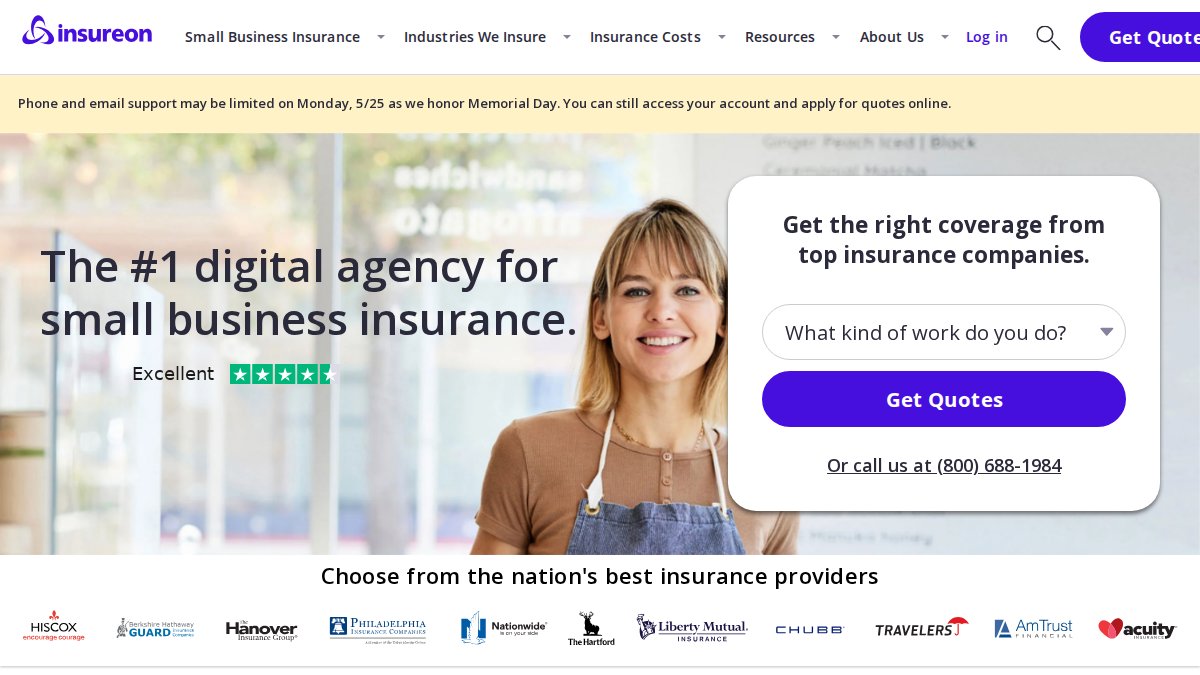
Insureon works well for businesses that want to see quotes from multiple A-rated carriers simultaneously. The online application is thorough, and licensed agents are available for complex coverage questions. One limitation: not every carrier appears in every quote result, so you’re not always seeing the full market.
CoverWallet stands out for its policy management dashboard. If you’re managing multiple policies, need to issue certificates of insurance on demand, or want everything in one place, CoverWallet’s interface is genuinely well-designed. The trade-off is that quote complexity can vary for businesses with unusual risk profiles.
NEXT Insurance is the fastest option for straightforward coverage. The fully digital application takes minutes, and coverage can activate the same day. It’s the right choice for freelancers and contractors who need basic general liability quickly. The limitation is support: NEXT relies heavily on digital and AI-driven service, with limited phone access.
Thimble fills a specific niche that most platforms ignore: on-demand, short-term coverage. If you’re a photographer, event contractor, or seasonal business in Las Vegas that only needs coverage for specific projects, Thimble’s hourly, daily, and monthly options are genuinely useful. For full-time, year-round businesses, the per-project pricing model rarely beats an annual policy.
Don’t choose a platform based solely on the lowest initial quote. A policy with a low premium but high deductible and low coverage limits can leave you paying out of pocket for claims that a slightly more expensive policy would cover in full.
Business Insurance Cost Factors Every Small Business Owner Should Understand
Business insurance cost factors are not arbitrary. Carriers use actuarial underwriting criteria to assess your specific risk profile, and understanding those criteria before you start comparing quotes helps you present your business accurately, avoid overpaying, and recognize when a quote is suspiciously low because coverage has been quietly narrowed.
Most comparison guides stop at “your industry affects your premium.” That is true but not useful. What follows is the deeper framework: how underwriters actually score risk, what that means for your expected premium range by industry type, and how gig workers and solopreneurs fit into a system that was not originally designed for them.
How Underwriters Actually Calculate Your Premium
Every carrier uses a combination of the following inputs to arrive at your quoted premium. Understanding each one tells you exactly which levers you can pull to reduce cost without reducing meaningful protection.
1. Industry classification (SIC or NAICS code)
This is the single largest driver of your base rate. Carriers assign a loss-cost multiplier to each industry code based on historical claims frequency and severity across their entire book of business. A landscaping company and a software consultancy can request identical coverage limits and receive premiums that differ by a factor of three or more, purely because of industry classification. If your business spans multiple activities, the carrier will typically rate you on the highest-risk activity you perform, which is why accurately describing your operations matters more than most business owners realize.
2. Annual gross revenue
For general liability, revenue is often the primary exposure base. Higher revenue signals more customer interactions, more contracts, and more potential for a claim. A freelance graphic designer billing $60,000 per year and a design agency billing $600,000 per year doing identical work will pay materially different premiums, even with the same coverage limits.
3. Number of employees and payroll
Workers’ compensation premiums are calculated directly from payroll, multiplied by a class code rate that reflects the injury risk of the work performed. Office workers carry a much lower class code rate than roofers or electricians. For general liability, employee count signals operational scale and exposure.
4. Claims history
A business with prior claims, particularly multiple claims within a three-to-five year window, will pay a surcharge or may find certain carriers unwilling to quote at all. A clean claims history is a genuine underwriting asset. Some carriers offer loss-free credits that reduce premiums by a meaningful percentage for businesses with no prior claims.
5. Location
Nevada’s regulatory environment, local litigation climate, and property risk factors (including proximity to flood zones, crime statistics, and fire risk ratings) all influence pricing. Las Vegas commercial properties in high-foot-traffic areas carry different slip-and-fall exposure than a home-based consulting operation in Henderson.
6. Coverage structure choices
The deductible you select, the per-occurrence limit, the aggregate limit, and any endorsements you add or remove all affect the final premium. Raising your per-occurrence deductible from $500 to $2,500 can reduce your general liability premium noticeably, but only makes financial sense if your business has the cash reserves to absorb that deductible in the event of a claim.
Cost-Benefit Analysis by Industry Type
The following framework is designed to help you assess whether the coverage you are being quoted is proportionate to your actual risk exposure, not just the cheapest option available.
Construction and trades (electricians, plumbers, general contractors, landscapers)
This is the highest-premium category for good reason. Workers’ compensation claims in construction are frequent and expensive. General liability claims involving property damage at a job site are common. The cost-benefit calculation here strongly favors higher coverage limits and lower deductibles. A contractor who carries a $300,000 per-occurrence general liability limit to save on premium and then faces a $400,000 property damage claim at a client’s home is personally liable for the gap. Most commercial clients and general contractors will require a $1,000,000 per-occurrence minimum before allowing a subcontractor on site, meaning inadequate coverage also costs you work.
Retail and food service (restaurants, boutiques, salons, convenience stores)
Slip-and-fall claims are the dominant exposure. A business owner’s policy bundling general liability and commercial property is typically the most cost-effective structure. Business interruption coverage deserves serious attention in this category: a restaurant forced to close for two weeks due to a kitchen fire loses not just repair costs but all revenue during closure. The BOP sub-limit for business interruption varies significantly between carriers, always check the actual dollar cap, not just whether the coverage is included.
Professional services (consultants, accountants, designers, real estate agents, marketing agencies)
General liability premiums in this category are relatively low because the physical injury exposure is minimal. The meaningful risk is professional liability, errors, omissions, missed deadlines, or advice that a client claims caused them financial harm. E&O claims can be expensive to defend even when the business owner did nothing wrong, because defense costs are incurred before any judgment. The cost-benefit case for professional liability insurance in this category is strong: premiums are often modest relative to the potential defense and settlement costs of a single disputed engagement.
Technology and digital businesses (SaaS, app developers, IT consultants, e-commerce)
Cyber insurance has moved from optional to essential for this category. A data breach affecting customer payment records triggers notification obligations under Nevada’s data breach notification law (NRS 603A), potential regulatory scrutiny, and reputational damage, all before any lawsuit is filed. Cyber policies cover notification costs, credit monitoring for affected customers, forensic investigation, and in many cases, ransomware payments and business interruption from a network outage. The premium for a basic cyber policy for a small tech business is often lower than business owners expect, and the coverage addresses a risk that general liability and professional liability policies explicitly exclude.
Healthcare and wellness (personal trainers, massage therapists, chiropractors, estheticians)
Professional liability (often called malpractice or professional indemnity in this context) is the priority coverage. Nevada professional licensing boards for many health and wellness occupations require proof of liability coverage as a condition of licensure renewal. General liability covers the premises exposure; professional liability covers the treatment exposure. Carrying only one of the two leaves a significant gap.
Coverage for Side Hustles and Gig Workers
This is the segment most insurance guides address with a single paragraph and a generic disclaimer. It deserves more, because the coverage gaps for gig workers and solopreneurs are specific, consequential, and often invisible until a claim is denied.
The personal policy exclusion problem
Personal insurance policies, homeowners, renters, and personal auto, contain business-use exclusions that are broader than most policyholders realize. A freelance photographer who stores $8,000 of camera equipment at home is not covered for theft of that equipment under a standard renters policy if the equipment is used for paid work. A food delivery driver whose personal auto policy excludes “delivery for compensation” has no collision or liability coverage during a delivery. These exclusions are not buried in fine print, they are standard policy language, but they are rarely explained at the point of sale.
What gig workers actually need
The coverage requirements for a gig worker or solopreneur depend on the nature of the work:
- Client-facing service providers (photographers, event contractors, personal trainers, tutors): General liability is the priority. If a client or third party is injured, or their property is damaged, in connection with your work, general liability responds. Many clients and venues now require proof of general liability before booking.
- Advice and knowledge workers (freelance writers, consultants, coaches, bookkeepers): Professional liability is the priority. A client who claims your advice cost them money can file a claim regardless of whether you made an objective error.
- Delivery and transportation gig workers: Personal auto policies do not cover commercial delivery. Rideshare and delivery platforms provide some coverage during active trips, but the coverage during the “waiting for a request” phase is often limited. A commercial auto endorsement or a rideshare-specific policy fills this gap.
- Home-based businesses: A home-based business endorsement on a homeowners or renters policy can extend coverage to business equipment and limited business liability, but it does not replace a proper general liability policy for businesses with client interactions.
Platforms designed for this segment
Thimble and NEXT Insurance have built products specifically for freelancers and gig workers. Thimble’s on-demand model, coverage by the hour, day, or month, is particularly well-suited to project-based work where an annual policy would be disproportionately expensive. A photographer who shoots twelve paid events per year can purchase coverage for each event individually rather than carrying a year-round policy. For gig workers whose income is variable and whose work is intermittent, this flexibility has genuine financial value.
According to the Nevada Division of Industrial Relations workers’ compensation guidance, independent contractors in Nevada should carefully verify their classification status, as misclassification can create unexpected workers’ compensation obligations for both the contractor and the businesses that engage them.
If you operate a side hustle alongside a full-time job, your employer’s insurance does not cover your independent business activity. Even a small freelance operation needs its own coverage. The annual premium for a basic general liability policy for a low-risk solopreneur is often less than the cost of a single hour of legal defense if a client dispute escalates.
The most expensive insurance mistake is not overpaying for coverage, it is carrying a policy that excludes the specific activity that generates your claim. Before binding any policy, read the exclusions section, not just the declarations page. If your business activities are not explicitly covered, they are likely excluded.
How to Get Business Insurance Quotes: A Step-by-Step Process
Getting business insurance quotes online takes less time than most business owners expect. The process from first click to bindable quote runs 15-30 minutes for most standard business types.
Step 1: Gather your business information
You’ll need your business structure (LLC, sole proprietor, corporation), annual revenue, number of employees, and a description of your primary business activities.
Step 2: Identify your coverage priorities
Decide which coverage types are mandatory (workers’ comp if you have employees in Nevada), which are contractually required (general liability for most commercial leases), and which address your specific risk exposure.
Step 3: Use a comparison platform
Enter your information once and receive quotes from multiple carriers. Avoid entering your details on multiple individual carrier sites, which triggers repeated sales calls.
Step 4: Compare coverage limits, not just premiums
A lower premium with a $5,000 deductible and $300,000 coverage limit is not the same product as a slightly higher premium with a $1,000 deductible and $1,000,000 limit.
Step 5: Review the certificate of insurance (COI)
Before binding coverage, confirm the COI reflects your correct business name, address, and coverage details. Errors on a COI can create compliance issues with clients and landlords.
Step 6: Bind coverage and save your policy documents
Most platforms allow same-day coverage activation. Store your policy documents and COI in a secure, accessible location.

What Information You Need Before You Apply
- Legal business name and DBA (if applicable)
- Business address and years in operation
- Industry classification (SIC or NAICS code)
- Annual gross revenue
- Number of full-time and part-time employees
- Description of business operations and any prior claims history
- Existing policy details if renewing or switching carriers
Regulatory Compliance Checklist for Nevada Businesses
Nevada has specific insurance requirements that differ from other states. Before finalizing coverage, verify the following:
- Workers’ compensation: Required for all Nevada employers with one or more employees
- Commercial auto: Required if any vehicle is used for business purposes
- Professional licensing boards: Many Nevada professional licenses require proof of E&O or liability coverage
- Commercial lease requirements: Most Las Vegas commercial landlords require general liability with specific coverage limits and the landlord named as an additional insured
- Client contracts: Review all active contracts for insurance requirements before binding coverage
- Nevada business license: Some business license categories require proof of insurance at the time of application
Choosing the Right Coverage: What to Look for Beyond the Premium
Most people who compare small business insurance quotes online focus exclusively on the monthly premium. That is the wrong metric to optimize, and it is exactly what insurance carriers and comparison platforms are designed to make you focus on, because a lower-looking premium drives conversions.
The three factors that actually determine whether a policy protects your business are the coverage structure, the policy exclusions, and the claims experience. The third one is almost never discussed before the purchase. It should be the first thing you research.
Understanding Deductibles, Coverage Limits, and Policy Structure
Deductible is the amount you pay out of pocket before your insurance responds to a claim. A higher deductible lowers your annual premium but increases your financial exposure every time you file. The right deductible is not the lowest available, it is the highest amount your business can absorb from operating cash flow without disrupting operations. For a business with strong cash reserves, a $2,500 deductible on general liability may be a rational trade-off for a lower annual premium. For a startup with thin margins, a $500 deductible provides more predictable cost control even at a higher premium.
Per-occurrence limit is the maximum your carrier will pay for any single claim. This is the number that matters most in a serious incident. A $300,000 per-occurrence limit sounds substantial until you are facing a premises liability lawsuit in a Nevada district court where medical costs, lost wages, pain and suffering, and legal fees can combine to exceed that figure. Many commercial landlords and enterprise clients in Las Vegas require a $1,000,000 per-occurrence minimum as a condition of doing business with you, meaning a policy with lower limits does not just underinsure you, it disqualifies you from certain contracts.
Aggregate limit is the maximum your carrier will pay across all claims in a policy period, typically one year. If your per-occurrence limit is $1,000,000 and your aggregate limit is $2,000,000, the carrier will pay up to $1,000,000 per claim but no more than $2,000,000 total across all claims in that year. For businesses with high customer volume or multiple job sites, the aggregate limit deserves as much attention as the per-occurrence limit.
Exclusions are the provisions that define what your policy does not cover. Every policy has them. The most consequential exclusions for small businesses include: professional services (excluded from general liability, requires a separate E&O policy), intentional acts, contractual liability beyond what is assumed in an insured contract, and cyber events (excluded from most general liability and property policies, requires a separate cyber policy). Reading the exclusions section before binding coverage is not optional. It is the only way to know what you are actually buying.
A policy with a low premium and a long exclusions list is not a bargain. It is a policy that has been priced low because the carrier has removed the coverage that would respond to your most likely claims. Always request the full policy form, not just the declarations page, before binding coverage.
The Claims Process: What Actually Happens After You File
This is the section of the insurance buying process that almost no comparison guide addresses, and it is the one that matters most when something goes wrong. Understanding how claims work before you need to file one is the difference between a policy that functions as advertised and a coverage dispute that compounds an already difficult situation.
Step 1: Notice of claim
Most policies require you to notify your carrier of a claim or potential claim “as soon as practicable”, and some policies specify a hard deadline. Failing to provide timely notice is one of the most common grounds carriers use to deny or limit coverage. If a customer slips and falls at your business, or a client threatens legal action over a professional dispute, notify your carrier immediately, even if you believe the situation will resolve without a formal claim. Late notice after a situation escalates is far more damaging than early notice that turns out to be unnecessary.
Step 2: Claims assignment
Once you file, the carrier assigns a claims adjuster to your case. The adjuster’s role is to investigate the claim, assess coverage, and determine the carrier’s liability. The adjuster works for the carrier, not for you. For straightforward property claims, this process is typically efficient. For liability claims involving third-party injuries or professional disputes, the adjuster’s investigation may take weeks, and the outcome depends heavily on the documentation you provide.
Step 3: Documentation and cooperation
Your policy requires you to cooperate with the claims investigation. This means providing incident reports, contracts, communications, financial records, and any other documentation the adjuster requests. Businesses that maintain organized records, incident logs, signed client contracts, safety inspection records, move through this stage faster and with better outcomes than those that cannot produce supporting documentation.
Step 4: Coverage determination
The carrier issues a coverage determination: the claim is covered, partially covered, or denied. If coverage is denied, the carrier must provide a written explanation citing the specific policy provision that excludes the claim. A denial is not necessarily final, if you believe the denial is incorrect, you can dispute it through the carrier’s internal appeals process or, in Nevada, file a complaint with the Nevada Division of Insurance.
Step 5: Resolution
For covered claims, resolution takes one of two forms: direct payment to you (for property claims and business interruption) or defense and settlement management by the carrier (for liability claims). For liability claims, the carrier typically retains legal counsel on your behalf and manages the defense. Your policy’s per-occurrence limit caps the carrier’s total obligation, including defense costs, which is why adequate limits matter even before a judgment is reached.
How to Evaluate a Carrier’s Claims Performance Before You Buy
The claims experience is the product you are actually purchasing. The premium is the price. Most buyers research the price extensively and the product not at all. Here is how to assess claims performance before committing to a carrier:
Check the carrier’s financial strength rating. A.M. Best, Moody’s, and S&P all rate insurance carriers on their financial ability to pay claims. A carrier rated A- or better by A.M. Best has demonstrated the financial stability to honor large or multiple claims. Carriers with lower ratings or no rating may offer lower premiums because they carry more financial risk, which becomes your risk if they cannot pay a significant claim.
Review the carrier’s complaint ratio. The National Association of Insurance Commissioners (NAIC) publishes a complaint index for every licensed carrier, comparing the number of complaints filed against a carrier relative to its market share. A complaint index above 1.0 means the carrier receives more complaints than average for its size. The Nevada Division of Insurance also maintains complaint records for carriers licensed in the state. A carrier with a high complaint ratio in the claims category is telling you something important about the post-purchase experience.
Ask about claims submission options. Modern carriers offer online claims submission, mobile app filing, and 24/7 reporting for time-sensitive incidents. A carrier that requires you to call a general customer service line during business hours to initiate a claim adds friction at exactly the moment you need the process to be fast. United Family Insurance’s claims platform is designed specifically to remove this friction, with online submission and a user-friendly interface that guides you through the documentation process.
Ask about dedicated claims contacts. For small business policies, some carriers assign a dedicated claims representative to your account. Others route every interaction through a general claims queue. A dedicated contact who knows your policy and your business history moves your claim through the process faster and with fewer documentation requests.
Read recent policyholder reviews specifically about claims. General star ratings on Google or Trustpilot are not useful for this purpose, they reflect the overall customer experience, which is dominated by the sales and onboarding process. Filter specifically for reviews that mention claims. A carrier with strong sales reviews and poor claims reviews has optimized for acquisition, not for the moment that actually matters.
The three numbers that matter most when evaluating a policy are not the premium. They are the per-occurrence limit, the aggregate limit, and the deductible. Optimize for those, then compare premiums. And before you bind coverage with any carrier, spend ten minutes reviewing their NAIC complaint index and their claims submission process. The five minutes you invest before a claim is worth far more than the hours you will spend navigating a difficult claims process after one.
According to the Insurance Information Institute’s guide to business insurance, small businesses should review their coverage limits annually as revenue and headcount change, since policies purchased at startup often underinsure a business that has grown. The same principle applies to the claims process: a carrier that was adequate for a two-person operation may not have the capacity or responsiveness to handle the more complex claims exposure of a fifteen-person business.
Common Mistakes When Comparing Business Insurance Online
The online comparison process is faster and more transparent than traditional insurance shopping. It also creates new opportunities to make avoidable errors.
Mistake 1: Comparing only on price. A policy with a lower premium and inadequate coverage limits is not a better deal. It’s a deferred liability.
Mistake 2: Skipping professional liability because you “don’t make mistakes.” Professional liability claims are filed based on a client’s perception of an error, not an objective standard. Any business providing advice, design, or professional services needs E&O coverage.
Mistake 3: Not listing all business activities. If you describe your business narrowly to get a lower premium and a claim arises from an unlisted activity, the carrier can deny the claim. Accurate underwriting information protects you.
Mistake 4: Ignoring cyber insurance. Any Las Vegas business that processes credit cards, stores customer data, or uses cloud-based software has cyber exposure. Cyber insurance is no longer a specialty product for large enterprises.
Mistake 5: Treating the COI as a formality. The certificate of insurance is a legal document. Errors in the insured name, coverage dates, or additional insured designations can void coverage in a dispute.
Mistake 6: Not reassessing coverage annually. Business risk profiles change. A policy that was adequate when you had two employees may be dangerously thin when you have fifteen.
What most guides miss is that the biggest risk isn’t buying the wrong policy. It’s buying a policy without understanding what it actually covers, then discovering the gap at the worst possible moment.
Running a business in Las Vegas means accepting certain risks. Uninsured liability shouldn’t be one of them. United Family Insurance helps small business owners across Nevada compare the market, access expert agent guidance, and secure tailored coverage that matches their actual risk profile, not a generic template. With a user-friendly claims platform and the potential to save significantly on premiums, the process is faster and more affordable than most business owners expect. Get a quote with United Family Insurance and protect what you’ve built.
Frequently Asked Questions
Is it better to compare small business insurance quotes online or through an agent?
Both approaches have merit, but combining them delivers the best outcome. Comparing small business insurance quotes online gives you speed and transparency, you can review multiple premiums, coverage limits, and deductibles in minutes. Working with a licensed agent, like those at United Family Insurance, adds expert risk assessment and tailored coverage recommendations that digital-only tools can miss. A hybrid approach, start online, then consult an agent, is ideal for most small business owners.
What information do I need to get a business insurance quote?
To get accurate business insurance quotes, you typically need your business name, location, industry type, annual revenue, number of employees, and the types of coverage you want, such as general liability, workers’ compensation, or commercial auto. Having your existing policy details on hand also helps. The more accurate your information, the more precise your quote will be, which helps avoid surprises during underwriting or at the claims processing stage.
What types of small business insurance coverage are essential for startups?
Most startups should prioritize general liability insurance as a baseline, since it covers property damage and third-party injury claims. Professional liability (errors and omissions) is critical for service-based businesses. If you have employees, workers’ compensation is typically required by law. A Business Owner’s Policy (BOP) bundles general liability and commercial property coverage at a lower combined premium, making it a cost-effective choice for new businesses managing tight budgets.
How long does it take to get a business insurance quote online?
Most online platforms can generate an instant quote in under 10 minutes once you provide your business details. Digital-first carriers like NEXT Insurance and Thimble are built for speed, often activating coverage the same day. Marketplaces like Insureon and CoverWallet may take slightly longer if a licensed agent reviews your application. United Family Insurance compares the market on your behalf, streamlining the process so you spend less time shopping and more time running your business.
How can I find the most affordable small business insurance without sacrificing coverage?
The most effective strategy is to compare multiple quotes simultaneously rather than going to a single carrier. Look at bundled options like a Business Owner’s Policy, which typically costs less than buying general liability and property coverage separately. Raising your deductible can lower your premium, though it increases out-of-pocket costs during a claim. Working with a broker who compares the market for you, like United Family Insurance, can help identify savings of up to 58% without reducing essential protection.