

Table of Contents
- Is Workers Compensation Mandatory in Nevada?
- Nevada Workers Compensation Exemptions: Who Is Not Required to Have Coverage
- Penalties for No Workers Comp in Nevada: What Employers Risk
- How to File a Workers Comp Claim in Nevada: Step-by-Step
- Nevada Workers Compensation Forms C-1, C-3, and C-4 Explained
- How Much Does Workers Compensation Insurance Cost in Nevada?
- Workers Compensation vs. Other Business Insurance in Nevada
- Conclusion: Protecting Your Business and Employees in Nevada
Last Updated: May 23, 2026
Is Workers Compensation Mandatory in Nevada?
The question of is workers compensation mandatory in nevada comes up constantly among business owners setting up shop in Las Vegas and across the state, and the answer is clear: yes, with very few exceptions. Nevada law requires nearly every employer with at least one employee to carry workers’ compensation coverage. This guide from United Family Insurance breaks down exactly who must comply, what coverage provides, and what happens when employers skip it. Understanding the rules now protects both your business and the people who work for it.
Nevada Revised Statutes Chapter 616A-616D governs workers’ compensation in the state. The Division of Industrial Relations (DIR) enforces compliance, and the system is designed to cover medical costs and lost wages when employees are injured or become ill due to their work. Most employers must either purchase a policy from a private insurer, obtain coverage through the Nevada State Industrial Insurance System, or qualify as a certified self-insured employer.
Here’s what most guides get wrong: they treat workers’ comp as just another regulatory checkbox. It isn’t. For a small business in Las Vegas, a single uninsured workplace injury claim can exceed the cost of years of premiums. The mandatory nature of the law reflects that reality.
Which Employers Must Carry Coverage
Workers’ compensation coverage in Nevada is mandatory for any business that employs one or more workers, whether full-time, part-time, seasonal, or temporary. The law does not distinguish between business size, industry, or how many hours an employee works per week. If someone is on your payroll, you are almost certainly required to carry coverage.
Covered employers include:
- Sole proprietors with at least one employee (the owner themselves is not automatically covered but can elect coverage)
- Partnerships and LLCs with non-owner employees
- Corporations of all sizes
- Nonprofits with paid staff
- Out-of-state employers whose workers perform services in Nevada
The obligation begins the moment you hire your first employee. Waiting until you have a larger workforce is a common and costly mistake.
What Benefits Does Nevada Workers Comp Provide?
Workers’ compensation in Nevada provides injured employees with medical benefits, temporary total disability payments, permanent disability compensation, and vocational rehabilitation services when applicable. Death benefits are also available to dependents of workers killed on the job.
Medical benefits cover all reasonable and necessary treatment related to a work injury, with no out-of-pocket cost to the employee. Temporary disability payments replace a portion of lost wages during recovery. The specific replacement rate is set by Nevada statute and is tied to the state’s average weekly wage, so the exact amount varies by year and individual earnings.
From an employer’s perspective, workers’ comp also provides legal protection. Employees who receive benefits generally cannot sue their employer directly for workplace injuries, which shields businesses from potentially catastrophic civil litigation.
Nevada Workers Compensation Exemptions: Who Is Not Required to Have Coverage
Not every worker relationship in Nevada triggers the mandatory coverage requirement. Nevada workers compensation exemptions exist for specific categories under NRS Chapter 616A, and the conditions attached to each exemption are more precise than most summaries suggest. Misreading an exemption is one of the most common reasons Nevada employers end up facing back-premium assessments.
The Statutory Exemption Categories in Detail
Sole proprietors with no employees
A sole proprietor who has zero employees is not required to carry workers’ compensation. However, the moment that owner hires even one worker, regardless of hours, pay frequency, or job title, the exemption disappears and coverage becomes mandatory. Sole proprietors may voluntarily elect coverage for themselves, which matters if they work in a physically hazardous trade and want access to medical benefits without relying on personal health insurance.
Corporate officers with ownership stakes
Under NRS 616A.310, a corporate officer who owns at least a certain percentage of the corporation’s stock may elect to be excluded from workers’ compensation coverage. The election must be made in writing and filed with the insurer. This is not automatic, the paperwork must exist and be current. If an officer fails to file the written exclusion, they are treated as a covered employee for premium and claims purposes. Officers who do exclude themselves should understand they have no workers’ comp coverage if injured on the job and will need to rely on personal health, disability, or accident policies.
Domestic workers in private homes
Persons employed in private homes for domestic service, housekeepers, nannies, personal care attendants, may fall outside the mandatory coverage requirement depending on the scope and regularity of their employment. The exemption is not blanket: if the domestic worker is employed full-time or the household payroll crosses statutory thresholds, coverage obligations can apply. Nevada homeowners who regularly employ domestic workers should verify their specific situation with the DIR rather than assuming the exemption applies.
Agricultural workers on qualifying farms
Farm and ranch employers are subject to a payroll-based threshold under Nevada law. Agricultural operations with a total annual payroll below the statutory limit are exempt. Once payroll crosses that threshold, coverage becomes mandatory for agricultural employees. The threshold is set by statute and is subject to legislative adjustment, so agricultural employers should confirm the current figure with the DIR or a licensed Nevada insurance agent each year rather than relying on figures from prior seasons.
Casual employees outside the employer’s usual business
A worker whose services are casual in nature, meaning irregular, infrequent, and not part of the employer’s core business operations, may qualify for the casual employee exemption. The classic example is a retail store owner who hires a neighbor to paint the exterior of the building once. That painter is arguably a casual employee outside the usual course of the retail business. However, if the same retail store regularly hires people for tasks that support its operations, those workers are unlikely to qualify as casual employees under DIR scrutiny.
How the DIR Actually Audits Exemption Claims
This is the part most guides skip entirely. Knowing the exemption categories is only half the picture. Understanding how the Nevada Division of Industrial Relations investigates and challenges exemption claims is what separates businesses that stay compliant from those that receive surprise assessments.
The DIR conducts both complaint-driven and random audits. When an audit is triggered, often by an injury claim, a competitor complaint, or a routine industry sweep, investigators do not simply accept an employer’s classification of their workers. They request:
- Payroll records and tax filings (W-2s, 1099s, quarterly wage reports)
- Written contracts or agreements with workers
- Evidence of how work was directed and controlled
- Bank records showing payment patterns
- Any written exclusion elections filed by corporate officers
If the documentation does not support the exemption claimed, the DIR will reclassify the workers as covered employees retroactively. The employer then owes back premiums for the entire uninsured period, plus penalties, plus interest. In cases involving an actual injury during the uninsured period, the employer also becomes directly liable for all benefits the injured worker would have received through a policy.
The DIR’s enforcement posture is particularly active in construction, landscaping, food service, and hospitality, industries where misclassification and informal work arrangements are common in the Las Vegas market.
Independent Contractors vs. Employees in Nevada
The independent contractor distinction is where Nevada employers most frequently run into trouble. Whether a worker qualifies as an independent contractor, rather than an employee, determines whether workers’ comp is required for that individual.
Nevada uses a multi-factor test to evaluate the true nature of a working relationship. Factors include:
- Whether the business controls how the work is performed, not just the outcome
- Whether the worker uses their own tools and equipment
- Whether the worker performs services for multiple clients
- Whether there is a written contract defining the independent relationship
- Whether the worker can profit or suffer loss from the engagement
A written contract alone does not make someone an independent contractor under Nevada law. The DIR looks at the economic reality of the relationship. Many workers labeled as contractors in industries like construction, food service, and hospitality in Las Vegas are reclassified as employees during audits, leaving employers exposed to back premiums, penalties, and uninsured claims.
According to Nevada Division of Industrial Relations employer guidance, misclassification is one of the most common compliance violations the agency investigates.
The Practical Checklist Before Claiming an Exemption
Before relying on any exemption, Nevada employers should be able to answer yes to every applicable item:
- The exemption category is specifically identified in NRS Chapter 616A, not assumed
- If a corporate officer exclusion applies, the written election is on file with the insurer and current
- If an agricultural threshold applies, the current statutory payroll figure has been confirmed with the DIR this year
- No worker classified as exempt has been directed, scheduled, or controlled in a way that resembles an employment relationship
- All independent contractor relationships are supported by written agreements, separate business registrations, and evidence of work for multiple clients
- The exemption position has been reviewed by a licensed Nevada insurance agent or employment attorney within the past 12 months
Claiming an exemption without documentation is treated the same as having no coverage at all if the DIR investigates. The burden of proving an exemption applies falls on the employer, not the agency. Keep written records of every exemption decision and review them annually.
Penalties for No Workers Comp in Nevada: What Employers Risk
The penalties for no workers comp in Nevada are steep enough to threaten the survival of a small business. This is not a situation where the state sends a warning letter and waits.
Nevada law gives the DIR authority to:
- Issue a stop-work order immediately upon discovering an uninsured employer
- Assess civil penalties for each day the employer operated without coverage
- Hold employers personally liable for all medical costs and lost wages of injured workers
- Pursue criminal charges in cases of willful noncompliance
A stop-work order means your business shuts down on the spot. In Las Vegas, where many businesses operate on thin margins with daily revenue at stake, even a 48-hour closure can cause irreparable financial damage.
Beyond the immediate penalties, an uninsured employer who has a worker injured on the job faces direct liability for all benefits the worker would have received through a policy. Medical bills for a serious injury can run into six figures. Add legal fees if the worker pursues civil remedies, and the exposure becomes existential for most small businesses.
The DIR maintains a public database of uninsured employers, which affects your ability to win contracts, particularly in construction and government work where proof of coverage is a standard requirement.
How to File a Workers Comp Claim in Nevada: Step-by-Step
Knowing how to file a workers comp claim in Nevada correctly protects both the injured employee and the employer. Errors in the filing process can delay benefits, trigger disputes, and expose employers to additional liability.
Total Time: Approximately 2-3 business days for initial filing
Step 1: Provide immediate medical care [Time: Same day]
The employer must ensure the injured worker receives prompt medical attention. In Nevada, the employer has the right to direct the employee to a designated treating physician or medical provider for the initial visit.
Step 2: Employee completes Form C-1 [Time: Within 7 days of injury]
The injured employee must complete a Notice of Injury (Form C-1) and submit it to the employer. This form documents the nature of the injury, when and where it occurred, and how it happened.
Step 3: Employer reports the claim to the insurer [Time: Within 6 days of receiving C-1]
The employer is required to report the injury to their workers’ compensation insurer within six days of receiving the C-1 form. Delays in reporting can result in penalties and complicate the claims process.
Step 4: Treating physician completes Form C-3 [Time: Within 3 days of initial visit]
The attending physician submits a Physician’s Report (Form C-3) directly to the insurer. This form documents the diagnosis, treatment plan, and initial assessment of the worker’s condition.
Step 5: Insurer makes a coverage determination
The insurer reviews the claim and issues an acceptance or denial. If accepted, benefits begin. If denied, the worker has the right to appeal through the DIR’s appeals process.
Step 6: Monitor and manage the claim
Employers should stay in communication with their insurer throughout the recovery process. Facilitating a return to work, even in a modified capacity, typically reduces total claim costs.
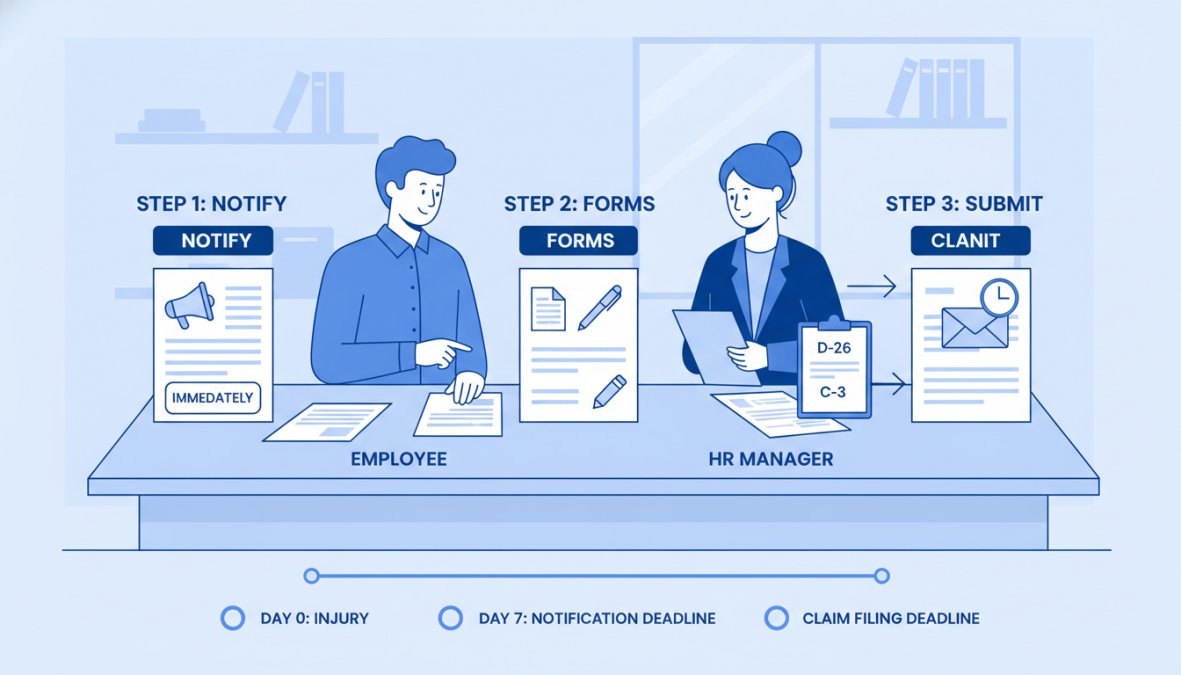
Designate a specific point of contact in your organization for all workers’ comp claims before an injury happens. Businesses that have a clear internal process in place file claims faster, experience fewer disputes, and see lower overall claim costs.
Nevada Workers Compensation Forms C-1, C-3, and C-4 Explained
The Nevada workers’ compensation system relies on three core forms that move a claim from injury to resolution. Misunderstanding which form does what, or who is responsible for submitting it, is a frequent source of delays.
Form C-1: Notice of Injury or Occupational Disease
The C-1 is the employee’s responsibility. It must be filed with the employer within seven days of the injury or the date the employee knew (or should have known) that a condition was work-related. Missing this deadline can jeopardize the employee’s right to benefits, though exceptions exist for injuries that develop gradually over time.
Form C-3: Physician’s Report
The C-3 is completed by the treating physician and sent directly to the insurer within three working days of the initial examination. This form establishes the medical foundation of the claim. It documents the diagnosis, the causal relationship to work activities, and the initial treatment plan. Insurers use the C-3 to evaluate the legitimacy and scope of the claim.
Form C-4: Employee’s Claim for Compensation / Physician’s Report
The C-4 serves a dual purpose. It is both the employee’s formal claim for compensation benefits and an ongoing physician’s report used throughout the treatment process. The C-4 must be filed within 90 days of the injury. It is the document that formally triggers the insurer’s obligation to accept or deny the claim.
| Form | Who Completes It | Deadline | Purpose |
|---|---|---|---|
| C-1 | Employee | Within 7 days of injury | Notice of injury to employer |
| C-3 | Treating physician | Within 3 working days | Medical documentation to insurer |
| C-4 | Employee / Physician | Within 90 days of injury | Formal claim for compensation |
Missing any of these deadlines creates complications. Employers should educate their workforce on the C-1 requirement before any injury occurs.
How Much Does Workers Compensation Insurance Cost in Nevada?
Workers’ compensation insurance cost in Nevada varies considerably depending on the nature of your business, your payroll, your claims history, and the insurer you choose. There is no single flat rate, and the difference between a well-classified policy and a poorly classified one can be thousands of dollars per year on identical payrolls.
How the Premium Formula Works
Premiums are calculated using a classification system that assigns a base rate to each type of job. Your total annual premium is calculated roughly as:
(Total Payroll ÷ 100) × Classification Rate × Experience Modifier = Annual Premium
Each component of that formula deserves attention because each one is a lever you can influence.
Classification Rate: Nevada participates in the National Council on Compensation Insurance (NCCI) rating system, which assigns a four-digit class code to each job type. According to National Council on Compensation Insurance rate data, these codes reflect the statistical injury frequency and severity for each occupation category. A clerical office worker (class code 8810) carries one of the lowest rates available. A roofing contractor carries one of the highest. The same employee doing the same work can be coded differently by different insurers, which is why code audits matter.
Experience Modifier (E-Mod): The e-mod compares your actual claims history against what NCCI’s data predicts for a business of your type and size. A modifier of 1.0 is average. A modifier of 0.80 means your claims history is better than average and your premium is reduced by 20 percent. A modifier of 1.25 means your history is worse than average and your premium increases by 25 percent. New businesses typically start at 1.0 and develop a modifier after three years of claims data. A single serious claim in year one can push your modifier above 1.0 and keep it there for up to three years.
Industry-Specific Cost Profiles for Nevada Employers
This is where generic guides fall short. The cost of workers’ comp is not just an abstract formula, it plays out very differently depending on what your business actually does. Here is how the major Nevada industry categories compare in terms of cost drivers and risk profile:
Construction and Trades (Las Vegas Metro)
Construction is consistently the highest-cost category for workers’ comp in Nevada. Roofing, framing, electrical, and concrete work all carry elevated class code rates reflecting the frequency of falls, equipment injuries, and heat-related illness in the Nevada climate. Las Vegas construction employers also face a seasonal surge in payroll during major project cycles, which directly increases premium bases. Subcontractor relationships are heavily scrutinized here, general contractors who cannot produce certificates of insurance from their subs are typically charged as if those workers are direct employees.
Hospitality, Food Service, and Gaming Support
Las Vegas’s dominant industry creates a specific workers’ comp profile that most national guides ignore entirely. Hotel and casino floor workers, food and beverage staff, and housekeeping employees face slip-and-fall risks, repetitive motion injuries from service work, and ergonomic claims from extended standing shifts. These are not catastrophic-injury industries, but they generate high claim frequency, which over time elevates e-mods for employers who do not actively manage return-to-work programs. Hospitality employers with strong modified-duty programs, meaning they can bring injured workers back in a light-duty capacity before full recovery, consistently maintain lower e-mods than those who do not.
Healthcare and Home Health Services
Nevada’s growing healthcare sector, including home health aides and assisted living workers, faces elevated rates driven by patient-handling injuries (back strains, falls while assisting patients) and exposure to bloodborne pathogens. Healthcare employers often underestimate their workers’ comp costs when budgeting because the class codes for direct patient care are materially higher than administrative or clinical support roles. Accurate segregation of payroll by job function, keeping nurses, aides, and office staff coded separately, is essential to avoid overpaying.
Professional Services, Consulting, and Technology
Office-based businesses in Nevada, accountants, attorneys, IT firms, marketing agencies, carry some of the lowest workers’ comp rates available. The injury risk is minimal, and clerical class codes reflect that. For these employers, the premium is often small enough that the bigger risk is not the cost of coverage but the administrative error of miscoding a field technician or delivery driver under an office rate, which creates an audit liability when the insurer discovers the discrepancy at policy audit.
Retail and Warehouse Operations
Retail employers in Nevada face moderate rates that increase significantly for warehouse and distribution operations. Forklift operation, loading dock work, and high-volume picking environments generate musculoskeletal claims that accumulate over time. Retailers with both storefront and back-of-house warehouse functions need to ensure their payroll is split correctly between the retail floor class code and the warehouse class code, as the latter carries a higher rate.
Factors That Affect Your Premium in Las Vegas and Beyond
Several variables move the needle on what Nevada employers actually pay:
- Industry classification: High-hazard industries like roofing, electrical work, and healthcare carry significantly higher base rates
- Total payroll: More employees and higher wages mean a larger premium base
- Claims history: A single large claim can elevate your e-mod for up to three years
- Safety programs: Documented safety training and OSHA compliance can support lower modifier calculations
- Policy deductible: Choosing a higher deductible reduces your premium but increases out-of-pocket exposure per claim
- Insurer competition: Rates vary between carriers, which is why comparing the market matters
- Payroll audit accuracy: Workers’ comp policies are audited at year-end based on actual payroll. Underestimating payroll at the start of the policy year results in a large audit bill at renewal
The Classification Code Audit: The Most Overlooked Cost-Reduction Tool
Of all the levers available to Nevada employers, the classification code audit is the one most frequently ignored and the one with the most immediate financial impact. Insurers assign class codes at policy inception based on the information you provide. Those codes are rarely revisited unless you or your agent requests a review.
Common miscoding patterns that result in overpayment include:
- Office managers and administrative staff coded under a higher-rate operations code
- Owners who do not perform field work coded under field labor rates
- Businesses that have shifted their operations (for example, from field installation to remote consulting) still carrying field-rate codes from years ago
- Multi-location businesses with different risk profiles all coded under the highest-risk location’s code
United Family Insurance compares workers’ compensation options across multiple carriers on your behalf, which means you are not locked into the first quote you receive. Many Las Vegas business owners find meaningful savings simply by having an expert review their classification codes, which are frequently miscoded and result in overpayment.
Your workers’ comp classification code is set by your insurer but is often wrong. An incorrect code for a lower-risk job category can cost you thousands in unnecessary premiums annually. Ask your agent to audit your codes at every renewal, and specifically ask whether your payroll is being split correctly between different job functions if your workforce includes both office and field employees.
What a Policy Audit Means for Your Business
One cost dynamic that surprises many Nevada employers is the year-end payroll audit. Workers’ comp premiums are estimated at the start of the policy year based on projected payroll. At the end of the year, the insurer audits your actual payroll records and adjusts the final premium accordingly. If your business grew faster than projected, you will owe additional premium. If payroll came in lower than estimated, you receive a credit.
Employers who experience rapid growth, a common pattern for Las Vegas businesses in construction and hospitality during active project cycles, should update their payroll estimates mid-year to avoid a large lump-sum audit bill at renewal. Most insurers will adjust the installment schedule if you report a significant payroll change during the policy period.
Workers Compensation vs. Other Business Insurance in Nevada
Workers’ compensation is mandatory and covers employee injuries. It does not cover everything else that can go wrong in your business. Understanding where workers’ comp ends and other coverage begins is essential for any Nevada employer.
General liability insurance covers third-party claims: a customer who slips and falls in your Las Vegas store, property damage you cause at a client’s location, or bodily injury claims from people who are not your employees. Workers’ comp covers your employees; general liability covers everyone else.
Professional liability insurance (also called errors and omissions) covers claims that your professional services caused financial harm. This matters for consultants, accountants, IT professionals, and similar service providers operating in Nevada.
Commercial auto insurance covers vehicles used for business purposes. Personal auto policies typically exclude business use, so Nevada employers with company vehicles or employees who drive for work need separate commercial coverage.
Cyber insurance has become increasingly relevant for Las Vegas businesses that store customer data or process payments online. A data breach can trigger costs that no other standard policy covers.
As documented in Nevada Division of Insurance commercial coverage guidance, the state regulates each of these lines separately, and each serves a distinct risk management function.
When You May Also Need General Liability or a BOP
A business owner’s policy (BOP) bundles general liability and commercial property insurance into a single policy, typically at a lower combined premium than buying each separately. For most small businesses in Las Vegas, a BOP paired with workers’ compensation provides the core coverage foundation.
You likely need a BOP or standalone general liability if:
- Customers visit your physical location
- You work at clients’ properties
- You sign contracts that require proof of liability coverage (a certificate of insurance, or COI, is the standard document used to demonstrate this)
- You advertise your services and face potential claims of advertising injury, defamation, or copyright infringement
A certificate of insurance (COI) is a one-page document your insurer issues that summarizes your active coverage. Landlords, general contractors, and corporate clients in Nevada routinely require a COI before allowing you to operate on their premises or enter into a contract. Your insurer can issue one quickly once your policies are in place.
The right combination of coverage depends on your specific operations. A Las Vegas restaurant has different exposure than a freelance graphic designer, even if both have the same number of employees.
According to U.S. Small Business Administration guide to business insurance, many small business owners underestimate their liability exposure until a claim occurs, at which point the gap in coverage becomes expensive to close.
Conclusion: Protecting Your Business and Employees in Nevada
Nevada’s workers’ compensation requirement exists because workplace injuries are expensive, unpredictable, and capable of destroying a business that isn’t prepared. The compliance obligation is clear, the penalties for ignoring it are severe, and the cost of proper coverage is almost always less than the cost of a single uninsured claim.
Managing workers’ compensation alongside general liability, commercial auto, and other required coverage is genuinely complex for Las Vegas business owners who are focused on running their operations. United Family Insurance compares the market on your behalf, with expert agents who review your classification codes, audit your coverage gaps, and secure affordable plans without you spending hours on hold with carriers. Get a quote from United Family Insurance and make sure your business is protected before the next workday begins.
Frequently Asked Questions
Does every Nevada employer need workers compensation insurance?
Yes, workers compensation is mandatory in Nevada for virtually all employers who have at least one employee, whether full-time or part-time. Nevada law requires employers to secure coverage before hiring their first worker. Failure to do so exposes the business to significant financial penalties and legal liability. Certain narrow exemptions exist, such as for sole proprietors with no employees or specific agricultural workers, but most businesses operating in Nevada, including those in Las Vegas, must carry a valid policy.
What are the penalties for not having workers comp in Nevada?
The penalties for no workers comp in Nevada can be severe. Employers found operating without required coverage may face fines of up to $15,000 per violation, be ordered to stop business operations, and be held personally liable for all medical costs and lost wages resulting from any employee injury. The Nevada Division of Industrial Relations actively enforces compliance. In addition to financial penalties, uninsured employers lose certain legal protections, meaning injured workers can sue them directly in civil court.
Who is exempt from workers compensation in Nevada?
Nevada workers compensation exemptions include sole proprietors with no employees, certain domestic workers employed in private homes, some agricultural and ranch workers, and corporate officers who choose to formally exclude themselves from coverage. Independent contractors are generally not covered, but Nevada applies a strict legal test to determine true contractor status, misclassifying employees as contractors is a common and costly mistake. If you are unsure whether your workers qualify for an exemption, consulting a licensed insurance agent is strongly recommended.
How do I report a work-related injury in Nevada?
To file a workers comp claim in Nevada, the injured employee must complete a C-1 Notice of Injury form within 7 days of the incident and give it to their employer. The employer then notifies their insurance carrier. A treating physician completes the C-3 Medical Report, and the insurer uses a C-4 form to authorize treatment. Missing these deadlines can jeopardize the claim. Employers should post clear injury-reporting procedures in the workplace and ensure all Nevada workers compensation forms are readily accessible to staff.
Are independent contractors covered by workers comp in Nevada?
Generally, independent contractors are not covered by workers compensation in Nevada. However, Nevada uses specific criteria, such as the degree of control the hiring business has over the worker, to determine true contractor status. If a worker is misclassified as an independent contractor when they legally qualify as an employee, the employer can face back premiums, penalties, and full liability for any injuries. Business owners in Las Vegas and across Nevada should review worker classifications carefully with a licensed insurance professional.