

Table of Contents
- Renters Insurance Cost for 1 Bedroom Apartments: What You Need to Know
- Average Renters Insurance Cost by State
- Factors Affecting Your Renters Insurance Premium
- What Does Renters Insurance Cover?
- Understanding Your Renters Insurance Deductible
- How to Get Renters Insurance Quotes for Your 1 Bedroom
- Landlord vs. Tenant Responsibility: What You Must Know
- How to Lower Your Renters Insurance Costs
Last Updated: July 23, 2026
Renters Insurance Cost for 1 Bedroom Apartments: What You Need to Know
Your renters insurance cost depends on where you live, what you own, your credit score, and your coverage limits. At United Family Insurance, we’ve helped thousands of renters navigate these decisions. Most people either overpay for coverage they don’t need or underpay and leave themselves exposed to loss.
A 1-bedroom apartment typically costs less to insure than larger units, and concrete steps can lower your premium without sacrificing protection. Below, we’ll walk you through how renters insurance cost for 1 bedroom apartment scenarios breaks down, what factors drive your premium, and how to find coverage that fits your situation.
The biggest mistake renters make is assuming all policies are identical. Two identical apartments in different zip codes can have premiums that differ by 40% or more. Location matters far more than apartment size alone.
Average Renters Insurance Cost by State
Your renters insurance cost for 1 bedroom apartment depends heavily on location. State-level variation reflects local risk factors: crime rates, weather patterns, building codes, and insurance competition. According to National Association of Insurance Commissioners data on state-level insurance costs, regional variation can swing premiums by 30-50% for identical coverage.
Las Vegas renters face their own distinct pricing environment. The city’s high population density, warm climate, and specific local risk profile all influence what carriers charge. A 1-bedroom in the Las Vegas Valley typically costs less than a unit in a high-crime urban corridor but potentially more than a suburban Nevada location with lower incident rates.
Never assume your neighbor’s premium applies to you. Request quotes from multiple carriers for your specific address. The difference between shopping around and accepting the first quote often exceeds $100 annually.
State and zip code matter more than apartment size. Two identical 1-bedroom units 5 miles apart can have 25-40% premium differences based on local risk factors.
Factors Affecting Your Renters Insurance Premium
Several specific factors determine what you’ll pay for renters insurance cost for 1 bedroom apartment coverage.
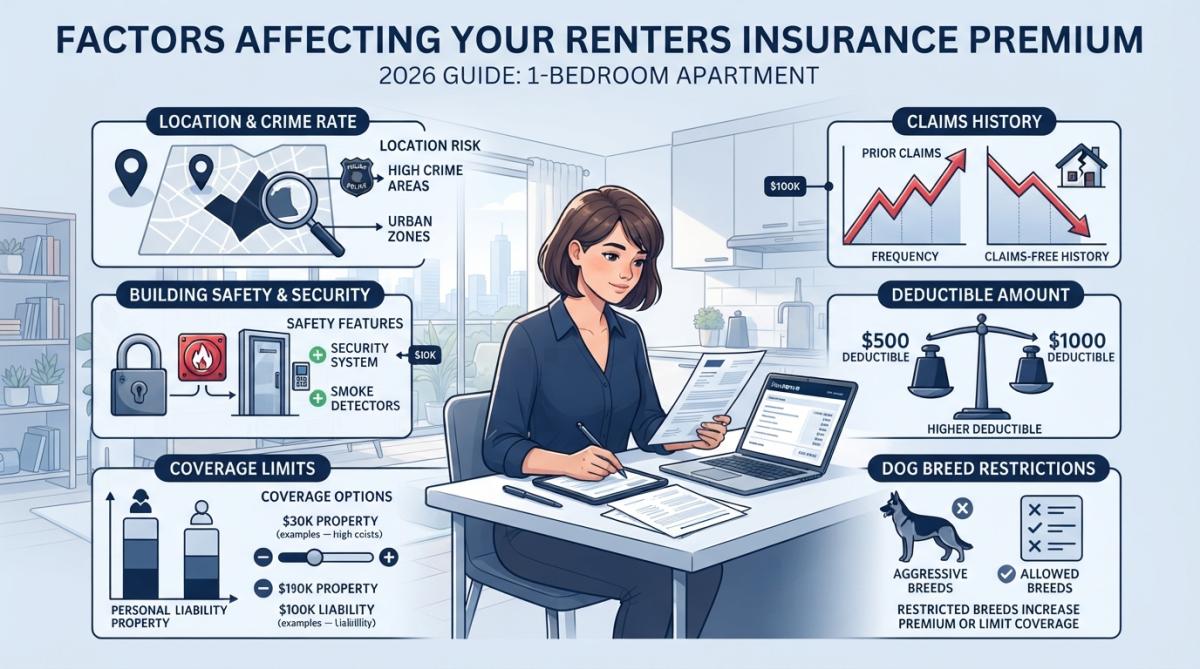
Building and Location Characteristics
The building itself influences your premium. Older buildings with outdated electrical systems or plumbing carry higher risk. Buildings with modern fire suppression systems, security systems, and alarm monitoring see lower rates. Whether your building is sprinklered and located in a flood zone or high-crime area matters. These facts about the property affect your cost but you cannot change them.
Your Claims History
Multiple claims signal higher risk to insurers. A clean claims history keeps your premium lower. Avoid small claims if possible and focus on protecting what matters most so you don’t need to file.
Credit-Based Insurance Score Impact
Your credit score influences your renters insurance cost for 1 bedroom apartment significantly. Insurance companies use credit-based insurance scores to predict claim frequency. Research from Consumer Federation of America study on insurance scoring shows that renters with lower credit scores pay 20-40% higher premiums for identical coverage.
If your score is lower, improve it over time and revisit your insurance quotes annually. Some carriers weight credit less heavily than others, making shopping around critical.
Apartment Size and Location
A 1-bedroom apartment is smaller than larger units, which typically means lower personal property coverage limits and thus lower premiums. Location within Las Vegas matters too. A 1-bedroom in a secure, well-maintained building near major commercial areas will likely cost less than an identical unit in an older building or higher-crime neighborhood.
What Does Renters Insurance Cover?
Renters insurance covers three primary areas: your personal property, your liability exposure, and additional living expenses if your apartment becomes uninhabitable.
Personal Property Coverage and Replacement Cost
Personal property coverage protects your belongings, furniture, electronics, clothing, and kitchenware. Two approaches exist: actual cash value and replacement cost. Actual cash value accounts for depreciation. Replacement cost reimburses what you’d pay today to replace items new. Replacement cost premiums are higher but reimbursement is significantly more generous.
For a 1-bedroom apartment, typical personal property coverage limits range from $20,000 to $50,000. Walk through your apartment and estimate the value of everything to determine your real need. Many renters underestimate this amount.
Actual cash value policies reimburse less than replacement cost because they account for depreciation. A 5-year-old TV might be worth $200 in actual cash value but cost $600 to replace new. Know which type your policy uses before you buy.
Liability Protection and Medical Payments
Liability protection covers legal and medical costs if someone is injured in your apartment and sues you, or if you accidentally damage someone else’s property. Medical payments coverage is separate and smaller, typically $1,000-$5,000, paying medical bills for injuries regardless of fault.
For a 1-bedroom renter, standard liability limits are $100,000 to $300,000. Most renters choose $300,000 as a baseline. The premium difference between these tiers is minimal, often just a few dollars per month.
Additional Living Expenses (Loss of Use)
If your apartment becomes uninhabitable due to a covered loss, additional living expenses coverage pays for temporary housing, meals, and other costs while repairs happen. For a 1-bedroom apartment, this coverage typically covers 10-20% of your personal property limit.
Understanding Your Renters Insurance Deductible
Your deductible is the amount you pay out of pocket before your insurance kicks in. Higher deductibles lower your premium. A $500 deductible costs less than a $250 deductible.
For a 1-bedroom renter, a $250 or $500 deductible is typical. Choose based on your emergency savings. If you have $1,000+ in savings, a $500 deductible saves you money annually and is manageable if you file a claim.
Your deductible applies per claim, not per year. If you have two separate losses in one year, you pay the deductible twice. This is why avoiding small claims matters, a $300 loss with a $250 deductible means you pay $250 and the insurer pays $50.
How to Get Renters Insurance Quotes for Your 1 Bedroom
Getting quotes effectively requires preparation and knowing what to compare.
Step-by-Step Quote Comparison Process
Document what you own by walking through your 1-bedroom apartment and estimating the value of belongings by category: furniture, electronics, clothing, and kitchen items. This number informs your personal property coverage limit.
Decide on deductible and liability limits. For most 1-bedroom renters, $250-$500 deductible and $300,000 liability are solid starting points. Decide whether you want actual cash value or replacement cost coverage.
Gather basic information: your apartment address, move-in date, whether the building has security systems or sprinklers, your age, and whether you have prior claims. Visit three to five insurance carriers’ websites or contact agents directly. Input the same coverage details across all quotes so you’re comparing apples to apples.
Compare total annual premiums, including discounts for bundling, paying upfront, or maintaining good credit. These discounts can reduce your effective cost by 10-25%.
Most carriers offer 10-20% discounts for bundling renters insurance with auto insurance. If you have a car, asking about bundle pricing should be your first question. The savings often exceed $100 annually.
Bundling with Auto Insurance to Lower Costs
If you own a car, bundling your renters and auto insurance with the same carrier typically yields significant discounts. A typical bundle discount ranges from 10-25% off your renters insurance premium. Over five years, bundling saves $100-$250 just on renters insurance.
Bundling also simplifies claims, renewals, and coverage adjustments. However, bundling only makes sense if the combined rates are competitive. Run the numbers both ways before deciding.
Landlord vs. Tenant Responsibility: What You Must Know
A critical misunderstanding affects many renters: the belief that landlord insurance covers a tenant’s belongings. It doesn’t.
Your landlord’s insurance protects the building structure and the landlord’s liability. It covers fire damage to the walls, roof, and common areas. It does not cover your personal property inside the apartment.
If a fire destroys your furniture, electronics, and clothing, your landlord’s insurance reimburses the landlord for building damage. Your renters insurance reimburses you for your belongings. Similarly, if someone is injured in your apartment and sues, your renters insurance covers your liability. The landlord’s insurance does not protect you from tenant liability claims.
In Nevada, landlords are not required to carry liability insurance that covers tenant-caused injuries. Renters insurance is your only protection against someone suing you for damages or injuries caused by your actions or negligence.
How to Lower Your Renters Insurance Costs
Several levers reduce your renters insurance cost for 1 bedroom apartment without cutting coverage to unsafe levels.
Install Security and Safety Devices
Many carriers offer discounts for deadbolt locks, security systems, fire extinguishers, and smoke detectors. Installing these devices can reduce your annual premium by 5-15%.
Maintain a Clean Claims History
File only necessary claims. If you have a small loss you can absorb, don’t file. Claims increase future premiums.
Improve Your Credit Score
Since credit-based insurance scores influence your premium, improving your credit score helps. Pay bills on time, reduce outstanding debt, and keep credit card balances low.
Shop Annually
Carriers adjust rates yearly, and new competitors enter markets constantly. Requesting new quotes every 12 months often reveals savings of $50-$150 annually.
Increase Your Deductible
Moving from a $250 to $500 deductible typically saves $15-$30 per year. Only make this change if you have emergency savings to cover the higher deductible.
Bundle Policies
Bundling renters and auto insurance typically saves 10-25%. If you’re not bundled, get a quote for both policies together.
Ask About All Available Discounts
Carriers offer discounts for paid-in-full annual payments, automatic payment setup, good student grades, military service, professional affiliations, and more. Ask your agent about every discount you might qualify for.
Finding the right renters insurance cost for 1 bedroom apartment requires balancing coverage needs with budget reality. The process starts with understanding what you own, what risks you face, and what protection you actually need. United Family Insurance simplifies this by comparing quotes from multiple carriers on your behalf, identifying discounts you qualify for, and ensuring your coverage aligns with your situation. Get a quote today and discover how much you can save while securing the protection your 1-bedroom apartment and belongings deserve.
Frequently Asked Questions
What is the average cost of renters insurance per month for a 1-bedroom apartment?
Renters insurance cost for 1 bedroom apartments varies significantly by state, location, and coverage selections. Pricing depends on your chosen coverage limits, deductible amount, and personal property protection level. Contact United Family Insurance for a personalized quote that reflects your specific situation, our agents compare the market to find you competitive rates tailored to your 1-bedroom apartment's needs.
How does my credit score affect my renters insurance premium?
Your credit-based insurance score is one of the most significant factors affecting your renters insurance cost. Insurers use this metric to assess risk, and a lower score typically results in higher premiums. Improving your credit over time can lead to lower rates when you renew your policy. United Family Insurance agents help you understand how your credit impacts pricing and identify ways to reduce your overall costs.
Can I save money by bundling renters insurance with auto insurance?
Yes, bundling your renters insurance with auto insurance often qualifies you for substantial multi-policy discounts. Many insurance carriers offer significant savings, sometimes 10-25% or more, when you combine policies. United Family Insurance specializes in bundled coverage solutions, comparing options across carriers to maximize your savings while maintaining comprehensive protection for both your vehicle and personal belongings.
What does renters insurance cover, and what doesn't?
Renters insurance typically covers personal property (furniture, electronics, clothing), liability protection (if someone is injured in your apartment), and additional living expenses if you need temporary housing due to a covered loss. It covers theft, fire, smoke damage, and vandalism. However, it does not cover the building structure itself (landlord's responsibility) or certain high-value items without endorsements. Review your policy details with an agent to understand specific coverage limits and exclusions.