

Table of Contents
- What Is Commercial Property Insurance and Who Needs It?
- What Does Commercial Property Insurance Cover?
- Policy Exclusions You Need to Know Before You Buy
- Commercial Property Insurance Cost Factors That Affect Your Premium
- How to Compare Business Insurance Quotes the Right Way
- How to Get Commercial Property Insurance Quotes Online in 5 Steps
- What to Expect During the Claims Process
- Get Commercial Property Insurance Quotes Online with United Family Insurance
- Conclusion
Last Updated: June 1, 2026
Protecting your business assets is not optional, and the fastest way to start is to get commercial property insurance quotes online before a single incident sets you back. United Family Insurance has helped Las Vegas business owners compare coverage options across multiple carriers, cutting through the noise so you spend less time on hold and more time running your operation. The reality is that many small businesses in Nevada carry either the wrong coverage or not enough of it, and they only discover the gap after filing a claim. Below, we’ll show you exactly how to compare quotes, what your policy should cover, and where most business owners go wrong before they sign.
What Is Commercial Property Insurance and Who Needs It?
Commercial property insurance is a business insurance policy that protects your physical assets, including your building, equipment, inventory, and fixtures, against covered losses such as fire, theft, vandalism, and certain weather events. It is the financial safety net between a single damaging incident and a business that cannot reopen.
Most people assume this coverage is only for large companies with sprawling warehouses. That assumption is wrong. Any business that owns or leases a physical space, stores inventory, or operates with equipment it cannot afford to replace out of pocket needs this protection.
The policy typically covers two categories: the commercial building itself (if you own it) and business personal property (BPP) inside it. Some policies also bundle in business interruption coverage, which replaces lost income when a covered event forces you to close temporarily.
According to the Insurance Information Institute’s guidance on commercial property, commercial property losses from fire alone account for billions in claims annually across the United States, and small businesses are disproportionately affected because they lack the reserves to self-insure.
Who Should Have Commercial Property Insurance in Las Vegas?
Las Vegas presents a specific risk profile that many national insurance guides ignore. The desert climate means extreme heat, occasional flash flooding, and dust storms that can damage HVAC systems, roofing, and exterior equipment. The city’s hospitality-heavy economy means a large share of businesses operate with high-value fixtures, electronics, and inventory that depreciate fast if damaged.
Business types in Las Vegas that consistently need commercial property coverage include:
- Restaurants and food service operations with commercial kitchen equipment
- Retail shops along the Strip or in local shopping centers with significant inventory
- Medical and dental offices with specialized diagnostic equipment
- Auto repair shops with tools and lifts
- Salons and spas with treatment equipment and product inventory
- Contractors and tradespeople who store tools and materials on-site
If you operate near me in the greater Las Vegas area and rent your commercial space, you still need coverage. Your landlord’s policy covers the building structure, not your contents. That distinction catches many Nevada tenants off guard.
What Does Commercial Property Insurance Cover?
Commercial property insurance covers physical assets and income losses tied to specific named perils. The policy pays to repair, replace, or rebuild what was damaged, up to your chosen coverage limits and minus your deductible. But the more useful question, the one competitors rarely answer, is not just what is covered, but how coverage actually applies in practice, and where the boundaries are drawn in ways that surprise business owners at claim time.
The Core Covered Perils
A standard commercial property policy typically covers losses caused by:
- Fire damage, including smoke residue and water damage from firefighting suppression systems
- Theft and burglary, covering stolen inventory, equipment, and in some cases cash in a secured safe
- Vandalism, including broken windows, graffiti removal, and deliberate destruction of fixtures
- Wind and hail, though the threshold for what qualifies as a covered wind event varies by carrier and policy form
- Burst pipes and internal water damage from plumbing failures originating inside the building
- Equipment breakdown caused by electrical surges or mechanical failure, typically only with a specific endorsement added
What Is NOT Covered: The Exclusions Most Guides Skip
This is the section that separates a useful insurance guide from a marketing brochure. Standard commercial property policies contain exclusions that are not buried in fine print, they are standard industry language, but most business owners never read them until after a claim is denied.
The most consequential exclusions in a standard commercial property policy include:
Flooding from external sources. Overland flooding, storm surge, and rising groundwater are excluded from virtually every standard commercial property policy. In Las Vegas, this matters more than most business owners realize. The valley’s hardpan soil and flash flood corridors mean that a single monsoon event can push water into ground-floor commercial spaces with almost no warning. A separate flood policy, either through the National Flood Insurance Program (NFIP) or a private flood carrier, is the only way to close this gap. The NFIP offers commercial building coverage and contents coverage as separate policies, and private market options sometimes offer broader terms.
Earthquakes. Nevada sits within a seismically active region. Earthquake coverage requires either a standalone policy or a specific endorsement, and it is not included in any standard commercial property form.
Employee theft and dishonesty. If an employee steals inventory, skims cash, or commits fraud, a standard commercial property policy will not respond. This exposure falls under a commercial crime policy or a crime endorsement, which is a separate product entirely.
Gradual deterioration and maintenance failures. If your roof leaks because it was never maintained, or your HVAC fails because it was overdue for service, the insurer will classify that as a maintenance issue rather than a covered loss. The distinction between sudden accidental damage and gradual deterioration is one of the most litigated areas in commercial property claims.
Mold resulting from a covered water loss. Many policies cover the initial water damage event but exclude the mold remediation that follows if the business owner did not act quickly enough to dry the space. Some carriers offer mold remediation endorsements, but the base policy typically caps or excludes it.
Outdoor property and signage. Fences, outdoor signs, landscaping, and exterior lighting are often subject to separate sublimits or excluded entirely from the base policy. For Las Vegas businesses where exterior signage is a significant investment, this sublimit deserves specific attention when reviewing a quote.
Buying a commercial property policy without reviewing the exclusions section is one of the most expensive mistakes a business owner can make. Two policies at the same premium can have meaningfully different exclusion lists. Always ask your agent to walk through what is NOT covered before you sign, not just what is.
How Coverage Actually Pays Out: Named Perils vs. Open Perils
There are two fundamental policy structures, and the difference affects every claim you ever file:
Named perils policies only cover losses caused by perils specifically listed in the policy. If the cause of your loss is not on the list, the claim is denied. These policies are typically less expensive.
Open perils policies (also called special form or "all-risk" policies) cover any cause of loss that is not explicitly excluded. If a cause of loss is not listed as an exclusion, it is covered. These policies are broader and generally cost more, but they provide significantly stronger protection because the burden of proof shifts, the insurer must demonstrate that an exclusion applies rather than the policyholder proving the peril is covered.
For most Las Vegas small businesses with meaningful equipment or inventory exposure, an open perils policy form is worth the additional premium. The practical difference becomes clear when an unusual loss occurs, a power surge that does not qualify as equipment breakdown, a vehicle crashing into your storefront, or a burst irrigation line damaging your inventory. Named perils policies create ambiguity in these scenarios; open perils policies generally do not.
The most common misconception about commercial property insurance is that it covers everything inside your building automatically. It does not. Business personal property and structural coverage are separate line items with separate limits, and the policy form, named perils versus open perils, determines how broadly those limits actually apply when something goes wrong.
Industry-Specific Coverage Considerations
Generic insurance guides treat all businesses as interchangeable. They are not. The coverage gaps that matter most depend heavily on what your business actually does.
Restaurants and food service: Spoilage coverage for refrigerated inventory is not included in a standard commercial property policy. A power outage that ruins thousands of dollars of perishable food is a common and painful gap. Spoilage endorsements are available and relatively inexpensive for the protection they provide. Commercial kitchen equipment, ranges, hood systems, walk-in coolers, also warrants a higher BPP limit than most restaurant owners initially estimate.
Retail businesses: Inventory valuation is the central challenge. Retail stock fluctuates seasonally, and a policy written in January may be significantly underinsured by the holiday season. Some carriers offer peak season endorsements that temporarily increase BPP limits during high-inventory periods.
Medical and dental offices: Specialized diagnostic equipment, imaging systems, dental chairs, sterilization units, carries replacement costs that standard BPP estimates often understate. These businesses also frequently need a specific endorsement for electronic data and records, since patient records stored on-site represent a significant asset and a significant liability if destroyed.
Contractors and tradespeople: Tools and equipment stored at a job site rather than a fixed business location may not be covered under a standard commercial property policy, which typically covers property at the listed business address. Inland marine coverage (also called tools and equipment coverage) is the correct product for mobile business property.
Understanding which coverage gaps apply to your specific industry is the difference between a policy that works and one that looks adequate until you actually need it.
Policy Exclusions You Need to Know Before You Buy
This is the part most insurance guides gloss over, and it is where policyholders get blindsided at claim time.
Standard commercial property insurance policies do NOT cover:
- Flooding from external sources, including storm surge and overland flooding. Nevada’s flash flood risk is real, and a separate flood policy through the National Flood Insurance Program or a private carrier is worth evaluating.
- Earthquakes, which require a separate endorsement or standalone policy.
- Employee theft and fraud, which falls under a crime insurance policy or commercial crime endorsement.
- Vehicle damage, even if the vehicle is used for business. That falls under commercial auto insurance.
- Wear and tear or gradual deterioration, which insurers classify as a maintenance issue, not a covered loss.
- Intentional acts, meaning damage you or your employees cause deliberately.
Buying a commercial property policy without reviewing the exclusions list is one of the most expensive mistakes a business owner can make. Always ask your agent to walk through what is NOT covered before you sign. A policy that looks affordable may have exclusions that leave your biggest risks unprotected.
Understanding exclusions is not just about avoiding gaps. It also helps you compare quotes accurately. Two policies at the same premium may have meaningfully different exclusion lists, and the cheaper one is not always the better value.
Commercial Property Insurance Cost Factors That Affect Your Premium
No two commercial property insurance premiums are identical, because underwriting weighs a combination of property-specific and business-specific variables. Understanding these factors does two things: it helps you anticipate where your quote will land, and it identifies the levers you can actually pull to reduce your premium without reducing your protection.
The Primary Rating Factors
Underwriters evaluate the following variables when pricing a commercial property policy:
| Factor | How It Affects Premium | What You Can Control |
|---|---|---|
| Building construction type | Fire-resistant masonry or steel construction lowers risk vs. wood frame | Limited unless you own the building |
| Location and local crime rate | Higher crime areas increase theft risk rating | Security systems can partially offset this |
| Business type and industry | Restaurants and auto shops pay more than professional offices | Accurate classification matters, miscoding costs you |
| Coverage limits chosen | Higher limits mean higher premiums | Set limits based on actual replacement value, not book value |
| Deductible amount | Higher deductible lowers premium | Match deductible to what you can absorb out of pocket |
| Claims history | Prior claims signal higher risk to underwriters | Three to five years of clean history improves pricing |
| Security systems | Monitored burglar alarms reduce theft risk rating | One of the fastest ways to reduce premium |
| Sprinkler systems | Automatic fire suppression significantly reduces fire risk | Verify your system is up to code, non-compliant systems may not get the credit |
| Years in business | Established businesses are viewed as lower risk | Time in operation works in your favor |
| Policy form | Open perils costs more than named perils | Understand the trade-off before choosing the cheaper form |
What Businesses in Different Industries Actually Pay
Most insurance guides give a single starting price and call it a day. The reality is that industry type is one of the strongest predictors of where your premium lands, and the range across industries is wide.
Professional service businesses, accountants, consultants, insurance agencies, typically carry lower commercial property premiums because their BPP consists largely of computers and furniture, their operations do not involve flammable materials, and their liability exposure from property damage is limited. A small office in a modern building with a monitored alarm system represents a low-risk profile to an underwriter.
Food service businesses sit at the opposite end of the spectrum. Commercial kitchens involve open flame, high-heat cooking equipment, grease accumulation in hood systems, and significant perishable inventory. Underwriters price this risk accordingly. A restaurant with the same square footage and the same building as a professional office will pay a meaningfully higher premium, and the gap widens if the kitchen equipment is older or the hood suppression system has not been recently serviced.
Auto repair shops and contractors face elevated premiums because of the combination of flammable materials (solvents, fuels, paints), high-value tools and equipment, and the physical nature of the work environment. Theft risk is also higher for businesses that store portable, high-value tools.
Medical and dental offices occupy a middle tier, lower fire risk than food service, but higher BPP values due to specialized equipment, and potential exposure from electronic records and data that requires specific endorsements.
If a quote seems unusually low for your industry, the most likely explanation is not that the carrier is more competitive, it is that the policy has a narrower coverage form, higher exclusions, or lower sublimits than a policy priced closer to the market average. Cheap and comprehensive rarely coexist in commercial property insurance.
The Las Vegas-Specific Premium Variables
National insurance guides treat location as a zip code on a form. For Las Vegas businesses, location affects premium in ways that are worth understanding specifically.
Businesses near high-traffic entertainment corridors, the Strip, Fremont Street, and surrounding commercial zones, face higher burglary risk ratings than those in suburban commercial parks. Foot traffic that drives revenue also drives theft exposure, and underwriters price that into the premium.
The desert climate creates a different set of variables. Extreme heat accelerates wear on roofing materials and HVAC systems, which affects how underwriters assess the building’s condition. Flash flood risk is concentrated in specific drainage corridors across the valley, and businesses in those areas may face higher premiums or coverage restrictions on water damage depending on the carrier.
Building age matters significantly in Las Vegas, where a large share of commercial inventory was built during specific development booms. Older buildings with outdated electrical systems, original plumbing, or roofing past its expected service life will be rated higher than newer construction, and some carriers will require an inspection before binding coverage.
Replacement Cost vs. Actual Cash Value: A Decision Framework
This is one of the most consequential decisions in structuring a commercial property policy, and it deserves more than a brief mention.
Replacement cost coverage (RCV) pays what it costs to replace damaged property with new items of similar kind and quality, with no depreciation deducted. If a covered loss destroys your commercial refrigeration unit, replacement cost coverage pays for a new equivalent unit at today’s prices.
Actual cash value (ACV) pays the depreciated value of the item at the time of loss. The insurer calculates what the item was worth, accounting for age, condition, and market depreciation, and pays that amount. The gap between ACV and what it actually costs to replace the item comes out of your pocket.
The practical difference compounds over time. Equipment that has been in service for several years carries significant depreciation under ACV valuation. For a restaurant owner, that might mean a commercial range with an ACV of a fraction of its replacement cost. For a medical office, it could mean diagnostic equipment where the ACV payout covers only a portion of a replacement unit.
The decision framework is straightforward:
- Choose replacement cost if your BPP includes equipment that is expensive to replace, has been in service for more than a few years, or would require significant out-of-pocket spending to replace at ACV payout levels.
- ACV may be sufficient if your BPP consists primarily of low-value or easily replaceable items, or if you have the cash reserves to cover the depreciation gap without disrupting operations.
Replacement cost policies carry higher premiums, typically a meaningful percentage more than ACV for the same coverage limits, but for equipment-heavy operations, the difference in payout at claim time almost always justifies the additional cost.
Five Ways to Reduce Your Premium Without Reducing Your Coverage
Most business owners approach insurance cost reduction by either raising their deductible or lowering their limits. Both strategies reduce premium, but one reduces your out-of-pocket exposure at claim time and the other reduces your protection. There are better options.
1. Install and certify a monitored security system. A professionally monitored burglar alarm, one that reports to a central station and can dispatch law enforcement, earns a premium credit with most carriers. The credit varies, but the system often pays for itself in reduced premiums within the first year or two.
2. Verify your sprinkler system is up to current code. Automatic fire suppression earns a significant premium reduction, but only if the system is functional and compliant. A system that exists but has not been inspected or serviced recently may not receive the full credit, and some carriers will require documentation of recent inspection.
3. Bundle with a Business Owners Policy (BOP). For businesses that qualify, generally smaller businesses below certain revenue and square footage thresholds, a BOP packages commercial property and general liability coverage at a lower combined premium than purchasing each separately. The savings are real, and the coverage is typically equivalent for businesses that fit the BOP eligibility criteria.
4. Review your BPP limit for accuracy in both directions. Overinsurance is less common than underinsurance, but it happens. If your BPP limit was set years ago and you have since reduced your inventory, sold equipment, or downsized operations, you may be paying for coverage you no longer need. An annual review of your BPP limit against your current asset inventory keeps your premium aligned with your actual exposure.
5. Maintain a clean claims history. This is a long-term strategy rather than an immediate lever, but it matters. Carriers review three to five years of claims history when pricing a renewal. Businesses that handle small losses out of pocket rather than filing claims for minor incidents often see better renewal pricing than those with frequent small claims on record.
Request quotes from at least three carriers before deciding. Premium differences for identical coverage can be significant, especially in Las Vegas where local risk factors vary by zip code and carrier appetite for specific industries differs. An independent agent with access to multiple markets can surface pricing and coverage options that a direct-to-carrier search will miss.
How to Compare Business Insurance Quotes the Right Way
Comparing business insurance quotes is not about finding the lowest number. It is about finding the policy that covers your actual exposure at a price that makes sense for your operation.
Most business owners make one of two mistakes: they compare premiums without comparing coverage limits, or they compare limits without reading the exclusions. Both approaches lead to the same outcome: a policy that fails when it matters most.
A disciplined comparison process looks like this:
- Confirm that each quote uses the same coverage limits and deductible for an apples-to-apples comparison
- Review the exclusions section on each policy, not just the declarations page
- Check whether the policy uses replacement cost or actual cash value for BPP
- Verify that business interruption coverage is included and note the restoration period
- Ask whether the carrier offers an endorsement for equipment breakdown, which standard policies often exclude
Working with an independent agent who compares the market on your behalf, the way United Family Insurance operates, removes the burden of tracking down multiple quotes individually. You get side-by-side comparisons without spending hours on hold with separate carriers.
Request quotes from at least three carriers before deciding. Premium differences for identical coverage can be meaningful, especially in Las Vegas where local risk factors vary by zip code. An independent agent with market access can surface options a direct-to-carrier search will miss.
How to Get Commercial Property Insurance Quotes Online in 5 Steps
The process to get commercial property insurance quotes online is straightforward when you know what information to have ready. Most digital quote processes take 10 to 20 minutes when you come prepared.
Step 1: Gather your business information
You’ll need your business name, address, entity type (LLC, sole proprietor, corporation), and years in operation. Carriers use this to assess business maturity and risk profile.
Step 2: Document your property details
Note the square footage of your space, whether you own or lease, the year the building was constructed, and the construction type (wood frame, masonry, steel). If you own the building, have a rough replacement value estimate ready.
Step 3: Estimate your business personal property value
Total the replacement cost of your equipment, inventory, furniture, and fixtures. Erring on the high side here is better than discovering you are underinsured after a loss.
Step 4: Choose your coverage options
Decide between replacement cost and actual cash value, select your deductible, and determine whether you need business interruption coverage included. If you are not sure, ask an agent before finalizing.
Step 5: Compare quotes and review policy details
Do not stop at the premium. Compare coverage limits, exclusions, and endorsement options across each quote before selecting a policy.
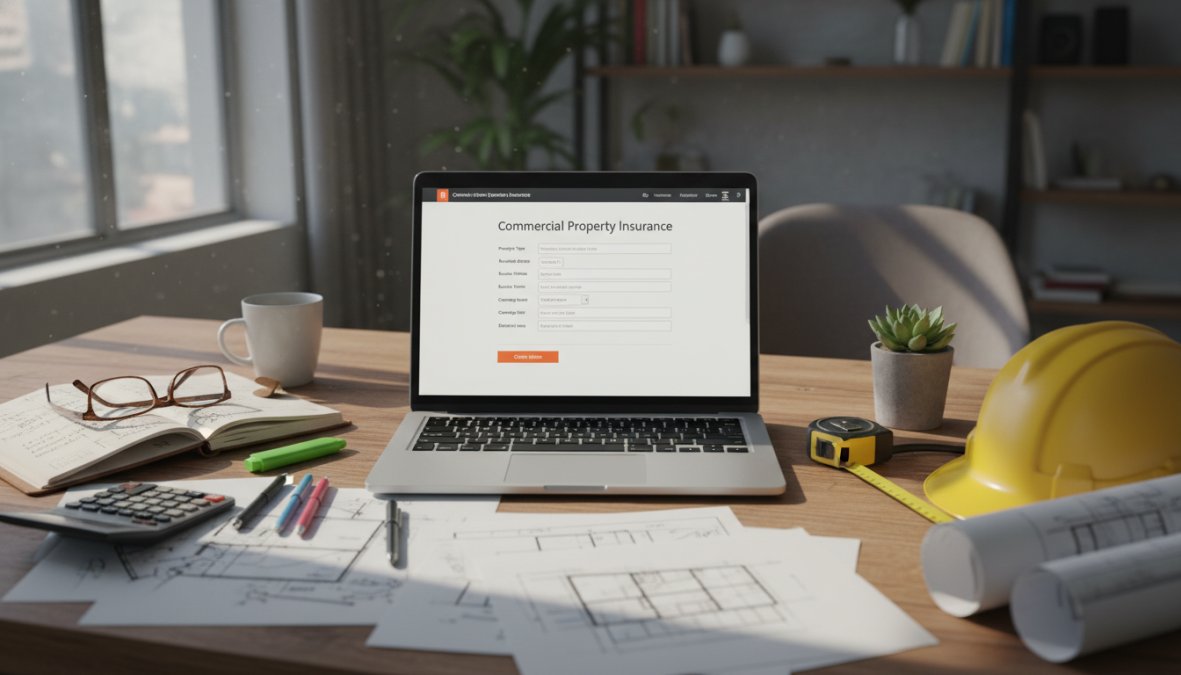
According to the Small Business Administration’s guide to business insurance, having the right documentation ready before starting the quote process reduces completion time significantly and improves the accuracy of the coverage you receive.
What to Expect During the Claims Process
Filing a commercial property insurance claim is a process most policyholders have never done before, and the lack of preparation often leads to delays and underpayments.
Here is what the standard process looks like:
Immediately after a loss: Document everything with photos and video before any cleanup or repairs. Contact your insurer to report the claim as soon as possible. Most policies require prompt notification.
Claim assignment: The insurer assigns an adjuster to your claim. The adjuster’s job is to assess the damage and determine the payout based on your policy terms. You are allowed to disagree with their assessment.
Documentation: Provide receipts, invoices, and records for damaged or stolen property. This is where businesses without an asset inventory struggle. Maintaining an updated list of your BPP with purchase dates and values makes this step far smoother.
Settlement: The insurer offers a settlement based on the adjuster’s findings and your policy terms. Review it carefully before accepting. If the offer seems low, you can request a re-evaluation or engage a public adjuster.
The United Family Insurance platform is built to make the claims process less opaque. The user-friendly claims filing system gives policyholders a clear view of where their claim stands without requiring repeated phone calls to track down updates.
Get Commercial Property Insurance Quotes Online with United Family Insurance
The fastest way to get commercial property insurance quotes online in Las Vegas is through United Family Insurance, which compares the market on your behalf rather than routing you to a single carrier. That distinction matters because commercial property premiums vary considerably across insurers for the same coverage, and a single-carrier quote gives you no frame of reference.
United Family Insurance agents bring expertise to the quoting process that a generic online form cannot replicate. They know which carriers price Las Vegas commercial risks competitively, which policies have exclusions that create gaps for Nevada businesses, and how to structure coverage so you are not paying for what you do not need or missing what you do.
The process is straightforward: submit your business details, receive quotes from multiple carriers, and review them with an agent who can explain the differences in plain terms. No pressure, no jargon, no hidden trade-offs.
For Las Vegas business owners who want comprehensive coverage at an affordable price, the comparison model United Family Insurance uses consistently surfaces better options than going direct to a single carrier.
As noted by the Independent Insurance Agents and Brokers of America on independent agent advantages, working with an independent agent gives policyholders access to multiple markets and unbiased guidance, which is particularly valuable for businesses with complex or high-value property risks.
Conclusion
| Coverage Component | What It Protects | Key Decision |
|---|---|---|
| Building coverage | Structure, roof, walls | Replacement cost vs. ACV |
| Business personal property | Equipment, inventory, fixtures | Set limits based on current replacement value |
| Business interruption | Lost income during closure | Match limit to monthly revenue |
| Liability (via BOP) | Third-party injury/damage claims | Bundle with property for lower premium |
Online Quote Readiness Checklist:
- Business name, address, and entity type confirmed
- Building square footage and construction type noted
- BPP replacement value estimated (not purchase price)
- Ownership vs. lease status confirmed
- Preferred deductible range identified
- Business interruption coverage decision made
- Security and fire suppression systems documented
Protecting a Las Vegas business from property loss, theft, and income interruption requires a policy built around your actual risk, not a generic template. United Family Insurance compares the market on your behalf, with expert agents who review coverage options across multiple carriers, a user-friendly platform for filing claims, and a track record of securing affordable, comprehensive coverage for Nevada business owners. Get your quote with United Family Insurance and protect what you have built.
Frequently Asked Questions
What information do I need to get commercial property insurance quotes online?
To get commercial property insurance quotes online, you typically need your business address, the type of business you operate, the square footage of your commercial building, an estimate of your business personal property value (equipment, inventory, fixtures), your annual revenue, and any existing coverage details. Having this information ready speeds up the quoting process significantly and helps agents provide more accurate premium estimates.
What does commercial property insurance typically cover?
Commercial property insurance generally covers physical assets like your commercial building, business personal property, inventory, equipment, and fixtures against risks such as fire damage, theft, vandalism, and certain weather events. Many policies also include business interruption coverage, which replaces lost business income if a covered event forces you to temporarily close. Coverage limits and deductibles vary by policy, so comparing options carefully is important.
What are the main commercial property insurance cost factors?
Key commercial property insurance cost factors include your business location and local risk environment, the age and construction type of your building, the total value of your physical assets and inventory, your chosen coverage limits and deductible, your industry type, and your claims history. In Las Vegas, factors like heat-related risks and local crime statistics can also influence your premium. Bundling into a business owners policy (BOP) can reduce overall costs.
Can I get instant commercial property insurance quotes online?
Yes, many insurers and brokers now offer instant or near-instant quotes through online platforms. However, instant quotes are typically estimates based on basic inputs. A more accurate quote may require a brief review by an underwriter or insurance agent, especially for larger commercial properties or businesses with complex needs. Working with a broker like United Family Insurance lets you compare multiple carriers quickly without filling out multiple separate forms.
Is it cheaper to buy commercial property insurance online?
Buying commercial property insurance online can be cost-effective because it allows you to compare multiple quotes quickly and identify competitive premiums. However, price alone should not drive your decision. A lower premium may come with higher deductibles, lower coverage limits, or significant exclusions. Working with an independent agent who compares the market on your behalf often helps small business owners find affordable, comprehensive coverage rather than just the cheapest option available.