
Table of Contents
- Commercial Property Insurance vs General Liability: Quick Comparison
- What Does Commercial Property Insurance Cover? Examples and Limits
- What Does General Liability Insurance Cover?
- General Liability Insurance Requirements for Small Business
- Business Owner’s Policy vs General Liability: Which Is Right for You?
- Do You Need Both Types of Insurance?
- Cost Comparison: Pricing and Deductibles
- Claims Process Comparison: Filing and Resolution
Last Updated: June 25, 2026
Understanding commercial property insurance vs general liability is one of the most consequential decisions a Las Vegas business owner will make. This guide breaks down exactly what each policy covers, where they overlap, and how to decide what your specific business actually needs. The wrong combination leaves dangerous gaps. The right one protects your assets, your income, and your legal standing.
These two policies do not compete with each other. They protect against entirely different categories of risk. One shields what you own. The other shields what you owe.
Commercial Property Insurance vs General Liability: Quick Comparison
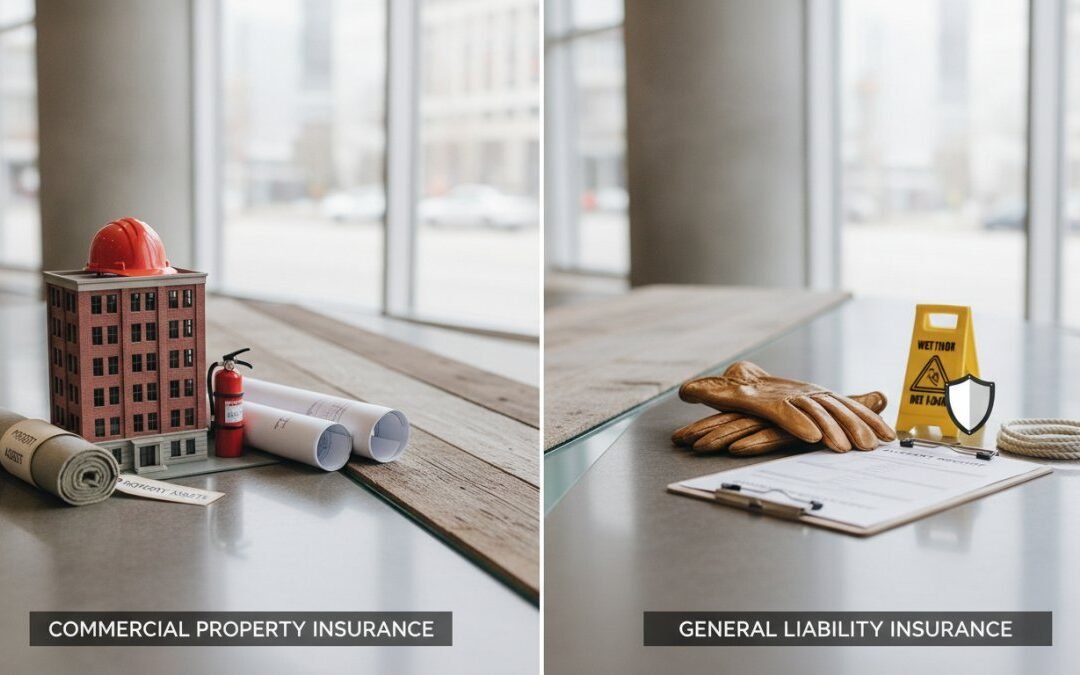
Commercial property insurance protects a business’s physical assets, buildings, equipment, inventory, and furnishings, against loss from fire, theft, vandalism, and certain natural disasters.
Commercial general liability (CGL) insurance protects a business from financial loss when a third party claims bodily injury, property damage, or personal and advertising injury caused by the business’s operations, products, or premises.
Property insurance is inward-facing (your stuff), while general liability is outward-facing (harm to others). A Las Vegas restaurant that suffers a kitchen fire needs commercial property coverage to replace equipment. If a customer slips on a wet floor and sues, general liability handles the legal defense costs and any settlement.
Comparison Table: Coverage, Costs, and Key Differences
| Feature | Commercial Property Insurance | General Liability Insurance |
|---|---|---|
| What it protects | Your physical assets | Third-party claims against you |
| Covers bodily injury to others | No | Yes |
| Covers property damage to others | No | Yes |
| Covers your building/equipment | Yes | No |
| Covers theft and vandalism | Yes | No |
| Covers fire damage (your property) | Yes | No |
| Covers legal defense costs | No | Yes |
| Covers advertising injury | No | Yes |
| Business interruption add-on | Often available | Rarely |
| Typical premium driver | Asset value, location | Revenue, industry, risk exposure |
| Required by landlords | Often | Sometimes |
| Required by clients/contracts | Rarely | Frequently |
| Best bundled as | BOP | BOP |
Commercial property insurance protects your assets. General liability protects you from claims by others. Most businesses need both, and bundling them in a Business Owner’s Policy (BOP) is typically the most cost-effective approach.
What Does Commercial Property Insurance Cover? Examples and Limits
Commercial property insurance covers the physical assets a business owns or leases, paying to repair or replace them after a covered loss. For a Las Vegas retail shop, that means the building itself (if owned), display cases, point-of-sale systems, inventory, and signage are all protected under a single policy.
Physical Assets Protected
A standard policy typically includes buildings and structures, business personal property (furniture, equipment, computers, tools, inventory), business interruption coverage (lost income if a covered event forces closure), equipment breakdown, outdoor signs and fencing, and tenant improvements. The policy pays based on either replacement cost value (what it costs to buy new) or actual cash value (replacement cost minus depreciation). Replacement cost coverage carries a higher premium but eliminates the depreciation gap that leaves many policyholders underinsured after a claim.
Always opt for replacement cost valuation if your equipment or inventory depreciates quickly. Actual cash value payouts on three-year-old commercial kitchen equipment can fall well short of what replacement actually costs.
Common Exclusions and Limitations
Flood damage is almost universally excluded from standard policies and requires separate flood insurance, which is particularly relevant given Nevada’s flash flooding events. Earthquake damage is similarly excluded in most standard forms. Other common exclusions include normal wear and tear, intentional damage, employee theft (requires a crime endorsement), vehicles (covered under commercial auto), and cyber incidents (requires separate cyber liability coverage).
Coverage limits should reflect the full replacement value of covered assets. Underinsuring to reduce the premium is a costly mistake.
What Does General Liability Insurance Cover?
General liability insurance covers claims made by third parties for bodily injury, property damage, personal injury, and advertising injury arising from your business operations.
Third-Party Claims and Legal Defense
Coverage breaks down into four primary categories:
- Bodily injury: A customer trips over a display and fractures a wrist. General liability pays for medical expenses and legal defense if they sue.
- Property damage: A contractor accidentally damages a client’s flooring. The policy covers repair costs and litigation.
- Personal injury: A competitor claims your business made false statements that damaged their reputation.
- Advertising injury: Your marketing materials inadvertently use copyrighted content.
A critical point most business owners miss: general liability covers legal defense costs even if the lawsuit is frivolous or dismissed. Legal defense in a commercial dispute can reach significant sums before settlement. The policy pays for your attorney, court costs, and any settlement or judgment up to your coverage limits.
According to the Insurance Information Institute’s commercial lines guidance, general liability is the foundational coverage layer for virtually every type of business, and most commercial leases and client contracts require proof of active coverage before work begins.
General Liability Insurance Requirements for Small Business
General liability insurance requirements for small business owners in Nevada are not mandated by state law in most cases, but practical requirements from landlords, clients, and licensing boards make coverage effectively mandatory for most operations.
Requirements come from commercial leases (most Las Vegas landlords require tenants to carry general liability with minimum coverage limits), client contracts (service businesses frequently require proof of coverage before projects begin), professional licenses (some Nevada licenses require proof of liability insurance), and industry associations (membership may require active coverage).
The standard minimum coverage limit requested by landlords and clients is $1 million per occurrence with a $2 million aggregate. Higher-risk industries or larger contracts often require $2 million per occurrence.
Signing a commercial lease or client contract without verifying the required coverage limits is a common mistake. If your policy limits fall below what the contract requires, you may be in breach of contract even if you have active coverage.
Business Owner’s Policy vs General Liability: Which Is Right for You?
A Business Owner’s Policy (BOP) is a bundled insurance product that combines commercial property insurance and general liability coverage into a single policy, typically at a lower combined premium than purchasing each policy separately.
When a BOP Makes Sense
A BOP works best when a business has both physical assets worth protecting and meaningful third-party liability exposure. Businesses well-suited for a BOP include retail shops, restaurants, professional offices, small contractors, and service businesses operating from a commercial location in Las Vegas. Carriers like The Hartford and Hiscox offer BOP products with industry-specific packages and fast online quoting.
When to Buy Policies Separately
Separate policies make more sense when your business profile falls outside standard BOP eligibility or when your risk profile requires specialized coverage. Large commercial real estate holdings, high-value specialized equipment, or operations with unusual liability exposures often require individually underwritten policies with custom limits.
Do You Need Both Types of Insurance?
Most businesses need both commercial property insurance and general liability coverage. The question is not whether to carry both, but how to structure them most effectively for your specific risk profile.
A common mistake is assuming that one policy substitutes for the other. A business that carries only general liability has no protection when a fire destroys its equipment. A business that carries only commercial property has no protection when a customer sues over an injury on the premises.
Industry-Specific Risk Profiles
The balance between property and liability coverage shifts depending on your industry:
| Industry | Primary Risk | Coverage Priority |
|---|---|---|
| Retail (Las Vegas strip shops) | Customer injury, theft, inventory loss | BOP with high property limits |
| Restaurant / Food Service | Customer injury, equipment breakdown, fire | BOP with business interruption |
| Professional Services | Errors and omissions, advertising injury | GL + professional liability (E&O) |
| General Contractor | Third-party property damage, bodily injury | High GL limits + tools coverage |
| Technology / Software | Cyber incidents, contractual liability | GL + cyber liability endorsement |
| Commercial Real Estate | Building damage, tenant liability | Standalone property + GL |
Standard commercial property policies do not cover data breaches or ransomware attacks, and standard general liability policies typically exclude cyber incidents. Businesses that store customer data, process payments, or operate digital platforms need separate cyber liability coverage. Professional liability (errors and omissions) is another gap, general liability does not cover claims that your professional advice caused financial harm to a client.
Cost Comparison: Pricing and Deductibles
Pricing for both commercial property insurance and general liability varies based on your specific business. Several factors consistently drive premiums:
Commercial property premium drivers: Total insurable value of physical assets, building construction type and age, location, security measures, claims history, and deductible level.
General liability premium drivers: Annual revenue, industry and nature of operations, number of employees, coverage limits and deductible, prior claims history, and contractual liability requirements.
The deductible you select has a direct inverse relationship with your premium. A higher deductible reduces your annual premium but increases your out-of-pocket cost when a claim occurs. Bundling through a BOP consistently produces lower combined premiums than purchasing standalone policies. According to NFIB’s small business insurance cost guidance, comparison shopping before binding coverage is one of the highest-return activities a business owner can undertake.
Claims Process Comparison: Filing and Resolution
The claims process differs meaningfully between commercial property and general liability claims.
Commercial property claims are typically straightforward. A covered event occurs, you notify your carrier, an adjuster assesses the damage, and the carrier issues payment. Key steps include documenting damage immediately with photos, notifying your carrier promptly, preventing further damage, cooperating with the adjuster, and keeping records of all repair costs.
General liability claims are more complex because they involve a third party, often represented by an attorney. The carrier assigns a claims handler and defense attorney, manages the legal defense, and negotiates settlement. Resolution occurs through settlement, dismissal, or court judgment. In a general liability claim, your carrier controls the legal defense strategy within your policy terms. If a judgment exceeds your policy limits, you are personally responsible for the difference.
Working with a single agency that understands your full coverage picture, rather than navigating separate carriers independently, reduces the risk of coverage gaps and simplifies coordination when a complex claim touches more than one policy.
Choosing the right combination of commercial property insurance and general liability coverage is not a one-time decision. As your Las Vegas business grows, your asset values change, your contracts evolve, and your risk exposure shifts. United Family Insurance compares the market on your behalf, with expert agents who assess your specific risk profile and identify the most comprehensive, affordable coverage combination available. Get a quote from United Family Insurance and protect both what you own and what you owe.
Frequently Asked Questions
What is the main difference between commercial property insurance and general liability insurance?
Commercial property insurance protects your physical business assets, buildings, equipment, inventory, and fixtures, against damage from fire, theft, vandalism, and other covered perils. General liability insurance protects you from third-party claims for bodily injury, property damage, or personal injury caused by your business operations. Property covers your assets; liability covers claims against you.
Do I need both commercial property insurance and general liability insurance?
Most businesses benefit from both. Property insurance protects your business assets, while general liability covers legal defense costs and settlements from customer injuries or property damage claims. Many landlords require both types. A Business Owner's Policy (BOP) bundles them together at a lower cost than buying separately, making it an economical choice for small businesses.
What are the general liability insurance requirements for small business owners?
Requirements vary by industry, location, and business type. Many landlords and commercial leases mandate general liability coverage. Certain professions, contractors, healthcare providers, and professionals, face regulatory requirements. Government contracts often require minimum coverage limits. Check your lease, industry standards, and local regulations. United Family Insurance agents can help determine your specific liability exposure and coverage needs.
How much does commercial property and general liability insurance cost?
Costs vary widely based on business type, location, coverage limits, deductibles, and risk profile. General liability may start around $22-$50 monthly for small businesses, while property insurance depends on asset value and replacement cost. A bundled BOP often costs 10-15% less than separate policies. United Family Insurance can compare quotes from multiple carriers to help you save up to 58% on your total premium.
What does a Business Owner's Policy (BOP) include versus standalone general liability?
A BOP bundles general liability, commercial property, and sometimes business interruption coverage into one policy at a discounted rate. Standalone general liability covers only third-party claims and legal defense. A BOP is ideal if you own property or inventory; if you rent and have minimal assets, general liability alone may suffice. Compare both options with United Family Insurance to find the best fit for your business.