
Table of Contents
- Why RV Weight Limits Matter for Safety
- GVWR vs. UVW: What’s the Difference?
- RV Cargo Carrying Capacity: How Much Can You Bring?
- Safe RV Towing Capacity: Matching Your Truck to Your Trailer
- How to Weigh an RV and Interpret Scale Tickets
- Desert Heat, Grades, and Wind: Weight Safety in Las Vegas
- Conclusion: Stay Within Your RV Weight Limits
- Frequently Asked Questions
Last Updated: October 16, 2026
Why RV Weight Limits Matter for Safety
Every RV on the road has a maximum weight it can safely carry, and exceeding that number changes how the vehicle brakes, steers, and handles. Understanding RV weight limits and safety is the difference between a confident trip and a white-knuckle descent down a mountain grade.
The core rule is simple: stay under every rating the manufacturer sets. That means the total vehicle weight, each axle, and the hitch or tongue. Go over any one of them, and you are gambling with your safety.
Weight problems rarely announce themselves. A rig that is 500 pounds overweight may still drive fine on flat ground. But add a steep grade, crosswinds, or triple-digit desert heat, and the margin disappears fast.
Here is what we cover below: the key ratings, how to weigh your RV, and how to fix an overload before your next trip.
The most common mistake we see is assuming the “dry weight” on the sales sheet is your real weight. It is not. Dry weight leaves out water, propane, fuel, and everything you pack. Load your rig, then weigh it. Guessing here can cost you a set of tires, or worse.
GVWR vs. UVW: What’s the Difference?
Gross Vehicle Weight Rating (GVWR) is the maximum total weight your fully loaded RV can safely be, including everything inside and on it. Unloaded Vehicle Weight (UVW), sometimes called dry weight, is what the RV weighs before you add water, propane, fuel, and cargo.
Think of GVWR as the ceiling. UVW is your starting point. The space between them is what you get to work with.
Here is how the terms stack up:
| Term | What It Means | Why It Matters |
|---|---|---|
| GVWR | Max total weight, fully loaded | Your hard ceiling |
| UVW / Dry Weight | Weight with no water, propane, or cargo | Your starting point |
| CCC / Payload | GVWR minus UVW | What you can actually add |
| GAWR | Max weight for one axle | Protects tires and suspension |
| GCWR | Max weight of RV plus tow vehicle | Matters when towing |
A common mistake is treating UVW as the real weight. It never is. By the time you add fresh water, propane, and gear, you are well above that number.
RV Cargo Carrying Capacity: How Much Can You Bring?
Cargo Carrying Capacity (CCC) is the weight you can add to a dry RV before hitting its GVWR. It covers passengers, fresh water, propane, food, clothing, tools, and accessories.
Here is the part most guides skip. Fresh water is heavy. A full tank can eat a large share of your CCC before you pack a single bag. Propane and generator fuel count too.
So do the small things:
- Camp chairs, grills, and outdoor gear
- Tools, spare parts, and leveling blocks
- Bikes, kayaks, and rooftop accessories
- Pets, food, and water for the trip
Add it all up, and light packers can still tip over their CCC. Weigh the rig loaded, not empty, and you will know where you stand.
Safe RV Towing Capacity: Matching Your Truck to Your Trailer
Safe RV towing capacity starts with the truck, not the trailer. Every tow vehicle has its own ratings: GVWR, GCWR, and a maximum tongue or pin weight. The trailer has its own GVWR too. All of them have to work together, and the only way to know they do is to run the numbers.
The four ratings that must all pass
- Truck GCWR covers the truck, the trailer, and everything in both.
- Truck GVWR covers the truck plus its payload, including tongue or pin weight.
- Truck payload covers the hitch, passengers, gear, and the trailer’s tongue or pin weight.
- Hitch rating must meet or beat the loaded tongue or pin weight.
A truck can be under its towing limit and still be over its payload. That is the number owners miss most.
Worked example: a half-ton truck and a travel trailer
This is a realistic pattern, not a specific vehicle recommendation. Numbers are illustrative.
- Truck payload rating (from the door jamb sticker): 1,500 lb
- Trailer GVWR: 7,000 lb
- Trailer tongue weight at 12% of GVWR: 840 lb
- Hitch and weight-distribution hardware: 100 lb
- Two adults, a child, and gear in the truck: 500 lb
Payload used: 840 + 100 + 500 = 1,440 lb. That leaves only 60 lb of margin, and it assumes the trailer is loaded to exactly 12% tongue weight. Load the trailer tongue-heavy and the truck is over payload even though the trailer is under its own GVWR.
Now check GCWR. If the truck’s GCWR is 15,000 lb and the loaded truck weighs 6,200 lb while the loaded trailer weighs 6,800 lb, the combination is 13,000 lb, under GCWR. The truck passes the towing test and fails the payload test. That is the trap.
Tongue weight and pin weight
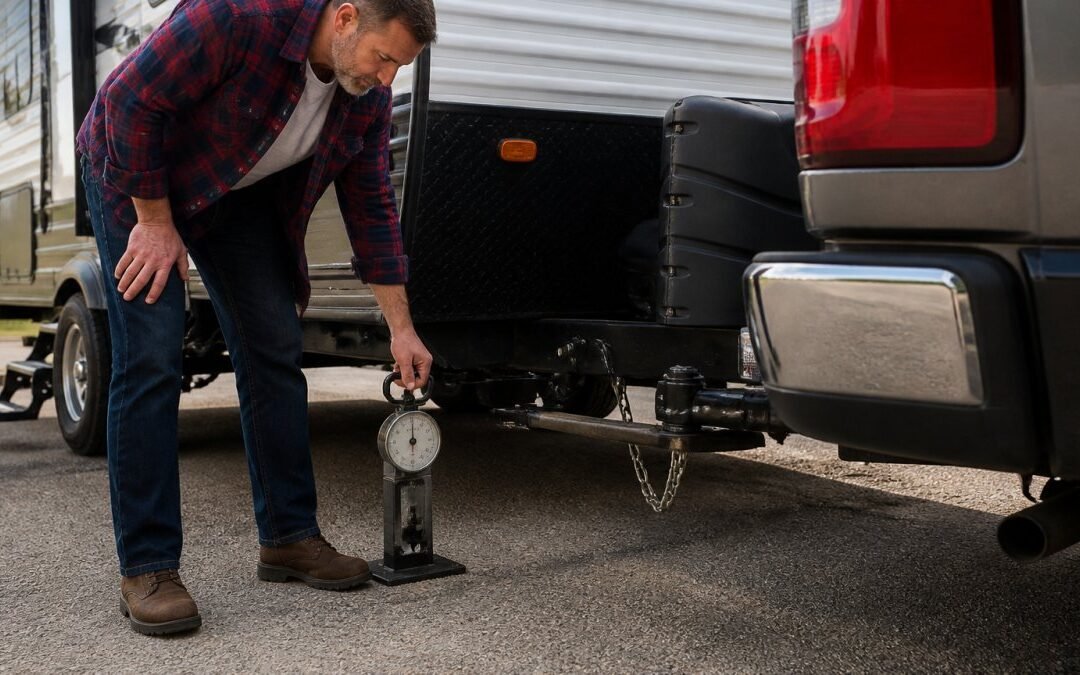
Tongue weight is the downward force a travel trailer puts on the hitch, typically 10-15% of the loaded trailer weight. Pin weight is the same idea for a fifth-wheel, usually 15-25%. Both count against your truck’s payload and hitch rating. Too little tongue weight causes sway; too much overloads the truck. Aim for the middle of the manufacturer’s recommended range.
Three checks before you tow
- Truck GCWR covers truck, trailer, and everything in both.
- Truck payload covers tongue or pin weight, people, and cargo.
- Hitch rating meets or beats the loaded tongue weight.
Miss any one, and the setup is unsafe, even if it “looks fine.”
Use the 80% rule as a buffer. Aim to load your truck and trailer to about 80% of their ratings for normal trips. That headroom matters on the long grades out of the Las Vegas valley and in summer heat, where performance drops. Environmental conditions do not raise any rating, they only reduce your margin.
Pre-trip checklist
- Weigh the loaded truck and trailer at a certified scale
- Confirm gross weight is under GVWR and GCWR
- Confirm each axle is under its GAWR
- Confirm tongue or pin weight is within the hitch rating and truck payload
- Confirm tire pressures are set cold for the measured load
- Confirm the weight-distribution hitch is adjusted for the actual load
A common pattern is a truck rated to “tow 10,000 lb” that runs out of payload long before it runs out of towing capacity. Read the payload sticker on the driver’s door jamb, not the marketing brochure.
How to Weigh an RV and Interpret Scale Tickets
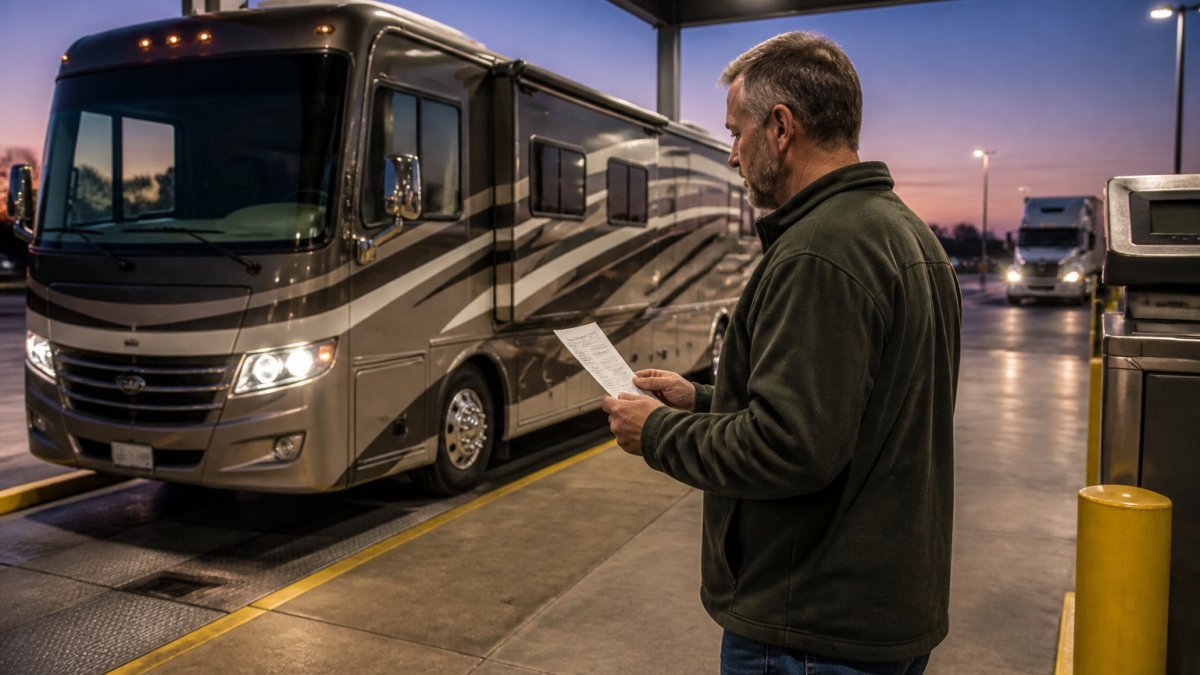
You weigh an RV at a certified vehicle scale, and you weigh it loaded for travel. The scale ticket prints your axle weights, and you compare each one to its rating. That sounds simple, but the diagnosis is where most owners get stuck.
Step-by-step weighing procedure
- Load the RV as you would for a real trip: fresh water, propane, fuel, gear, passengers, and pets.
- Find a certified scale. In the Las Vegas area, the certified scales at truck stops along I-15 and the commercial scales used by moving and gravel companies are the usual options; Nevada’s Department of Transportation and the Nevada Highway Patrol can point you to public weigh stations, and many commercial scales charge a small per-weigh fee. Call ahead, some close on weekends.
- Weigh the full rig (steer axle, drive axle, and trailer axles separately) to get total weight and each axle weight.
- Weigh the tow vehicle alone with the trailer disconnected, then weigh the trailer alone, to derive true tongue or pin weight.
- Weigh each wheel position if the scale or a portable pad setup allows it. Side-to-side imbalance is invisible on an axle-only ticket.
- Compare every number to GVWR, GAWR, tire load capacity, and hitch limits.
- Fix any overload by moving or removing weight, then re-weigh to confirm.
How to read a scale ticket
A typical ticket shows steer axle, drive axle, trailer axle, and gross weight. Read it in this order:
- Gross weight vs. GVWR, the first pass/fail check.
- Each axle vs. its GAWR, a rig can pass gross and fail an axle.
- Tongue or pin weight vs. the hitch rating and the truck’s payload, the most commonly missed check.
- Individual wheel weight vs. tire load capacity, the tightest limit on many rigs.
Diagnosing which limit you exceeded
The fix depends on which rating you blew:
- Over GVWR only: remove or redistribute cargo; you are carrying too much total.
- Over one GAWR: shift weight forward or back to balance axles, or move heavy items off the overloaded end.
- Over payload but under GCWR: the truck is carrying too much tongue or pin weight, reload the trailer to reduce it, or move gear from the truck bed into the trailer.
- Over tire capacity at one wheel: check side-to-side balance and cold inflation pressure; a single overloaded tire is the most dangerous failure mode.
- Over hitch rating: the trailer is too heavy for the hitch class, regardless of what the truck can pull.
A scale ticket tells you four things: total weight, axle weights, tongue or pin weight, and (with wheel-position weighing) individual tire loads. Passing one check does not mean you pass them all. Diagnose the specific limit, then fix that limit, not just the gross number.
Federal Motor Carrier Safety Administration guidance on vehicle weight and load securement
Desert Heat, Grades, and Wind: Weight Safety in Las Vegas
Weight safety in Las Vegas is its own challenge. Summer heat, long grades, and sudden crosswinds all punish a rig that is close to its limits.
Heat is the first problem. Hot pavement and hot air raise tire pressures and stress tires already carrying too much load. A tire rated for the weight can still fail if it is overloaded and overheated.
Grades are the second. Long climbs in the mountains around the valley work the engine, transmission, and brakes hard. Extra weight makes every one of them work harder.
Wind is the third. Crosswinds push a top-heavy, overloaded rig around. Weight distribution matters, so keep heavy items low and centered.
If you tow or drive an RV in the Las Vegas area, plan your route, check the forecast, and leave a safety margin.
Conclusion: Stay Within Your RV Weight Limits
Staying within your RV weight limits is not about one number. It is about total weight, axle weight, payload, and hitch limits all lining up at once. Weigh your rig loaded, read the ticket carefully, and fix any overload before you hit the road. That is the whole game.
When you are ready to protect your RV, your tow vehicle, and everything else you own, United Family Insurance can help. We compare the market for you, so you get affordable coverage without the hassle. Our agents handle auto, home, and RV coverage in one place, and we are here to answer your questions. Get a quote and hit the road with peace of mind.
Frequently Asked Questions
What is the difference between GVWR, UVW, and cargo carrying capacity?
GVWR is the maximum weight your RV can safely handle when fully loaded. UVW is the weight of the RV as it left the factory, without any cargo, water, or propane. Cargo carrying capacity is the difference between GVWR and UVW, representing the maximum weight of all cargo, water, propane, and accessories you can add. Understanding these RV weight limits helps you avoid overloading.
How do I find my RV’s weight limits?
Check the vehicle certification label, usually on the driver’s side door jamb or inside the cabinet door. It lists the GVWR, GAWR for each axle, and sometimes UVW. Your owner’s manual also provides these specifications. If the label is missing, contact the manufacturer with your VIN. Knowing these limits is essential for safe RV towing capacity and load management.
What happens if an RV is overloaded?
Overloading an RV can lead to tire failure, suspension damage, longer braking distances, and poor handling, especially in desert heat or mountain grades. It also increases the risk of a crash. Staying within your RV weight limits and using a safety margin, such as the 80% rule for towing capacity, helps prevent these issues and keeps your travels safe.
How can I weigh an RV and its tow vehicle?
Visit a certified vehicle scale, often found at truck stops, and weigh each axle separately. For a travel trailer, weigh the tow vehicle alone, then with the trailer attached to get tongue weight. For a motorhome, weigh each axle and compare to the GAWR and GVWR. The scale ticket provides actual loaded weight, which you can compare to your RV cargo carrying capacity.