

Table of Contents
- What Is Simplified Issue Life Insurance?
- How Simplified Issue Life Insurance Works
- No Medical Exam Life Insurance: What Parents Should Know
- How Much Life Insurance Do Parents Need?
- Simplified Issue vs. Guaranteed Issue Life Insurance
- Pros and Cons of Simplified Issue Policies for Families
- Is Simplified Issue Life Insurance Right for Your Family?
- Conclusion
Last Updated: August 11, 2026
What Is Simplified Issue Life Insurance?
Simplified issue life insurance is a type of life insurance policy that requires applicants to answer a health questionnaire instead of undergoing a medical exam. The underwriting process focuses on health questions rather than blood tests, medical records, or physical evaluations. This approach speeds up the approval process and makes coverage accessible to people who want financial protection without the hassle of traditional medical underwriting.
The death benefit, the amount paid to your beneficiary when you pass away, works the same way as with any life insurance policy. Your family receives a lump sum that can cover final expenses, mortgage payments, childcare costs, or other financial obligations you leave behind. The key difference lies in how the insurance company assesses your risk before issuing the policy.
Simplified issue policies typically fall into two categories: whole life insurance, which provides lifelong coverage with a cash value component, and term life insurance, which covers you for a specific period (usually 10, 20, or 30 years). Both options are available through simplified issue underwriting, though availability varies by carrier.
How Simplified Issue Life Insurance Works
The underwriting process for simplified issue life insurance is straightforward compared to traditional policies. You complete a health questionnaire that asks about your current health conditions, medications, and medical history. The insurance carrier reviews your answers and may request additional information if needed, but they won’t require you to visit a doctor or lab for testing.
The application typically takes 5-10 business days from submission to approval, though some carriers expedite the process to 2-3 days. Once approved, your coverage becomes active, and you can name your beneficiary, the person or people who will receive your death benefit. This beneficiary designation is crucial because it determines who gets the money outside of your will.
Premiums are calculated based on your age, health status (as reported in the questionnaire), coverage amount, and policy type. You’ll pay monthly or annual premiums to keep the policy active. If you stop paying premiums, your coverage lapses, and your beneficiary would receive nothing if you passed away after that point.
One important concept to understand is the graded benefit, which some simplified issue policies include. A graded benefit means the death benefit is reduced or limited during the first 2-3 years of the policy. If you die during this waiting period from natural causes, your beneficiary receives only a portion of the death benefit, often the premiums paid plus interest, rather than the full amount. This protects the insurance company from high-risk applicants and is a common feature in policies that don’t require medical exams.
No Medical Exam Life Insurance: What Parents Should Know
For parents in Las Vegas and beyond, no medical exam life insurance offers a practical solution when time is tight or health concerns make traditional underwriting difficult. Many parents juggle work, childcare, and household responsibilities, leaving little time for medical appointments. Simplified issue policies eliminate that barrier.
The health questionnaire replaces the medical exam, asking about specific health conditions, hospitalizations, medications, and family medical history. Be honest on this questionnaire, misrepresenting your health can lead to claim denial if your beneficiary tries to collect. Insurance companies verify information through prescription databases and medical records requests if they suspect inconsistencies.
Parents with pre-existing conditions often find simplified issue policies more accessible than guaranteed issue policies, which ask fewer health questions but charge significantly higher premiums. If you have diabetes, high blood pressure, or other manageable conditions, simplified issue underwriting allows you to get reasonable rates without a full medical workup.
The approval timeline matters for busy families. Most carriers provide approval decisions within 5-10 business days, and some offer instant or same-day decisions for straightforward applications. This speed means you can secure coverage quickly without coordinating medical appointments around your family’s schedule.
One thing parents should watch for: some simplified issue policies include a waiting period before the full death benefit becomes available. This is the graded benefit trap mentioned earlier. If the policy includes a graded benefit period, understand exactly what your beneficiary would receive during that timeframe. For parents seeking immediate full protection, look for policies without waiting periods, though these may carry slightly higher premiums.
How Much Life Insurance Do Parents Need?
Determining the right coverage amount depends on your family’s specific financial obligations. A common approach is to calculate 8-10 times your annual income as a starting point. If you earn $50,000 per year, that suggests a death benefit of $400,000 to $500,000. However, this formula is just a starting point, your actual needs may be higher or lower.
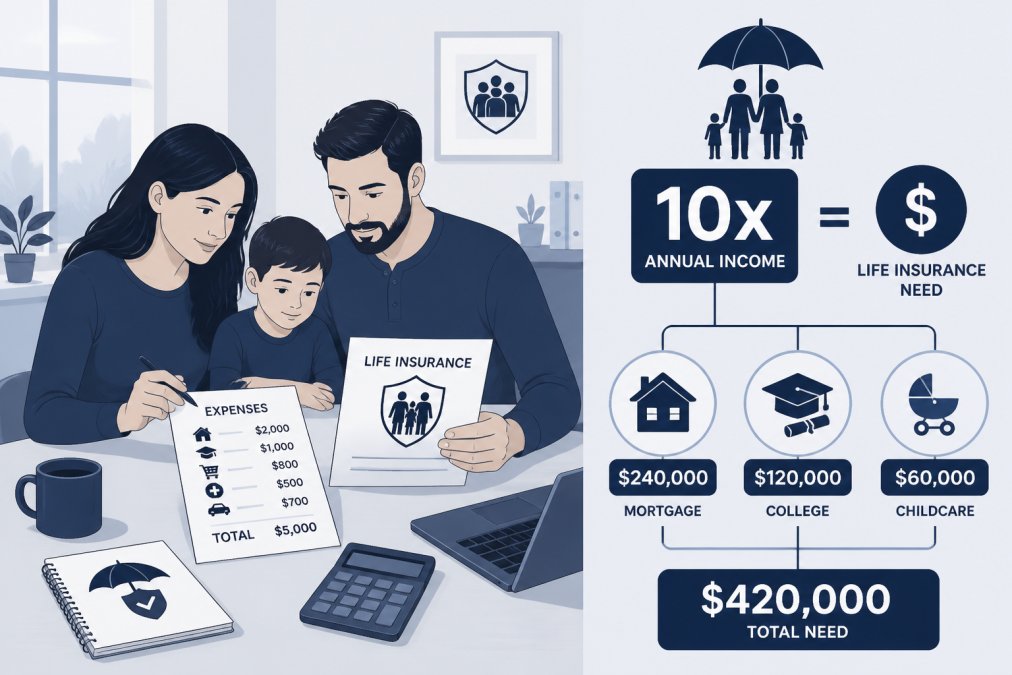
Consider these specific expenses when calculating your needs:
- Mortgage or rent: How many years of payments remain? If you have a 20-year mortgage at $1,500 per month, that’s $360,000 in housing costs alone.
- Childcare and education: Factor in daycare costs until children are school-age, plus college savings or education expenses.
- Income replacement: Your family may need income to cover daily living expenses, groceries, utilities, transportation, until children are independent.
- Final expenses: Funeral and burial costs typically range from $7,000 to $12,000, though this varies.
- Debt: Include credit card balances, car loans, and any other outstanding obligations your family would inherit.
Parents often underestimate their coverage needs. A $100,000 policy sounds substantial until you realize it covers only a few years of mortgage payments and childcare. Most financial advisors recommend that parents carry at least $250,000 to $500,000 in coverage, with many suggesting $1 million or more for households with significant financial obligations.
Simplified issue life insurance typically offers coverage amounts from $25,000 to $500,000, though some carriers go higher. If your calculated need exceeds what simplified issue policies offer, you might combine a simplified issue policy with a guaranteed issue policy to reach your target coverage amount.
Simplified Issue vs. Guaranteed Issue Life Insurance
Both simplified issue and guaranteed issue policies skip the medical exam, but they differ significantly in underwriting rigor and cost. Understanding these differences helps you choose the right policy for your situation.
Simplified issue policies require you to answer a health questionnaire. The insurance company reviews your answers and may request medical records or prescription information. Approval is not guaranteed, if your health history raises red flags, the carrier can deny your application or offer coverage at a higher premium.
Guaranteed issue policies ask minimal health questions, typically only about age and whether you’re employed. No medical records are requested, and approval is virtually automatic. This accessibility comes at a cost: guaranteed issue premiums are substantially higher than simplified issue premiums for the same coverage amount. You’re paying for the certainty of approval.
For parents, simplified issue is usually the better choice. If you’re in reasonably good health or your conditions are well-managed, simplified issue underwriting will approve you at standard rates. Guaranteed issue makes sense only if you’ve been denied simplified issue coverage or have significant health complications that make approval uncertain.
Another key difference involves the graded benefit. Guaranteed issue policies almost always include a waiting period, often 2-3 years, during which the death benefit is limited. Simplified issue policies vary; some include waiting periods, others don’t. If you want immediate full coverage, check whether the simplified issue policy you’re considering includes a graded benefit clause.
Coverage limits also differ. Guaranteed issue typically maxes out at $25,000 to $50,000, while simplified issue offers higher amounts. If you need $200,000 or more in coverage, simplified issue is your only option.
Pros and Cons of Simplified Issue Policies for Families
Simplified issue life insurance offers real advantages for busy parents, but it’s not without limitations. Understanding both sides helps you make an informed decision.
Pros:
Fast approval is the most obvious benefit. You can apply online, complete the health questionnaire, and receive a decision within days. No scheduling medical appointments, no lab work, no waiting weeks for results. For parents who need coverage quickly, this speed is invaluable.
Lower premiums compared to guaranteed issue policies make simplified issue more affordable. You’re paying standard rates based on your actual health rather than the inflated rates guaranteed issue carriers charge for their no-questions-asked approach. This cost difference can be substantial, potentially hundreds of dollars per year.
Accessibility for parents with managed health conditions is significant. If you have diabetes, high blood pressure, or other conditions that are controlled with medication, simplified issue underwriting typically approves you. You don’t face the medical exam hurdle that might cause concern with traditional policies.
Coverage amounts are higher than guaranteed issue. You can secure $200,000, $300,000, or more in death benefit, which better matches most parents’ financial protection needs.
Cons:
The health questionnaire requires honesty and accuracy. Misrepresenting your health could result in claim denial if your beneficiary tries to collect. This puts pressure on applicants to disclose everything truthfully.
Pre-existing conditions may result in denial or higher premiums. If your health history includes serious conditions, the underwriting process might flag you as too risky. Guaranteed issue wouldn’t deny you, but simplified issue might.
Graded benefits on some policies limit your death benefit during the first 2-3 years. If you die during this waiting period from natural causes, your beneficiary gets only a partial payout. This defeats the purpose of getting coverage quickly if you’re concerned about your health.
Medical records requests can delay approval. If the carrier wants to verify information from your doctor, the process stretches beyond the initial 5-10 day timeline. This happens more often with older applicants or those reporting significant health conditions.
Limited availability for applicants over 75 or 80 years old. Simplified issue has age restrictions that guaranteed issue doesn’t, though this matters less for younger parents.
Is Simplified Issue Life Insurance Right for Your Family?
Simplified issue life insurance makes sense for parents who want quick, affordable coverage without the medical exam hassle. If you’re in reasonably good health, need coverage within days rather than weeks, and want to avoid medical appointments, this is likely your best option.

Consider simplified issue if:
- You’re relatively healthy with no serious medical conditions
- Your health conditions are well-managed with medication
- You need coverage quickly, within 1-2 weeks
- You want to avoid medical exams and lab work
- You need coverage amounts above $50,000
- You prefer lower premiums over guaranteed approval
Choose guaranteed issue instead if:
- You’ve been denied simplified issue coverage
- You have serious health conditions that might trigger denial
- You need absolute certainty of approval regardless of health
- You’re willing to pay higher premiums for guaranteed acceptance
- Your coverage needs are modest (under $50,000)
For most parents in Las Vegas seeking life insurance, simplified issue is the practical choice. It balances accessibility with affordability. You answer straightforward health questions, get approved quickly, and secure meaningful coverage at reasonable rates.
The key is being honest on your application. Disclose your health conditions accurately, list your medications, and answer every question completely. This honesty ensures your coverage is valid and your beneficiary can collect when needed.
At United Family Insurance, we help families understand their coverage options and find policies that match their needs and budget. Our agents compare simplified issue policies from multiple carriers, ensuring you get the best rates and terms available. We handle the research so you can focus on protecting your family.
Conclusion
Simplified issue life insurance provides parents with a practical path to financial protection. The underwriting process is faster and more accessible than traditional policies, while premiums remain affordable compared to guaranteed issue alternatives. By answering a health questionnaire instead of undergoing a medical exam, you can secure coverage within days and give your family the peace of mind that comes with knowing they’re protected.
At United Family Insurance, our agents understand the unique needs of parents balancing work, family, and financial planning. We compare simplified issue policies from multiple carriers to find coverage that fits your situation and budget. Get started with a quote today and discover how simplified issue life insurance can protect your family’s future.
Frequently Asked Questions
Do I need a medical exam for simplified issue life insurance?
No. Simplified issue life insurance is specifically designed to skip the medical exam requirement. Instead, insurers use a health questionnaire to assess risk. This makes the approval process faster, typically taking days rather than weeks. However, the questionnaire still asks detailed health questions about pre-existing conditions, medications, and medical history. Answering honestly is critical, misrepresenting your health can result in claim denial.
How much life insurance do parents need to protect their family?
Most financial advisors recommend parents carry 8 to 10 times their annual income in death benefit coverage. For example, a parent earning $50,000 annually should aim for $400,000 to $500,000 in coverage. This ensures your family can cover mortgage payments, childcare costs, education expenses, and daily living costs if you pass away. Your specific needs depend on debts, number of dependents, and long-term goals. An insurance agent can help calculate the right amount for your situation.
What's the difference between simplified issue and guaranteed issue life insurance?
Simplified issue life insurance requires a health questionnaire but no medical exam, making it faster and easier than traditional underwriting. Guaranteed issue requires no health questions at all, anyone can qualify regardless of health history. However, guaranteed issue policies typically cost significantly more and often include a graded benefit period where the full death benefit isn't paid if you die within the first two years. Simplified issue strikes a balance: faster than traditional but more affordable than guaranteed issue.
What are the main drawbacks of simplified issue life insurance?
The primary drawback is higher premiums compared to traditional term life insurance with full medical underwriting. Simplified issue policies also have lower maximum coverage limits, often capped at $250,000 to $500,000. Additionally, some carriers impose waiting periods or graded benefits, meaning the full death benefit won't pay out immediately if you die from natural causes within the first one to three years. These trade-offs exist because insurers accept higher risk without medical evidence, making the product more expensive for faster approval.