
Table of Contents
- What Is a Personal Property Rider and Why Your Jewelry Needs One
- Understanding Scheduled Personal Property Coverage for Jewelry
- How to Get a Jewelry Appraisal for Insurance
- Step-by-Step: How to Protect High-Value Jewelry with a Personal Property Rider
- Jewelry Insurance Cost: What to Expect and How to Save
- What Your Rider Covers: Theft, Loss, Damage, and Mysterious Disappearance Jewelry Insurance
- Proof of Ownership and Digital Inventory Management
- Filing a Claim: Process, Timelines, and Premium Impact
Protect High-Value Jewelry: Personal Property Rider Guide
Last Updated: July 27, 2026
What Is a Personal Property Rider and Why Your Jewelry Needs One
Most homeowners policies cap jewelry coverage at just a few hundred dollars, leaving a single engagement ring or watch collection vastly underprotected. A personal property rider is an insurance endorsement that extends coverage for specific high-value items beyond your standard homeowners policy limits, allowing you to insure individual pieces for their full appraised value.
The rider works by listing specific items, your grandmother’s diamond bracelet, your wedding band, your vintage Rolex, with their individual appraised values. Your insurer then agrees to cover each piece at that stated value, regardless of what happens to it.
The biggest advantage of a rider is that it bypasses the deductible for insured items. If your ring is stolen and you have a $500 deductible on your homeowners policy, a rider typically covers the full scheduled amount with little to no deductible.
How a Rider Differs from Standard Homeowners Coverage
Standard homeowners insurance treats jewelry like any other personal property, subject to a sublimit, usually $500 or $1,500 total. A rider eliminates this cap by insuring individual pieces at their full appraised value.
Standard coverage also applies your policy deductible to every claim. A rider typically bypasses this. Additionally, standard homeowners coverage usually pays actual cash value (original price minus depreciation), while riders are written on a replacement cost basis, paying what it costs to replace the item today.
When Standard Limits Leave You Exposed
You own a collection worth $15,000 across several pieces. Your homeowners policy covers jewelry up to $1,500 total. After a burglary, you receive only $1,500 for all stolen jewelry, regardless of actual value. This gap is especially relevant in Las Vegas, where jewelry ownership is common and theft risk is real.
Mysterious disappearance also falls into this gap. If your ring vanishes and you can’t prove theft, standard homeowners coverage won’t pay. Many riders include mysterious disappearance coverage, protecting you even when you can’t prove what happened.
Understanding Scheduled Personal Property Coverage for Jewelry
Scheduled personal property coverage moves your jewelry from the general "personal property" bucket into its own protected compartment. The insurer knows exactly what they’re covering, and you know exactly what protection you have, eliminating disputes at claim time.
Scheduled vs. Unscheduled: Which Protects Your Collection
Unscheduled coverage (standard homeowners) covers jewelry as part of the broader personal property limit, subject to the jewelry sublimit. The insurer doesn’t know you own a specific Cartier bracelet or Patek Philippe watch.
Scheduled coverage requires you to list each item individually with its description, purchase date, and appraised value. With scheduled coverage, the value is pre-agreed. When you file a claim, there’s no debate, you get the scheduled amount.
Scheduled coverage also typically includes mysterious disappearance, which unscheduled coverage does not. For most people with jewelry worth more than $2,000, scheduled coverage is the clear choice.
Scheduled coverage transforms jewelry insurance from a guessing game into a certainty. You know what you’re covered for, and your insurer knows exactly what they’ve agreed to protect.
Replacement Cost vs. Actual Cash Value
Replacement cost means the insurer pays what it costs to replace the item today. Actual cash value means they pay the original price minus depreciation.
You buy a diamond ring for $4,000 in 2015. In 2026, you file a claim. Under replacement cost, if the jeweler quotes $4,200 to create an identical replacement, you get $4,200. Under actual cash value, the insurer calculates depreciation and you receive less.
Most personal property riders are written on a replacement cost basis, which is why they’re valuable. You get the current cost to replace the item, not some arbitrary depreciated value.
How to Get a Jewelry Appraisal for Insurance
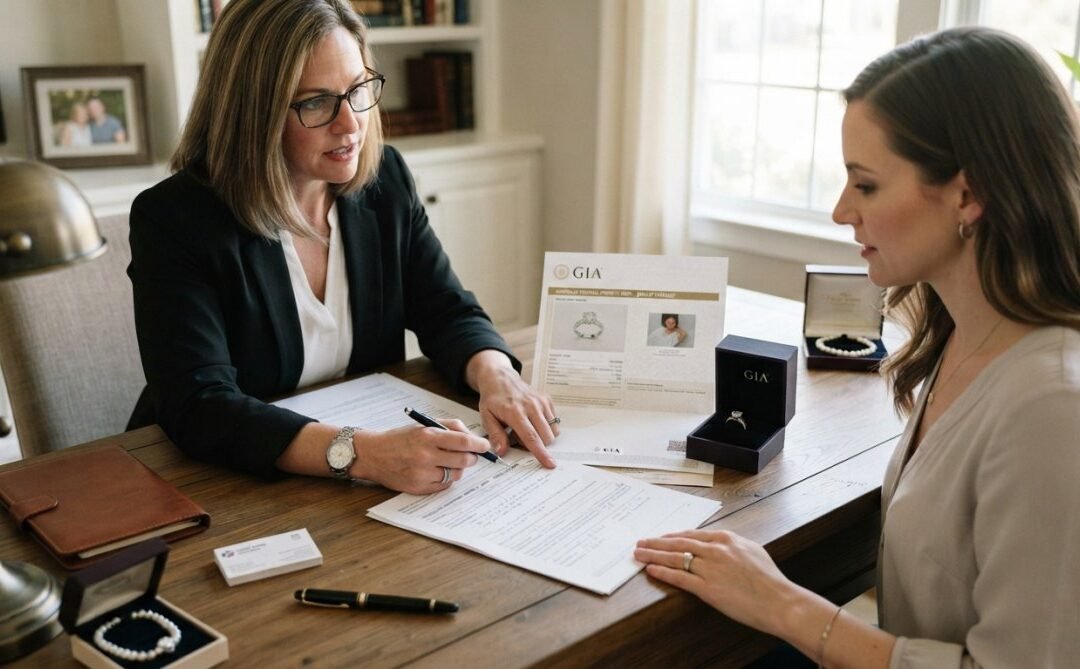
Your insurer won’t schedule a piece of jewelry without an appraisal. They need an independent, professional valuation to justify the coverage amount.
Finding a Qualified Appraiser and What to Expect
Look for appraisers certified by the American Society of Appraisers (ASA) or the International Society of Appraisers (ISA). Ask about their fee structure, most charge a flat fee per item or hourly rate. Avoid appraisers who charge a percentage of the appraised value, as this creates a conflict of interest.
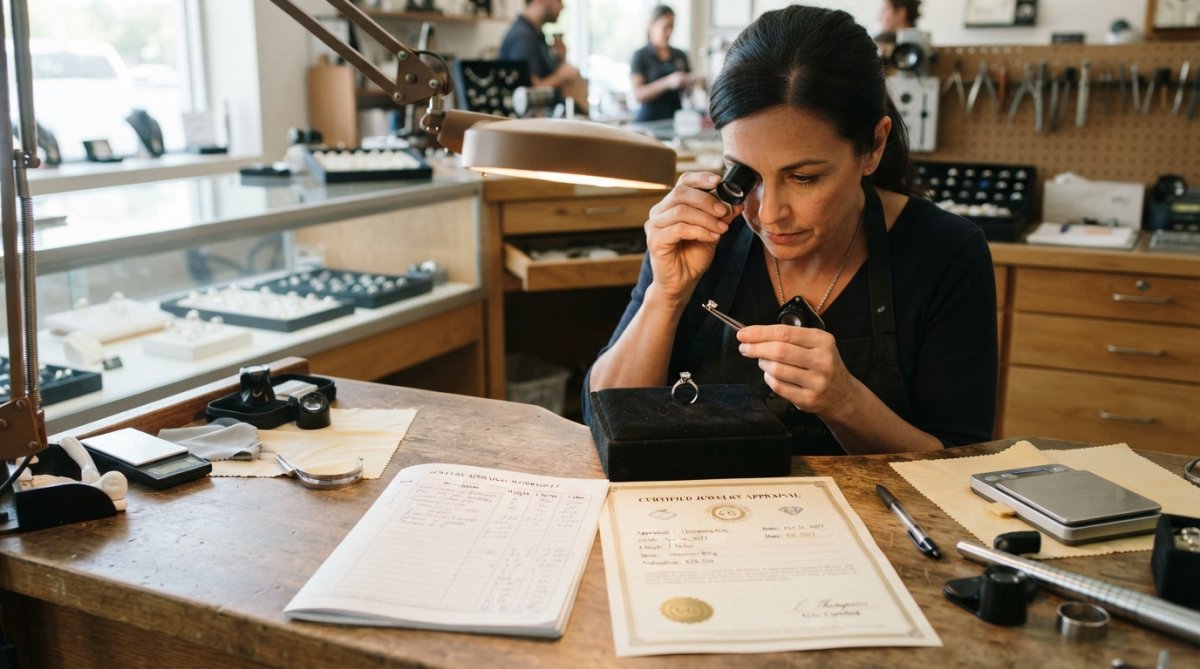
During the appraisal, the appraiser will examine the piece under magnification, test materials, identify gemstones, document any damage, and research comparable sales to determine fair market value. The process typically takes 30-60 minutes per item. Bring any original documentation you have.
GIA Certifications and Gemological Reports
A GIA (Gemological Institute of America) certificate is a detailed report on a diamond or gemstone that includes its characteristics and grade. However, a GIA cert alone isn’t a complete appraisal, it doesn’t assign a dollar value. You still need an appraisal to establish insurance value.
For insurance purposes, a detailed appraisal from a qualified ASA or ISA appraiser is typically sufficient.
Step-by-Step: How to Protect High-Value Jewelry with a Personal Property Rider
Step 1: Document Your Collection and Create an Inventory
Create a detailed inventory of the jewelry you want to protect. For each piece, note the description, approximate age, current location, and estimated value. Take clear photos from multiple angles. Gather original receipts, certificates, or appraisals.
Step 2: Obtain Professional Appraisals
Contact a qualified appraiser and explain you need appraisals for insurance purposes. Schedule appraisals for all pieces you want to protect. Keep original appraisal reports in a safe place, you’ll need to provide copies to your insurer.
Never rely on informal valuations from jewelry store staff. Insurers require formal, written appraisals from qualified appraisers.
Step 3: Review Coverage Options and Select Your Rider Type
Contact your homeowners insurer and ask about their specific requirements: Do they require appraisals for all items? Do they use replacement cost or actual cash value? What perils are covered? What’s the deductible structure? For Las Vegas residents, discuss whether you need coverage for jewelry worn outside the home.
Step 4: Submit Documentation to Your Insurer
Gather your appraisals, photos, and inventory list. Submit completed rider application, copies of appraisal reports, photos, and your inventory list. The insurer will review and confirm coverage within a few business days.
Review the updated policy carefully to ensure all items are listed correctly and values match your appraisals.
Step 5: Monitor Your Policy and Update as Needed
If you acquire new jewelry, add it to your rider with a new appraisal. If you sell or give away a piece, notify your insurer to remove it. Appraisals are typically valid for 3-5 years; update them periodically to ensure values remain accurate.
Jewelry Insurance Cost: What to Expect and How to Save
Factors That Affect Your Premium
Your rider premium is based primarily on the total scheduled value of your jewelry. Location matters significantly, in Las Vegas, premiums may be slightly higher due to theft risk. Your home’s security features also affect cost; a safe or safe deposit box may qualify for discounts.
Your homeowners policy deductible influences the rider cost. A higher deductible typically results in a lower premium. The type of jewelry also affects premium; diamonds and precious metals typically have lower premiums than other gemstones.
Deductible Strategies and Premium Trade-Offs
Many riders offer low or zero deductibles for scheduled items. Some insurers offer $0 deductible for jewelry riders, meaning you get the full scheduled value if a covered loss occurs. Consider whether it’s worth paying a higher premium to eliminate the deductible.
Another trade-off is the choice between replacement cost and agreed value. Agreed value riders cost more but eliminate disputes. For valuable jewelry in Las Vegas, the extra cost of an agreed-value, zero-deductible rider is typically justified.
What Your Rider Covers: Theft, Loss, Damage, and Mysterious Disappearance
Understanding the Mysterious Disappearance Clause
Mysterious disappearance is coverage for items that go missing without a clear explanation. Your ring slips off at a restaurant, you can’t prove it was stolen, but the rider will pay the scheduled value. Standard homeowners insurance won’t cover this.
Not all riders include mysterious disappearance coverage. When shopping for riders, specifically ask whether it’s included. For jewelry you wear frequently, it’s worth paying extra for this coverage.
Mysterious disappearance coverage has saved many jewelry owners from total loss. A diamond ring lost while traveling, a watch that vanishes at the gym, or a bracelet that slips off at the beach are all covered under mysterious disappearance if your rider includes it.
Coverage Gaps and Exclusions to Know
Wear and tear isn’t covered, if your ring’s stone becomes loose from regular use, that’s maintenance, not an insurable loss. Loss or damage caused by war, civil unrest, or nuclear hazard is usually excluded. Damage from jewelry repair or resizing is excluded, as the jeweler assumes liability during that time.
Damage from normal wear, scratches, or dulling of finish isn’t covered. However, damage from a specific accident (you drop your ring and the stone cracks) is typically covered.
Proof of Ownership and Digital Inventory Management
When you file a claim, your insurer will ask for proof of ownership. Without proof, they might deny your claim or reduce the payout.
Building Your Documentation File
Original receipts and appraisals are ideal proof of ownership. Photos are crucial, take clear, detailed photos from multiple angles, showing any unique characteristics, maker’s marks, or engravings. For inherited jewelry or gifts, gather any documentation that came with them.
Keep all documentation in one secure location. A safe deposit box is ideal; digital copies stored in a cloud service are a good backup.
Digital Tools for Tracking Serial Numbers and Valuations
Modern jewelry often comes with serial numbers or maker’s marks. Document these in a digital inventory. Apps like Valuable or Everplans let you catalog your jewelry with photos, descriptions, appraisals, and values.
For each piece, record the item description, serial number, purchase date, current appraised value, photos, appraisal document, and typical storage location. Update your digital inventory whenever you acquire new jewelry or get appraisals updated.
Filing a Claim: Process, Timelines, and Premium Impact
What Happens When You File a Claim
Contact your insurer as soon as you discover a loss. For theft, you may need to file a police report first. Provide your claim number and police report number to your insurer.
The insurer will assign a claims adjuster who will contact you. Provide original appraisal documents, photos, proof of ownership, police report, and any other supporting documentation.
For scheduled items with agreed values, the claims process is straightforward. The adjuster reviews your documentation, confirms the item is scheduled, and processes payment for the scheduled amount, typically within 7-14 business days.
How Claims Affect Your Future Premiums
Filing a claim on your jewelry rider may affect your homeowners insurance premiums, but the impact is typically smaller than for other types of claims. A single jewelry claim might increase your premium by 5-10%.
Some insurers offer claim forgiveness for first-time claimants. Ask your agent whether your policy includes this protection.
Multiple claims within a short period can result in more significant premium increases. Consider the long-term cost of filing a claim before deciding whether to file for minor losses.
Protecting high-value jewelry with a personal property rider is one of the smartest insurance decisions you can make. The process, inventory, appraisal, documentation, and rider application, takes a few hours but provides years of peace of mind. United Family Insurance helps Las Vegas residents navigate this process with expert guidance, comparing coverage options across multiple insurers to find the best protection at competitive rates. Our agents understand jewelry insurance requirements and can help you structure a rider that covers mysterious disappearance, offers replacement cost coverage, and eliminates deductibles for your most valuable pieces. Get a quote today and protect your collection with confidence.
Frequently Asked Questions
What is a personal property rider for jewelry?
A personal property rider is an endorsement to your homeowners or renters insurance policy that provides additional coverage specifically for high-value jewelry items. Unlike standard homeowners insurance, which typically caps jewelry coverage at $1,500 to $2,500 total, a rider allows you to schedule individual pieces with their full appraised value. This means engagement rings, watches, heirlooms, and other fine jewelry receive replacement cost coverage rather than actual cash value, protecting you against theft, loss, accidental damage, and sometimes mysterious disappearance.
How much does jewelry insurance cost with a personal property rider?
The cost of a personal property rider depends on several factors including the total appraised value of your jewelry, the deductible you choose, your location, your claims history, and the specific coverage options selected. Pricing varies by insurer and policy structure. Rather than relying on estimates, contact United Family Insurance for a personalized quote. Our agents can compare options from multiple carriers to help you find affordable coverage that matches your collection's value and your budget.
Do I need a professional appraisal to add a personal property rider for jewelry?
Yes, most insurers require a professional appraisal for jewelry valued above a certain threshold (often $500 or more per piece). A qualified appraiser will assess the item's condition, materials, craftsmanship, and current market value, providing a detailed report that serves as proof of ownership. For scheduled personal property coverage, appraisals are essential, they establish the replacement cost and protect you during the claim process. Appraisals should be updated every 3-5 years or when jewelry values fluctuate significantly.
What does mysterious disappearance jewelry insurance cover?
Mysterious disappearance coverage protects you when jewelry goes missing without a clear cause, such as when you can't remember where you left a ring or a necklace vanishes under unclear circumstances. Standard homeowners policies typically do not cover mysterious disappearance, but a personal property rider with this endorsement will. This is one of the key advantages of a scheduled personal articles policy over basic homeowners coverage. Not all insurers offer this clause, so confirm it's included when discussing your rider options with United Family Insurance.