

Table of Contents
- Liability Insurance for Full Time Bus Living: The Basics
- Converted School Bus Insurance: How Insurers See Your Build
- School Bus Personal Use Insurance vs. Commercial Coverage
- RV Liability Insurance: Coverage Limits That Actually Protect You
- Full-Time RV Insurance and Policy Eligibility
- Registration, Title, and Insurance in Nevada and Las Vegas
- Coverage While Converting, Parked, or Not Road-Ready
- Frequently Asked Questions
Last Updated: October 19, 2026
Liability Insurance for Full Time Bus Living: The Basics
Liability insurance for full time bus living is a specialized auto policy covering bodily injury and property damage you cause to others while your converted bus is your permanent residence.
A bus conversion sits in a strange middle ground: too modified for a standard auto policy, too home-like for a plain commercial policy, and too unusual for many RV underwriters without documentation.
Why a Standard Auto Policy Falls Short
A standard personal auto policy assumes your vehicle is transportation, not a dwelling. Full-time living creates three exposures the policy was never written for:
- Personal liability on the premises. A guest injured inside your parked bus may fall outside auto liability entirely.
- Personal belongings. Your clothing, electronics, and furnishings are typically excluded from auto coverage.
- Loss of use. If the bus is totaled and it was your home, a standard policy pays the vehicle’s value, not your housing costs.
The most common mistake is assuming an auto policy follows the vehicle wherever it goes. Once the bus becomes a residence, gaps open between what the policy covers and what actually happens on site. Read the exclusions page before you assume you are protected.
Converted School Bus Insurance: How Insurers See Your Build
Converted school bus insurance is priced on risk, and underwriters assess a conversion differently from a factory-built motorhome. A former passenger bus has a commercial history, a heavy chassis, and build quality the insurer cannot verify from a photo.
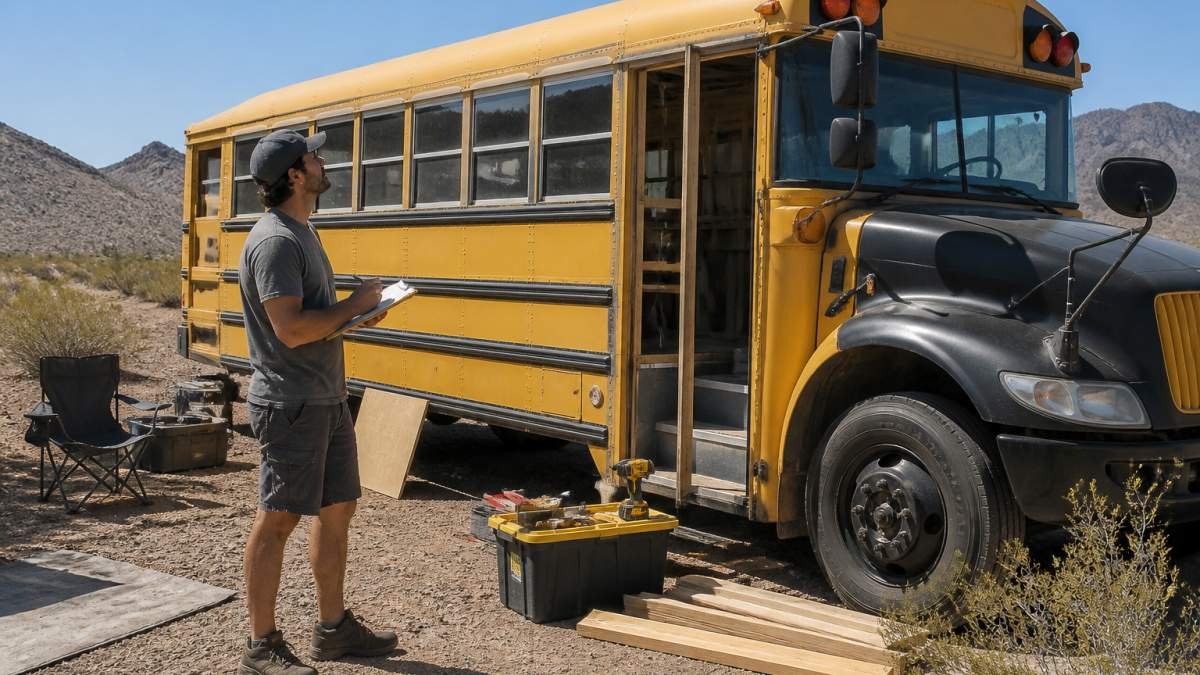
What underwriters want to see, in practice:
- A completed conversion, not a work in progress, for a standard RV-style policy
- Documented systems: electrical, propane, plumbing, and heating installed to recognized standards
- Photos and receipts showing the build timeline and materials
Documenting the Conversion for Underwriting
Build a conversion file before you shop: dated photos of each stage, receipts for major components, and inspection reports. Waiting until the application to gather this slows underwriting, and a partial file often produces a higher premium or a decline.
Photograph the bus in stages and keep a dated folder. When an underwriter asks how the electrical and propane systems were installed, a clean timeline answers the question before it becomes a reason to decline coverage.
School Bus Personal Use Insurance vs. Commercial Coverage
School bus personal use insurance covers a converted bus used privately and non-commercially. Commercial coverage applies when the bus carries passengers for hire, transports goods, or supports a business. A personal policy will not respond to a commercial exposure, and commercial coverage usually costs more than a full-time owner needs.
| Policy Type | Best For | Key Limitation |
|---|---|---|
| Personal auto | Short-term, occasional use | Excludes residential exposures |
| School bus personal use | Converted bus, private use | Requires completed conversion |
| Commercial vehicle | Business or passenger-for-hire use | Higher premium, business-only scope |
| RV / motorhome | Full-time or part-time living | Requires living-quarters documentation |
RV Liability Insurance: Coverage Limits That Actually Protect You
RV liability insurance is the core of a full-time bus policy, and the limits you choose determine how much of a serious claim you pay yourself. Nevada requires liability coverage, but the state minimum is rarely enough when a bus is involved in a multi-vehicle crash. The Nevada Department of Motor Vehicles insurance requirements set the legal floor; your actual exposure usually sits well above it.
What Nevada Actually Requires
Nevada’s minimum liability requirements for a private passenger vehicle are 25/50/20: $25,000 bodily injury per person, $50,000 per accident, and $20,000 property damage. Nevada also requires uninsured/underinsured motorist coverage unless you reject it in writing. Those minimums were set for passenger cars, not a 10-ton converted bus. A single serious Las Vegas injury claim can exceed the per-person minimum many times over, and you are personally exposed for the difference.
Bodily Injury, Property Damage, and Uninsured Motorist Limits
Work through the limits in order, and treat each one as a separate decision:
- Bodily injury liability: covers injuries you cause to others. A bus’s weight means longer stopping distances and higher injury severity. Most full-time bus owners should carry limits well above the state minimum, commonly 100/300 or higher, because a bus-versus-pedestrian claim in dense Las Vegas traffic can dwarf a 25/50 policy.
- Property damage liability: covers damage to other vehicles and structures. A bus can strike multiple vehicles in one incident, and Las Vegas freeway collisions often involve three or more cars. A $20,000 limit can be exhausted by two late-model vehicles; consider $50,000 or $100,000.
- Uninsured and underinsured motorist: protects you when the at-fault driver has no coverage or too little. Nevada has a meaningful uninsured-driver population, and bus repairs are expensive. This coverage fills the gap between the other driver’s limit and your actual loss, and responds to hit-and-run claims.
Choosing Limits: A Practical Framework
Do not pick limits by comparing premiums alone. Work backward from exposure:
- Add up what you could lose. Equity in the bus, savings, and any home or rental property you own are reachable in a judgment. Nevada does not protect wages and assets from an at-fault liability judgment the way some states protect a primary residence.
- Price the gap. Ask your agent for quotes at the state minimum, at 100/300/50, and at 250/500/100. The jump from minimum to 100/300 is often modest relative to the protection it buys.
- Layer an umbrella if the bus is your only major asset. A personal umbrella sits above the auto liability limit and is usually inexpensive for the extra coverage, but confirm the umbrella carrier accepts a converted bus as an underlying vehicle.
- Match uninsured motorist limits to your bodily injury limits. There is little point carrying 250/500 bodily injury if your uninsured motorist limit is 25/50; the at-fault driver’s lack of coverage is the scenario you are most likely to face.
Choose liability limits based on what you own and what you could lose, not on the state minimum. The difference in annual premium between minimum and higher limits is usually small compared with the cost of a serious at-fault claim, and in Nevada, a judgment can follow your income and assets for years.
Las Vegas-Specific Exposure
Clark County’s traffic mix raises the stakes: dense tourist traffic, freeway interchanges, and many rental cars and out-of-state drivers carrying only home-state minimums. A converted bus has blind spots a passenger car does not, and summer heat stresses tires and brakes. When requesting quotes, tell the agent the bus is garaged in Las Vegas and driven in Clark County, garaging location is a rating factor, and an accurate address avoids a claim-time dispute.
Full-Time RV Insurance and Policy Eligibility
Full-time RV insurance covers a bus used as a primary residence, and eligibility depends on how the insurer defines full-time use.
Insurance Information Institute guidance on RV coverage explains that full-time policies are written differently from recreational policies, which is why the use statement on your application must be accurate.
A common mistake is describing the bus as recreational when you live in it year-round.
Registration, Title, and Insurance in Nevada and Las Vegas
Registration and title classification in Nevada drive your insurance options. A bus titled as a bus is insured as a bus; a bus retitled as a motorhome can qualify for RV coverage. The Nevada DMV vehicle registration and title information outlines the retitling process, which generally requires proof of the conversion and a vehicle inspection. For a bus converted and garaged in Las Vegas, the sequence matters: title first, registration second, insurance bound before you drive.
The Nevada Retitling Path for a Converted Bus
Nevada does not have a standalone “skoolie” title class. In practice, owners pursue a motorhome or recreational vehicle classification so the vehicle can be registered and insured as an RV rather than a commercial bus. The general path looks like this:
- Complete the conversion to living-quarters standards. Insurers and DMV inspectors look for a sleeping area, a cooking appliance, a dedicated water supply, and a 110-volt or propane electrical system. A bus with a mattress and a cooler is not a motorhome.
- Gather build documentation. Dated photos of each stage, receipts for major systems, and any inspection reports. This file serves both the DMV and the underwriter.
- Obtain a Nevada inspection. The DMV may require a VIN inspection and, for a modified vehicle, a safety or equipment inspection. Confirm current requirements with the Las Vegas DMV office before scheduling, because procedures and forms change.
- Apply for the corrected title. Submit the title application with the conversion documentation and inspection results. The title should reflect the vehicle’s current use and body type.
- Register the vehicle and bind insurance. Nevada requires proof of insurance to register. Bind the RV or full-time policy before the registration transaction so there is no gap.
Do not cancel your existing coverage before the new policy is bound. A lapse in insurance can raise your rate and, in Nevada, create registration problems, the DMV can suspend a registration for an insurance lapse, and reinstating it costs fees and time.
Why Title Classification Changes Your Insurance
An insurer prices a bus-titled vehicle as a commercial or specialty risk. A motorhome-titled vehicle can be rated on an RV form, which offers full-time living coverage, personal liability away from the vehicle, and personal belongings protection. If the title still says bus, expect a decline or a commercial policy with a business-use exclusion. The title and policy need to tell the same story.
Las Vegas Garaging and Storage Considerations
For Las Vegas owners, garage location matters. Insurers rate on where the bus is stored, and summer heat plus desert dust drive comprehensive claims, sun-damaged seals, cracked dashboards, and dust infiltration are real losses.
If you are searching for liability insurance for full time bus living near me, confirm the agent understands both the conversion and the local garaging risk.
Registration, Insurance, and Full-Time Use Disclosure
Nevada registration does not ask whether you live in the vehicle full time, but your insurance application does. Disclose full-time use accurately. If the policy is written as recreational and you live in the bus year-round, a claim can be denied for misrepresentation, and the premium savings are small compared with losing coverage on the vehicle that is also your home.
Coverage While Converting, Parked, or Not Road-Ready
Coverage during the conversion process is the gap most owners miss. A bus under construction is often not road-ready, and standard policies may exclude damage to a vehicle that is not in drivable condition. Ask specifically about:
- Builders risk or comprehensive-only coverage during the conversion
- Storage coverage while the bus is parked and unregistered
- Transition coverage between the build phase and the finished RV policy
National Association of Insurance Commissioners consumer resources advises confirming in writing what a policy does and does not cover before a loss occurs. That written confirmation is your best protection when a claim is disputed.
Living full time in a converted bus means your insurance must cover a home and a vehicle at once, and most standard policies only do one.
Frequently Asked Questions
Does liability insurance cover a converted school bus used as a full-time home?
It can, but not under a standard personal auto policy. Once a bus is titled and registered as a motorhome and meets living-quarters requirements, an RV policy with liability coverage can apply. Full-time use usually requires a full-timer endorsement or a dedicated full-time RV policy. Insurers will ask for proof of the conversion, photos, and receipts before binding coverage, so keep documentation from the start of the build.
Can I get RV insurance for a school bus conversion?
Yes, several carriers write converted school bus insurance, but underwriting is stricter than for factory-built RVs. Most require the conversion to be complete, the title reclassified as a motorhome, and the bus to have standard RV systems such as plumbing, a stove, and a sleeping area. Some carriers decline skoolies entirely, so working with an agent who knows which companies accept conversions saves time.
What information do insurers need to insure a converted bus?
Expect to provide the vehicle identification number, current title and registration, photos of the exterior and interior, receipts for the conversion build, the completed living-quarters features, your garaging address, annual mileage estimates, and whether use is full-time or part-time. Underwriters also want to know your driving record and prior insurance history. Incomplete documentation is the most common reason a converted school bus insurance quote stalls.
Does standard auto liability cover belongings inside a bus conversion?
No. Liability coverage pays for damage you cause to other people and their property, not your own possessions. Personal belongings inside a bus conversion are typically excluded from auto and RV policies. Contents coverage, renters insurance, or a personal property floater may fill that gap. Ask your agent specifically about personal belongings before you assume the policy protects your gear.
Is RV insurance cheaper if you live in it full-time?
Full-time RV insurance usually costs more than part-time coverage because the vehicle is on the road and in use year-round, which raises liability exposure. Part-time policies assume seasonal use and a stored vehicle for part of the year. The difference varies by carrier, state, and vehicle value, so request quotes for both full-time and part-time use to see how the annual premium changes for your situation.
How do liability limits work for full time bus living?
Liability limits are the maximum your policy pays per person and per accident for bodily injury, plus a separate limit for property damage. State minimums are rarely enough for a serious crash involving injuries. Higher limits cost more in annual premium but protect your savings and future income. Uninsured and underinsured motorist coverage is worth adding because it pays when the other driver has no coverage or too little.