

Table of Contents
- How to File a Commercial Liability Insurance Claim: A Step-by-Step Process
- Documenting a Business Liability Incident: What Evidence Matters Most
- How Long Does a Business Insurance Claim Take to Resolve
- Business Insurance Claim Letter Template and Best Practices
- Tips for a Successful Business Insurance Claim
- After Your Commercial Liability Claim: Settlement and Next Steps
- Conclusion
Last Updated: July 1, 2026
Understanding how to file a commercial liability insurance claim is essential for protecting your business when accidents or incidents occur. Businesses that file claims promptly experience faster resolution times and better settlement outcomes. Whether you’re dealing with property damage, bodily injury liability, or third-party claims, knowing the proper procedure can mean the difference between smooth resolution and costly delays.
What You’ll Need Before Starting
Gather your policy documents, including your policy number, coverage limits, and effective dates. Have your insurance agent’s contact information and the 24/7 claims hotline number from your policy card readily available.
Collect incident reports, photographs or video of the damage, witness statements, and any related correspondence. For business interruption claims, gather records showing your normal revenue during the affected period. If third parties are involved, obtain their contact information and insurance details. Know your deductible amount and coverage limits.
Step 1: Report the Incident Immediately
Report the incident to your insurance agent or carrier within 24 hours. Most commercial policies require prompt notification, and delays can jeopardize your claim. Provide a clear, factual account of what happened: date, time, location, and how the injury or damage occurred. Don’t admit fault, that’s for the claims adjuster to determine.
Many carriers offer 24/7 reporting through a dedicated claims hotline. Ask for a claim number immediately and document the name of the person who takes your report.
Step 2: Gather Evidence and Document the Incident
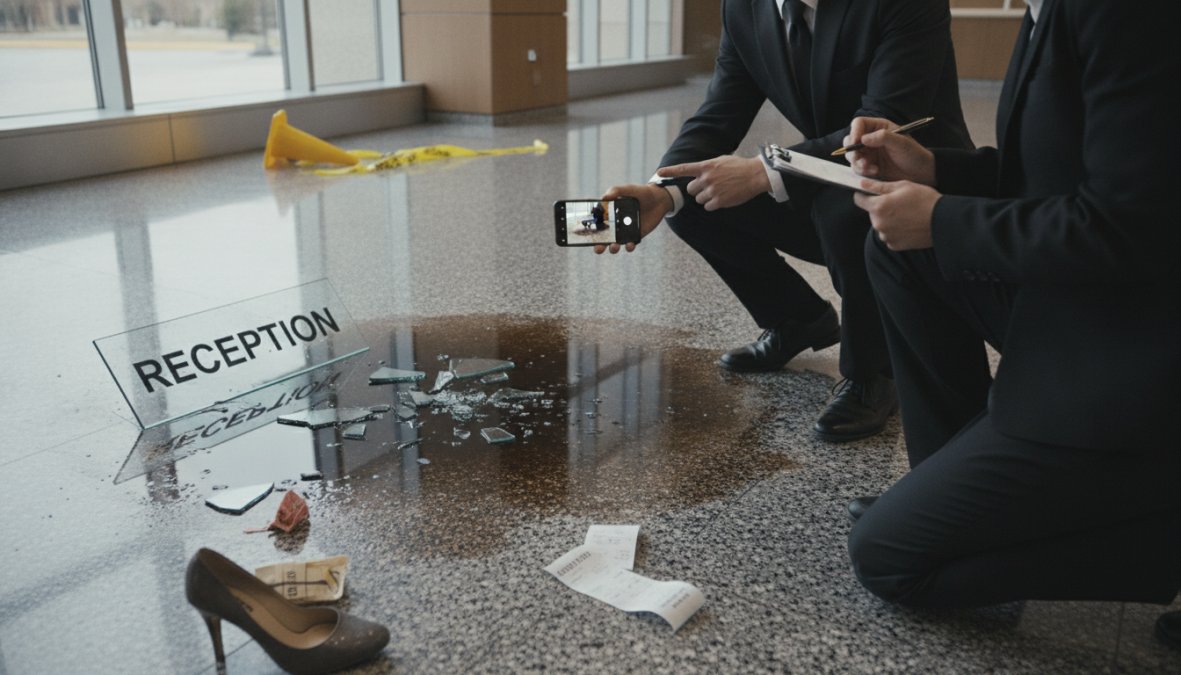
Photograph or video the incident scene from multiple angles, capturing both close-ups of damage and wider shots showing context. Timestamp your photos if possible. Don’t clean up or repair damage until the claims adjuster inspects it, unless safety requires immediate action.
Collect written statements from witnesses while details are fresh, including their names, contact information, and what they observed. For employee injuries, document medical treatment sought and obtain copies of medical reports. For third-party liability claims, obtain the other party’s insurance information, identification, and contact details. If police responded, get the report number and officer’s name.
Step 3: Contact Your Insurance Agent or Carrier
Call the claims hotline with your policy number and incident details ready. Explain the nature of your claim clearly and ask which documents your carrier needs and the submission deadline. Your agent can clarify coverage and advise whether you need legal counsel or a public adjuster.
Ask about the claims process timeline: How long until an adjuster is assigned? When will they contact you? What’s the expected settlement timeframe?
Step 4: Complete the Claim Form
Your carrier will send a formal claim form, often called a "proof of loss." Complete it thoroughly and accurately. Be specific and factual, describe the exact areas affected and type of damage. List all damages and expenses separately with supporting documentation: repair estimates for property damage, medical bills for bodily injury claims, and financial records for business interruption claims.
Sign, date, and keep a copy. Submit it to your claims adjuster and request confirmation of receipt.
Step 5: Submit Documentation to Your Claims Adjuster
Organize documentation logically in a folder with your claim number. Include the proof of loss form, photographs, witness statements, repair estimates, medical records, and police reports. Number each document and create a cover sheet listing contents.
Submit through your adjuster’s preferred method with a clear subject line containing your claim number. Keep copies of everything and maintain a log showing what you’ve sent, when, and confirmation of receipt.
Documenting a Business Liability Incident: What Evidence Matters Most
Photographs and video footage are your most powerful evidence. Capture the incident scene from multiple angles. For slip-and-fall claims, photograph the hazardous condition. For property damage, show damage from different distances. For vehicle incidents, photograph vehicle damage, road conditions, traffic signals, and street signs.
Medical documentation proves bodily injury claims. Collect records from all healthcare providers including diagnoses, treatment, medications, and prognosis. Witness statements from people who observed the incident carry significant weight. Include the witness’s name, contact information, occupation, and relationship to you.
Digital Evidence Management for Modern Claims
Organize digital photographs, videos, and documents in cloud storage with your claim number as the folder name. Use your smartphone’s native timestamp features, most phones automatically record when photos and videos were taken.
For business interruption claims, export financial reports from your accounting software showing revenue for the affected period compared to the same period in previous years. Email chains with customers or suppliers documenting the incident’s impact are valuable digital evidence.
Creating a Proof of Loss Document
A proof of loss is a detailed, itemized statement of your damages and losses. List each damaged item separately with replacement cost or repair estimate. For example: "Storefront window damage, replacement cost $3,200 (estimate from ABC Glass attached)."
For bodily injury claims, list medical expenses chronologically with copies of invoices and receipts. If the injured party missed work, calculate lost wages with supporting pay stubs. Organize by category (property damage, medical expenses, lost income, temporary repairs), subtotal each category, then provide a grand total.
How Long Does a Business Insurance Claim Take to Resolve
Simple claims with clear liability and complete documentation typically resolve in 30-60 days. Complex claims involving multiple parties, significant injuries, or disputed liability may take 90-180 days or longer. The investigation period typically lasts 20-45 days.
Bodily injury claims take longer than property-only claims because medical treatment may be ongoing. Third-party liability claims take longer because multiple insurance carriers may be involved. Disputes over liability further extend the timeline.
Tracking Your Claim Status Throughout the Process
Ask your claims adjuster for a realistic timeline at your first contact. Request updates every 2-3 weeks. Most carriers offer online portals where you can check claim status 24/7.
When contacting your adjuster, ask specific questions: Has investigation been completed? Are there outstanding documentation requests? What’s the expected settlement timeline? Document all communication with your adjuster, including dates, times, names, and topics discussed.
What Affects Claim Processing Time
Claim complexity is the primary factor. Straightforward property damage claims resolve faster than claims involving multiple injuries or significant business interruption. Documentation completeness dramatically affects processing time, claims with complete, organized documentation resolve 30-40% faster.
Property damage claims typically resolve faster than bodily injury claims. Liability disputes extend processing time significantly. Minor claims under $10,000 may resolve in 20-30 days, while major claims exceeding $100,000 require more thorough investigation, extending the timeline to 90+ days.
Business Insurance Claim Letter Template and Best Practices
A formal claim letter documents your intent to file a claim and summarizes key details. Use this template:
[Your Business Name]
[Business Address]
[City, State, ZIP]
[Date]
[Insurance Carrier Name]
Claims Department
[Carrier Address]
RE: Commercial Liability Insurance Claim – Policy #[Your Policy Number]
Dear Claims Manager,
I am writing to formally notify you of a claim under our commercial general liability insurance policy, effective [policy dates]. On [incident date], at approximately [time], an incident occurred at [incident location] that resulted in [brief description of incident].
The incident involved [property damage/bodily injury/business interruption]. We have documented the incident with photographs, witness statements, and [other relevant documentation]. We are submitting this claim for damages totaling [amount], as detailed in the attached proof of loss and supporting documentation.
Please confirm receipt of this letter and advise the next steps in the claims process. I am available at [phone number] or [email address] to provide additional information as needed.
Sincerely,
[Your Name]
[Your Title]
Key Elements Your Claim Letter Must Include
Reference your policy number prominently. Include the policy effective dates so there’s no question about coverage during the incident date. Describe the incident date, time, and location specifically.
Summarize the incident factually without admitting liability. For example: "A customer slipped on a wet floor in our entryway and fell, sustaining injuries to her knee and ankle" is factual. Avoid statements like "We caused the accident."
Reference the documentation you’re submitting and include your contact information. Request confirmation of receipt and ask the carrier to identify the assigned claims adjuster.
Tips for a Successful Business Insurance Claim
Report incidents within 24 hours, gather evidence immediately, and submit documentation quickly. Be honest and accurate in all communications, exaggerating damages or misrepresenting facts constitutes insurance fraud.
Organize your claim file meticulously using a binder or digital folder with clear section dividers. Maintain professional communication with your claims adjuster and respond promptly to requests for information.
Keep a detailed log of all claim-related expenses, including repair costs, medical bills, and lost income. This log becomes your proof of loss document and ensures you don’t overlook any recoverable expenses.
Common Mistakes to Avoid When Filing
Don’t delay reporting your incident. Waiting weeks or months gives your carrier grounds to deny coverage based on late notice. Avoid cleaning up or repairing damage before your adjuster inspects it. Don’t post about your incident on social media, statements can be used against your claim.
Never communicate directly with the other party’s insurance carrier without your own adjuster’s knowledge. Avoid accepting a settlement offer without fully understanding what it covers and what you’re waiving.
Handling Claim Denials and the Appeal Process
If your carrier denies your claim, request a detailed written explanation. Review your policy carefully, sometimes denials are based on misinterpretation of policy language. File a formal appeal if you disagree with the denial, explaining why you believe the claim should be covered and referencing specific policy language.
Consider hiring a public adjuster or attorney if the claim value is substantial. Document everything in your appeal, including copies of your policy, the denial letter, original claim documentation, and your written appeal.
Understanding Tax Implications of Insurance Payouts
Insurance proceeds for property damage are generally not taxable because they’re replacing damaged property. Business interruption insurance proceeds are typically taxable as ordinary income because they’re replacing lost profits. Personal injury settlements have complex tax implications, consult a tax professional about how your settlement should be reported.
Keep detailed records of how your settlement is allocated. If your settlement covers both property damage and lost income, have your insurance carrier specify the allocation.
After Your Commercial Liability Claim: Settlement and Next Steps
Review the settlement amount carefully and ask your adjuster to justify the calculation. You can negotiate if you believe the settlement is insufficient. Settlement checks are typically made payable to you and any contractors or vendors you’ve hired for repairs.
Once you receive your settlement, use it to repair damage or cover losses and keep receipts. After settlement, your claim file closes, if you discover additional damages after settlement, you typically cannot reopen the claim.
Calculating Business Interruption Losses
Calculate your daily or weekly average revenue for the 12 months preceding the incident. Multiply your average daily income by the number of days your business was unable to operate. Deduct expenses you didn’t incur while closed (employee wages, utilities, supplies).
| Calculation Step | Example Amount |
|---|---|
| Annual revenue | $500,000 |
| Daily average revenue | $1,370 |
| Days business was closed | 30 |
| Gross lost income | $41,100 |
| Variable daily expenses saved | $600 |
| Net daily loss | $770 |
| Net business interruption loss | $23,100 |
Document your calculations with financial records, accountant’s analysis, bank statements, credit card processing records, and prior-year tax returns.
Working with Legal Counsel if Needed
For complex claims, significant disputes, or denied claims, hiring an attorney may be necessary. Insurance attorneys specialize in claim disputes and understand policy language and state insurance regulations. Contact an attorney if your carrier denies your claim and you believe the denial is incorrect.
For claims involving serious injuries or significant damages, an attorney can help negotiate a higher settlement. Ensure your attorney has experience with commercial liability insurance claims similar to yours.
Filing a commercial liability insurance claim successfully requires organization, prompt action, and thorough documentation. Following these steps dramatically improves your chances of a favorable resolution. United Family Insurance provides expert guidance through every stage of the claims process, helping Las Vegas and Nevada businesses understand their coverage and maximize their settlements. Get a quote from United Family Insurance today and discover how our comprehensive commercial coverage protects your business when incidents happen.
Frequently Asked Questions
What is the process for filing a commercial liability insurance claim?
The process involves reporting the incident to your insurance carrier within 24 hours, gathering evidence and documentation, contacting your insurance agent with your policy number, completing the claim form, and submitting all materials to your claims adjuster. Your insurance carrier will investigate the claim, review coverage limits and deductible terms, and issue a settlement decision. The entire process typically takes 30-90 days, depending on claim complexity and the completeness of your documentation.
How long does a business insurance claim take to be approved and settled?
Most commercial general liability claims are resolved within 30 to 90 days, though complex claims involving third-party liability or significant bodily injury may take longer. Simple claims with clear documentation can be approved in 2-4 weeks. Delays often occur when evidence gathering is incomplete, when the claims adjuster needs additional proof of loss, or when underwriting requires further investigation. You can track your claim status through your insurance carrier's online portal or by contacting your claims hotline.
What documents do I need to file a commercial liability insurance claim?
Essential documents include your insurance policy, incident report with the date and details, photographs or video evidence, witness statements, proof of loss, receipts for damaged property, medical reports (if bodily injury occurred), and correspondence with third parties. For business interruption claims, include financial records showing lost income. Digital evidence management systems can help organize these materials. Your claims adjuster will specify additional documentation needed based on your policy coverage and claim type.
What should I do if my commercial liability insurance claim is denied?
If your claim is denied, request a detailed written explanation from your insurance carrier outlining the reason. Review your policy carefully to understand coverage limits and exclusions. You have the right to appeal the denial by submitting additional evidence, written arguments, or a formal appeal letter. Consider consulting legal counsel if the denial seems unjustified. Document all communication with your carrier. Many denials can be overturned with proper documentation or clarification of coverage terms, so persistence and thoroughness are essential in the appeal process.