

Table of Contents
- How Diabetes Affects Final Expense Insurance Eligibility
- Understanding Guaranteed Issue Life Insurance for Diabetics
- A1C Requirements for Life Insurance and What Insurers Look For
- Simplified Issue Life Insurance for Diabetes: When It Works Best
- Step-by-Step Process: Getting Final Expense Insurance With Diabetes
- Common Mistakes to Avoid When Applying With Diabetes
- Why Working With a Local Agent Matters
- Conclusion
Last Updated: August 10, 2026
How Diabetes Affects Final Expense Insurance Eligibility
Diabetes significantly impacts your ability to qualify for final expense insurance, but it doesn’t disqualify you. When you apply, underwriters evaluate your condition’s severity, how well you manage it, and whether you have related complications. Your A1C levels, medication regimen, and medical history become central to their decision.
Insurers recognize that many people with diabetes live long, healthy lives. What they’re measuring is risk. Someone with well-controlled Type 2 diabetes and an A1C below 7 presents a different risk profile than someone with uncontrolled Type 1 diabetes or recent hospitalizations.
The application process requires transparency. Hiding or downplaying your condition will backfire during underwriting. Insurers conduct medical record reviews and prescription history checks, and dishonesty gives them grounds to deny your claim later, exactly when your family needs the coverage most. Working with an experienced agent who understands how diabetes cases are underwritten can make the difference between approval and rejection.
Understanding Guaranteed Issue Life Insurance for Diabetics
Guaranteed issue life insurance approves applicants without medical underwriting or health questions. If you have diabetes and struggle to qualify for standard final expense insurance, guaranteed issue becomes an option worth considering.
The trade-off: guaranteed issue policies cost significantly more because insurers accept all applicants regardless of health status. Most guaranteed issue policies also include a waiting period (typically 2-3 years), meaning if you die from any cause during that period, your beneficiary receives only a return of premiums paid, not the full death benefit. After the waiting period expires, the full death benefit becomes available.
Guaranteed issue works best for people with severe diabetes complications, multiple chronic conditions, or a history of denied applications. The application process is remarkably simple, you answer basic questions about your age and identity, nothing about your health. Approval typically takes 1-2 weeks with no need for medical records or exams.
If you’re over 75 or have severe diabetes complications, guaranteed issue may be your only realistic option. Don’t waste time applying for simplified or standard issue policies if your medical situation makes approval unlikely.
A1C Requirements for Life Insurance and What Insurers Look For
Your A1C level is one of the first things insurers examine when you apply for final expense insurance with diabetes. A1C measures your average blood sugar over the past 2-3 months.
Most insurers use these general guidelines:
- A1C below 7: Generally favorable for standard underwriting
- A1C 7-8: Acceptable for simplified issue; may require standard underwriting with additional scrutiny
- A1C 8-9: Usually requires simplified issue only; standard policies unlikely
- A1C above 9: Typically restricted to guaranteed issue policies
These aren’t hard rules, different insurers have different thresholds. Some focus heavily on trend (whether your A1C is improving or worsening) rather than the absolute number.
Insurers also look beyond the A1C number itself. They want to see evidence that you’re actively managing your diabetes through regular doctor visits, consistent medication use, and documented attempts to control your blood sugar. Your prescription history tells this story. If your medical records show you’re filling prescriptions regularly and following treatment plans, insurers interpret that as responsible self-management.
Your A1C level matters, but your commitment to managing diabetes matters more. Insurers reward people who actively treat their condition with better rates and approval odds. Get your A1C tested before applying, and make sure your medical records show consistent doctor visits and medication use.
Simplified Issue Life Insurance for Diabetes: When It Works Best
Simplified issue life insurance sits between standard underwriting and guaranteed issue. You answer health questions on the application, but you don’t undergo a medical exam. For many people with diabetes, simplified issue is the sweet spot: better rates than guaranteed issue, but easier approval than standard policies.
Simplified issue works best when your diabetes is well-controlled. If your A1C is consistently below 8, you take your medications as prescribed, you have no major complications, and you haven’t been hospitalized recently, simplified issue policies will likely approve you at reasonable rates. The underwriting process is faster than standard (typically 1-2 weeks), and you avoid the medical exam hassle.
The health questions cover your A1C levels, current medications, any diabetes-related complications, hospitalizations in the past few years, and whether you’ve been denied insurance before. You won’t need to submit medical records unless the insurer requests them based on your answers.
Simplified issue policies typically offer death benefits ranging from $5,000 to $50,000, plenty for final expense coverage. The main limitation: simplified issue policies usually don’t accept applicants with certain complications like recent amputations, dialysis, severe kidney disease, or recent heart attack or stroke. In those cases, you’d need guaranteed issue.
Step-by-Step Process: Getting Final Expense Insurance With Diabetes
Getting approved for final expense insurance with diabetes requires preparation and honesty.
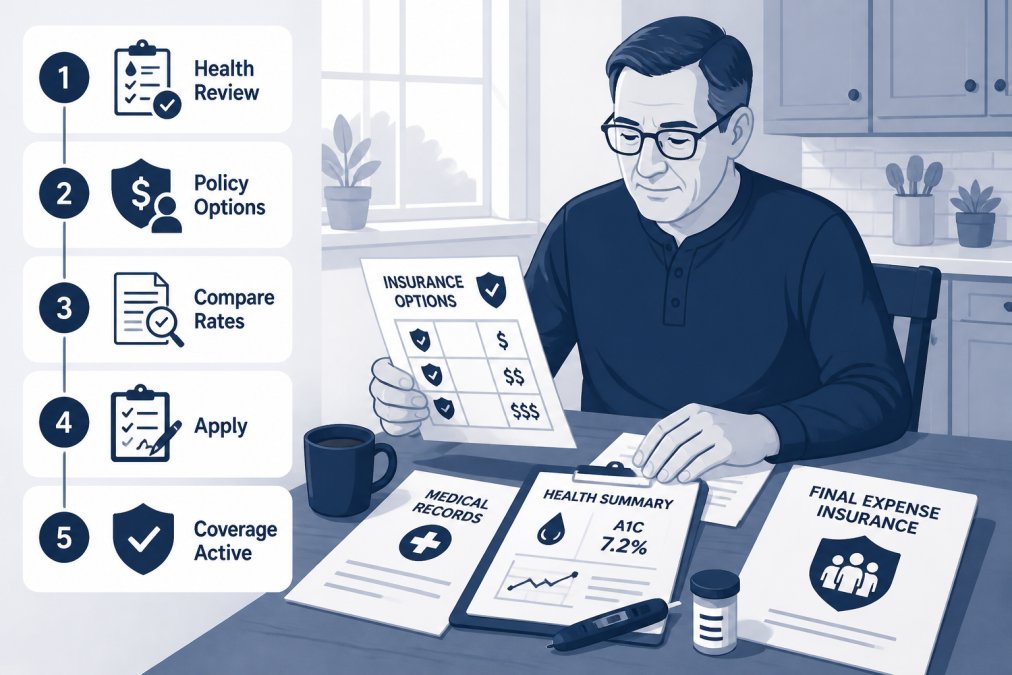
Step 1: Gather Your Medical Records and Health History
Before you apply, collect your most recent A1C test results, a list of all current medications with dosages, records of any hospitalizations or emergency room visits in the past 3-5 years, and documentation of any diabetes-related complications.
Contact your doctor’s office and request copies of your medical records. Include your last few office visit notes, which show that you’re actively managing your condition. If you see an endocrinologist or diabetes specialist, their records carry extra weight with insurers.
Create a written summary including your diabetes diagnosis date, type of diabetes, current A1C level and test date, all medications, any complications, hospitalizations or surgeries in the past 5 years, current weight and height, tobacco use, and family history of early death or serious illness.
Step 2: Determine Your Coverage Amount and Policy Type
Final expense costs in Las Vegas typically range from $8,000 to $15,000. Your coverage amount should reflect your actual anticipated costs plus a small buffer.
Decide which policy type makes sense:
- Standard issue: Best if your diabetes is well-controlled and you have no major complications. Offers the lowest premiums.
- Simplified issue: Good option if your A1C is below 8, you take medications consistently, and you have minimal complications.
- Guaranteed issue: Necessary if you have severe complications, uncontrolled diabetes, or previous denials.
Be realistic about which category you fall into. Applying for standard issue when you actually need simplified or guaranteed issue wastes time and results in rejection.
Step 3: Complete the Application Honestly
When you complete the application, answer every question truthfully. Lying on an insurance application, even by omission, gives insurers grounds to deny claims or cancel your policy later.
Be specific about your diabetes management. Instead of saying "I manage my diabetes," say "I take metformin 1000mg twice daily, check my blood sugar daily, and see my doctor every three months." If you’ve had complications, describe what happened, when, and how you’ve managed it since. This narrative shows you’re addressing complications rather than ignoring them.
Step 4: Prepare for Underwriting and Medical Questions
After you submit your application, expect follow-up questions. Respond to all underwriting requests promptly. If they request medical records, authorize them immediately. If they ask follow-up questions, answer within 24 hours if possible.
Be prepared to discuss your diabetes management in detail. Why did your A1C spike in 2024? What changes did you make to bring it back down? Someone whose A1C was 10 two years ago but is now 7.2 looks better than someone with a stable but elevated A1C, because it shows improvement.
If the underwriter requests a medical exam for a standard issue policy, schedule it promptly. The exam is typically simple: blood pressure check, weight, height, and sometimes blood work.
If underwriters request medical records and you delay providing them, they’ll deny your application. Underwriting has strict timelines.
Common Mistakes to Avoid When Applying With Diabetes
The biggest mistake is applying for the wrong policy type. Someone with an A1C of 9.5 and a recent hospitalization applies for standard issue, gets rejected, and assumes they can’t get coverage. In reality, they would have qualified for simplified or guaranteed issue immediately. Each rejection makes future applications harder.
Another common error is incomplete medical disclosure. Insurers discover omissions during record review, and the inconsistency triggers denial.
Timing matters too. If you’ve recently had an A1C spike, a hospitalization, or a medication change, wait a few months for things to stabilize before applying.
Some people make the mistake of not working with an agent. An experienced agent reviews your medical situation before you apply, recommends the right policy type, and knows which insurers are most likely to approve your specific profile.
Finally, people sometimes choose guaranteed issue prematurely without trying simplified issue first. If your diabetes is reasonably well-controlled, you should attempt simplified issue first.
Why Working With a Local Agent Matters
A local agent in Las Vegas knows the specific insurers operating in Nevada and understands their diabetes underwriting guidelines. Some insurers are stricter about A1C thresholds; others focus more on trend and management.

Agents also handle the underwriting process on your behalf. When an insurer requests medical records or asks follow-up questions, your agent manages those requests.
Working with United Family Insurance gives you access to agents who specialize in final expense coverage for people with chronic conditions. Our team compares multiple insurers on your behalf, so you’re not limited to one company’s underwriting standards.
An agent also saves you time and provides accountability. If something goes wrong with your application or claim, you have a person you can contact immediately.
Conclusion
Getting final expense insurance with diabetes requires honesty, preparation, and realistic expectations about which policy type suits your situation. Your diabetes doesn’t disqualify you from coverage, it simply means insurers will evaluate your condition more carefully. Well-controlled diabetes with consistent medical management makes approval likely. Uncontrolled diabetes or serious complications may require guaranteed issue, but coverage remains available.
United Family Insurance connects you with agents who understand diabetes underwriting and can guide you through the entire process. Our team compares multiple insurers to find the best rates and terms for your specific health profile, saving you time and ensuring you get coverage that actually protects your family. Contact United Family Insurance today to get a quote and speak with an agent who specializes in final expense insurance for people managing chronic conditions.
Frequently Asked Questions
Does type 2 diabetes disqualify you from final expense insurance?
No. Type 2 diabetes does not automatically disqualify you from final expense insurance. Insurers evaluate your overall health profile, including how well you manage your diabetes, your A1C levels, and whether you have complications. Guaranteed issue policies accept applicants with diabetes regardless of health status, though premiums are higher. Simplified issue policies require a medical questionnaire but skip the exam, making them accessible to many diabetics with stable blood sugar control.
What is a good A1C level for life insurance approval?
Most insurers prefer A1C levels below 7% for standard rates on simplified issue policies. Levels between 7% and 8% may still qualify but at higher premiums. Above 8% typically requires guaranteed issue coverage or results in significantly elevated costs. Your specific A1C reading, trend over time, and medication compliance matter more than a single number. Insurers review your medical records to confirm you're actively managing your diabetes.
What is the difference between simplified issue and guaranteed issue for diabetics?
Simplified issue policies require you to answer a medical questionnaire about your diabetes, medications, and complications, but skip the medical exam. Approval depends on your answers and medical history. Guaranteed issue policies accept anyone regardless of health or diabetes severity, with no exam or questionnaire, but carry much higher premiums and often include a waiting period before full benefits pay. Choose simplified issue if your diabetes is well-controlled; choose guaranteed issue if you have serious complications or were recently denied elsewhere.
Does insulin use affect my final expense insurance eligibility?
Insulin use is noted during underwriting but does not automatically disqualify you. Insurers assess whether you're insulin-dependent (Type 1) or use insulin as a Type 2 management tool, how long you've been on it, and how well it controls your blood sugar. Stable insulin use with good A1C levels is viewed more favorably than poor control. Guaranteed issue policies accept insulin-dependent applicants without question. Simplified issue policies may approve you but at higher premiums if insulin use is recent or your A1C is elevated.