
Table of Contents
- Why Small Businesses Need Commercial Auto Insurance in Nevada
- Nevada Commercial Auto Insurance Requirements
- Personal vs Commercial Auto Insurance: The Key Differences
- Commercial Auto Insurance Cost for Small Business
- Coverage Types Every Las Vegas Business Should Know
- How to Save on Commercial Auto Insurance
- Frequently Asked Questions
Last Updated: October 6, 2026
Why Small Businesses Need Commercial Auto Insurance in Nevada
If your company vehicle is involved in a crash while you’re running errands for work, your personal auto policy will likely deny the claim. That’s the hard truth behind why small businesses need commercial auto insurance in Nevada. A personal policy is built for commuting and school runs, not deliveries, client visits, or hauling tools across the Las Vegas valley.
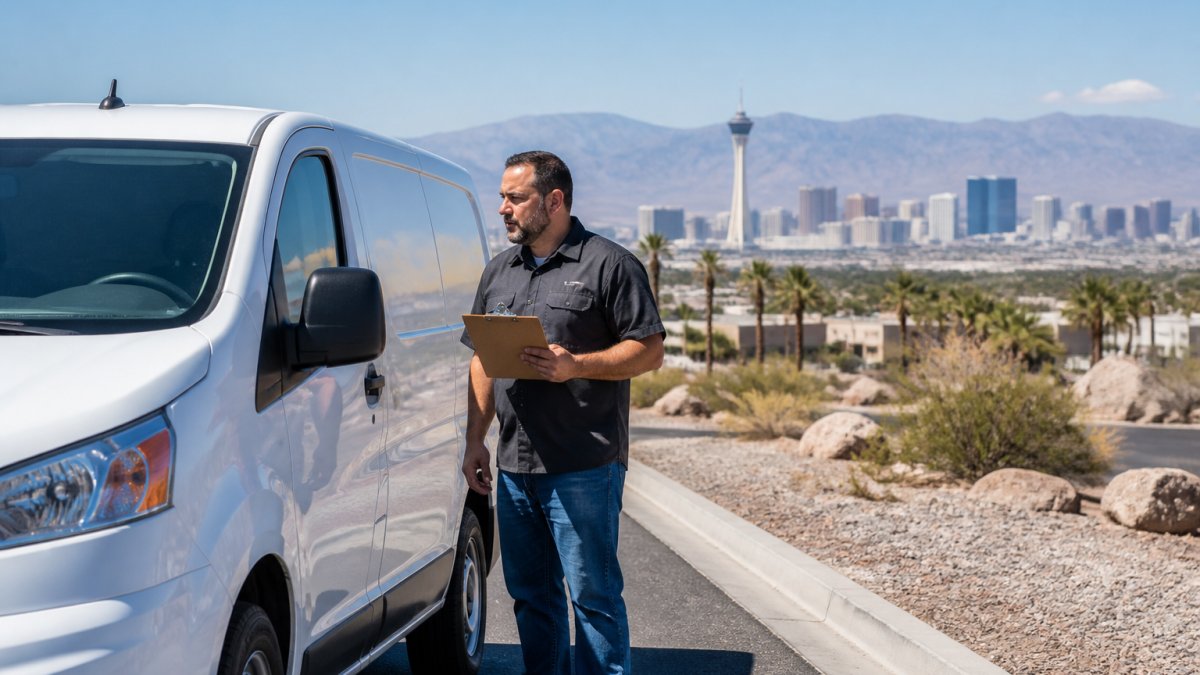
Nevada law treats business vehicles differently. If a vehicle is used mainly for work, it needs a commercial auto policy. Personal insurance simply doesn’t cover the risk.
The stakes go beyond a repaired bumper. A serious crash can lead to lawsuits, lost income, and damage to your business reputation. Commercial coverage protects your company, your employees, and your livelihood.
Below, we break down Nevada’s rules, the coverage types that matter, and how to keep your premium down without cutting corners.
Nevada Commercial Auto Insurance Requirements
Nevada requires every registered vehicle, personal or commercial, to carry liability insurance. For business vehicles, those same minimums apply, but they are only the floor. Most small businesses in Las Vegas need limits well above the state minimum because a single at-fault crash involving a work truck or delivery van can easily exceed them.
State Minimum Liability Limits
Nevada’s minimum liability requirements are set in Nevada Revised Statutes Chapter 485 and enforced by the Nevada Department of Motor Vehicles. As of the most recent DMV guidance, the minimums are:
- $25,000 for bodily injury or death to any one person
- $50,000 for bodily injury or death to two or more people in one accident
- $20,000 for injury to or destruction of another person’s property
These are commonly written as 25/50/20. Nevada also requires insurers to offer uninsured/underinsured motorist coverage at the same minimum limits, though you can reject it in writing.
Here’s the practical problem for a small business: a $25,000 per-person limit can be exhausted by a single emergency room visit and a few days in the hospital. If your driver is at fault and the injured party’s bills exceed your limits, your business is personally on the hook for the difference. That’s why most Nevada commercial auto policies for businesses with employees, vehicles over 10,000 lbs, or regular customer contact are written at 100/300/100 or higher.
When You Must Register a Vehicle as Commercial
Nevada treats a vehicle as commercial when it’s used primarily for business. The DMV’s registration rules and the insurance filing requirements kick in when a vehicle is:
- Titled to a business entity (LLC, corporation, partnership)
- Used to carry tools, supplies, or equipment for work
- Used for deliveries, pickups, or courier work
- Used to transport paying passengers
- Hauling equipment or materials to job sites
- Weighing more than 10,000 lbs gross vehicle weight rating (GVWR)
If your vehicle fits any of these, register it as commercial and insure it that way. A contractor’s truck hauling ladders and paint is a commercial vehicle, even if it’s also the family car on weekends.
Nevada’s Financial Responsibility Filing
Nevada is not a no-fault state. If your business vehicle is in an at-fault accident, the injured party can pursue your company directly. Nevada also requires commercial vehicles above certain weight thresholds to file proof of insurance with the DMV, and a lapse can trigger a registration suspension and reinstatement fees. For small businesses operating in Las Vegas, the practical takeaway is simple: keep continuous coverage, keep your limits above the minimum, and keep proof of insurance in every vehicle.
Nevada law allows the DMV to suspend your registration and impose reinstatement fees if your commercial auto coverage lapses, even for a single day. A missed payment can take a vehicle off the road and stall your business.
A Quick Decision Guide for Las Vegas Small Businesses
Use this to figure out whether you need a commercial auto policy:
- Do you own the vehicle in the business name? If yes, you need commercial auto.
- Do employees drive it? If yes, you need commercial auto, personal policies typically exclude employee drivers.
- Do you or employees make deliveries, service calls, or client visits in a personal vehicle? You likely need a commercial policy or a hired/non-owned auto endorsement.
- Do you rent vehicles for work? You need hired auto coverage.
- Do you haul tools or equipment over 10,000 lbs GVWR? You need commercial auto and may need a commercial driver’s license for the driver.
If you answered yes to any of the first four, call your agent before the next job, not after the next accident.
Personal vs Commercial Auto Insurance: The Key Differences
The main difference is what each policy is designed to cover. Personal auto insurance covers private, non-business driving. Commercial auto insurance covers vehicles used for business operations, including employee drivers and company-owned vehicles.
That gap matters more than most owners realize. Here’s how the two stack up:
| Feature | Personal Auto | Commercial Auto |
|---|---|---|
| Primary use | Commuting, errands | Business operations |
| Employee drivers | Usually excluded | Often covered |
| Business liability | Limited or none | Built in |
| Vehicle weight limits | Lower | Higher |
| Hired/non-owned autos | Not covered | Available as add-on |
A personal policy might cover a fender bender on your way to the office. It won’t cover a delivery driver who rear-ends someone in a company van.
The biggest mistake many owners make is assuming their personal policy will “probably” cover a work trip. When a claim comes in, the insurer reviews how the vehicle was being used, and a business use denial leaves you paying out of pocket.
If you’re switching from a personal policy, expect your commercial rate to look different. The coverage is broader, and the risk is higher.
Commercial Auto Insurance Cost for Small Business
There’s no single price for commercial auto coverage. What you pay depends on your vehicles, your drivers, and how far they travel. A one-truck landscaping business in Las Vegas will pay far less than a ten-vehicle delivery fleet.
Because we compare the market for you, we can help you find rates that fit your budget. We don’t publish a flat number because every business is different.
Factors That Shape Your Premium
Insurers weigh several things when they set your rate:
- Vehicle type and value: a heavy work truck costs more to insure than a sedan
- Driving distance: more miles means more risk
- Driver records: tickets and accidents raise rates
- Business type: delivery and hauling carry more risk than office use
- Coverage limits: higher limits mean higher premiums
- Deductible: a higher deductible lowers your premium
Businesses that keep clean driving records and reasonable mileage tend to pay less. So do owners who bundle commercial auto with other policies.
Coverage Types Every Las Vegas Business Should Know
Las Vegas driving brings its own risks. Heavy traffic on the Strip, long desert stretches on I-15, and summer heat that wears down tires and brakes all raise your odds of a claim.
A solid commercial auto policy usually includes liability, physical damage, and medical payments. Here’s how the pieces fit together.
Hired and Non-Owned Auto Coverage
This coverage protects your business when employees drive rented vehicles or their own cars for work. If a staff member runs a quick errand in a personal car and causes an accident, hired and non-owned auto coverage can step in.
Many owners skip this add-on. Then a single employee mistake turns into a lawsuit against the company.
Physical Damage, Uninsured Motorist, and Medical Payments
These coverages handle the damage and injuries that liability alone won’t:
- Collision coverage: repairs your vehicle after a crash
- Comprehensive coverage: covers theft, vandalism, fire, and storm damage
- Uninsured/underinsured motorist: protects you when the at-fault driver has no coverage
- Medical payments: pays medical bills for you and your passengers
Las Vegas sees plenty of uninsured drivers and hit-and-run crashes. Carrying uninsured motorist coverage is one of the smartest moves a small business can make.
Ask your agent about combining comprehensive and collision with a higher deductible. Raising your deductible from a low amount to a mid-range one often trims your premium without gutting your protection.
How to Save on Commercial Auto Insurance
You can lower your commercial auto premium without stripping your coverage. The trick is to reduce risk in ways insurers reward.
A few moves that work:
- Bundle policies. Combining commercial auto with general liability or workers’ comp often earns a discount.
- Raise your deductible. A higher deductible means a lower monthly premium, as long as you can cover the gap after a claim.
- Keep driver records clean. Screen new hires and review motor vehicle reports.
- Install telematics. Tracking devices that reward safe driving can cut rates over time.
- Right-size your coverage. Don’t pay for limits you’ll never need, but don’t underinsure either.
- Shop the market. Rates vary widely between carriers. Comparing them is where an agent earns their keep.
If you’re searching for commercial auto insurance near me in Las Vegas, working with a local agent who knows Nevada rules saves time and money.
Insurance Information Institute auto insurance basics
Frequently Asked Questions
Do I need commercial auto insurance for my small business in Nevada?
If your vehicle is used for business purposes beyond commuting, you likely need commercial auto insurance. This includes transporting goods, visiting clients, or carrying tools. Nevada requires commercial vehicles to carry liability coverage, and a personal auto policy typically excludes business use. Small businesses in Las Vegas with delivery vehicles, service trucks, or employee drivers should have a commercial auto policy to stay compliant and protected.
What happens if my business vehicle is not covered by commercial auto insurance?
If you have an accident while using a personal vehicle for business and your insurer determines the use was commercial, your claim can be denied. You would be personally responsible for bodily injury and property damage costs, which can reach tens of thousands of dollars. Nevada also requires proof of insurance for vehicle registration, and driving without the proper coverage can lead to fines and suspension.
How much does commercial auto insurance cost for a small business in Nevada?
Commercial auto insurance cost for small business depends on several factors, including the number of vehicles, driving records, coverage limits, and deductibles. A single work van will cost less than a fleet of trucks. Because pricing varies by business type and risk exposure, contact United Family Insurance for a personalized quote based on your Las Vegas operations.
How can a Nevada small business lower its commercial auto insurance costs?
To save on commercial auto insurance, maintain clean driving records for all employees, increase your deductible if you can afford the out-of-pocket risk, bundle your commercial auto with other business policies, and ask about telematics programs that reward safe driving. Reviewing your coverage annually also helps you avoid paying for limits you no longer need as your business grows.
Running a business in Las Vegas means protecting it from the risks that come with the road. Commercial auto insurance keeps your company, your employees, and your assets covered when the unexpected happens. At United Family Insurance, we compare the market on your behalf, offer expert advice from licensed agents, and make filing a claim simple through our user-friendly platform. Get started with United Family Insurance and drive with real peace of mind.